Explanatory Note:
The works listed in both the Core Composers and Featured Composers sections follow a consistent presentation format designed to make navigation and listening as clear and practical as possible.
Each entry begins with the title of the work. When necessary, the instrumentation or formation is indicated, particularly for works whose title alone does not make this immediately evident.
This is followed by the year of composition and, where applicable, the dates of later revisions. The approximate duration of the work is then given in minutes.
After this information, the listening source is indicated (Spotify, YouTube, etc.). Following the slash are the performers corresponding to the version available on that platform. In many cases, especially in contemporary music, the interpretation plays an essential role in the listening experience, which is why the performers are systematically identified.
A typical entry therefore follows this structure: Title of work (formation)-composition date, revision date(s)-duration -source / performers
Example: SQ 2-1983, rev. 1987 -18’ -YouTube / Arditti Quartet
The purpose of this system is to provide concise but precise information, allowing readers and listeners to identify both the work itself and the exact interpretation being referenced.
Core composers List Alphabetical
10 John Luther Adams
24 Dieter Ammann
8 Mark Andre
2 Pierre Boulez
7 Unsuk Chin
6 Chaya Czernowin
18 Morton Feldman
15 Brian Ferneyhough
21 Gérard Grisey
20 Sofia Gubaidulina
16 Georg Friedrich Haas
5 Clara Iannotta
27 Mauricio Kagel
14 Helmut Lachenmann
19 Catherine Lamb
1 György Ligeti
3 Zibuokle Martinaityte
26 Marc Monnet
17 Tristan Murail
9 Gabriela Ortiz
4 Hector Parra
22 Horatiu Radulescu
23 Kaija Saariaho
12 Giacinto Scelsi
25 Karlheinz Stockhausen
13 Ying Wang
11 Iannis Xenakis
1-György Ligeti -1923-2006 -Hungary
Primary Forces: Orchestral, Ensemble, Chamber, Piano
György Ligeti occupies a singular position in the music of the second half of the twentieth century because he repeatedly transformed his musical language without abandoning the deeper questions that drove it. Rather than establishing a system and developing it throughout his career, he continually searched for new ways of organizing sound, density, rhythm and perception. What remained constant was an extraordinary ability to make complex musical processes immediately perceptible as physical and acoustic phenomena.
In the works of the 1960s, Ligeti moved away from conventional melody, harmony and pulse toward immense fields of continuously changing sound. His celebrated micropolyphony was not simply a technique for producing dense textures. It allowed him to create music in which individual lines disappear into collective motion. Apparently static masses are in fact filled with microscopic activity, slowly changing their density, register, colour and internal pressure. Music becomes less a succession of events than an evolving organism.
Yet Ligeti refused to turn this discovery into a permanent personal formula. From the 1970s onward, rhythm increasingly emerged from the sound masses. Pulsation, mechanical repetition, polyrhythm and extreme contrasts gradually replaced the suspended continuity of the earlier works. His encounter with Central African rhythmic structures, alternative tuning systems and mathematical ideas further expanded this territory. In the late works, several different perceptions of time can coexist: patterns interlock, accelerate, collide and generate larger structures that no individual instrumental line contains.
This constant reinvention explains Ligeti’s exceptional historical position. He absorbed ideas from serialism, electronic music, folk traditions, mathematics and non-Western musical cultures without fully belonging to any of them. Each became material for an intensely personal investigation.
Behind the enormous diversity of the music lies a consistent trajectory: Ligeti repeatedly asks how a simple underlying process can generate an acoustic world of almost unimaginable complexity. Whether through micropolyphonic clouds, mechanical repetitions or intricate rhythmic networks, his music reveals structures that seem simultaneously ordered and unstable. He did not merely develop a recognizable language. He repeatedly changed the conditions under which music could be heard.
1 Lontano -1967- 12’ -Spotify/BPO-Nott
Marc’s Note: One of the composer’s most famous works for grand orchestra, in
which traditional melody and rhythm recede in favour of evolving sound masses
moving through space.
2 Piano Concerto -1985-1988 -23’ -Spotify/Aimard-Schönberg Ens.-De Leeuw
Marc’s Note: Ligeti struggled for years with this five-movement concerto,
which is saturated with aural illusions and sparkling textures. Fractal
thinking informed aspects of the work’s structure and contributes to its
constantly transforming character.
3 Violin Concerto -1989-1993 -28’ -Spotify/Faust-Les Siècles-Roth
Marc’s Note: This wild and extreme violin concerto is full of outlandish
timbres, abrupt swerves and expressive extremes. Ligeti pushes his imagination
to the hilt and achieves a real kaleidoscope of sounds and techniques.
4 SQ 2 -1968- 20’- Spotify/Quatuor Diotima
After four nervous, brutal and tumultuous movements, we are treated to one
of the most delicate finales in chamber music.
5 Etudes-Book 2 -1988-1994 -23’ -Spotify/Aimard
Ligeti opens this book with an etude that alludes to the harmonic and
timbral world of Debussy and gamelan. Entrelacs and der Zauberlehrling feature
dizzyingly fast note repetitions, while Vertige, l’Escalier du Diable and
Infinite Column refer to spiral phenomena in nature, man-made objects and
sound.
6 Volumina -1961-1962 -16’- YT/Susteck
Volumina for solo organ develops note clusters that form large sound blocks.
Traditional melody and harmony recede as the composer focuses on sound colour
and texture.
7 Lux Aeterna -1966 -10’ -YT/Capella Amsterdam-Reuss
This choral piece sets the Latin text of the Requiem Mass. Through
micropolyphonic writing and subtly shifting pulse, Ligeti creates a shimmering
and unsettling effect.
8 Requiem -1963-1965 -26’ -Spotify/Stein-Van Reisen-London Voices-BPO-Nott
Only three segments of the traditional Latin Mass (Introit, Kyrie and the
combined Dies Irae-Lacrimosa sequence) are set. The composer was strongly
influenced by painters such as Memling, Brueghel, Bosch and Dürer.
The highlight is the Dies Irae with its hysterical, dramatic and
unrestrained character.
2-Pierre Boulez-1925-2016-France
Primary Forces: Orchestral, Ensemble, Vocal
Pierre Boulez approached composition as an investigation into how musical thought could be organized after the collapse of the inherited tonal system. His importance lies not simply in serialism, but in the much broader question that occupied him throughout his life: how can musical material be organized rigorously without becoming fixed, predictable or closed?
The uncompromising works of his early period pushed serial thought far beyond the organization of pitch. Duration, dynamics, articulation and register could all become structural parameters. This produced music of extraordinary density and abstraction, but it also exposed a fundamental problem. A system capable of controlling almost everything could produce structures whose internal organization was difficult for the listener to perceive.
Boulez’s subsequent development can be understood partly as a response to this paradox. From the late 1950s and 1960s onward, control was not abandoned but redistributed. Mobile forms, proliferating structures and increasing flexibility allowed the music to breathe. Timbre became increasingly structural, and instrumental colour, resonance and spatial disposition began to clarify relationships that had previously been carried primarily by abstract organization.
This transformation is crucial to understanding the later Boulez. The rigorous mind remains, but the music becomes increasingly sensuous, transparent and fluid. Structures seem capable of continuously regenerating themselves. A musical idea may expand, fracture, reappear in another instrumental colour or become absorbed into a larger field. Form is no longer simply constructed: it appears to grow.
Boulez’s lifelong practice of revising compositions is therefore more than perfectionism. It reflects his conception of the musical work as something potentially unfinished, capable of revealing further possibilities. Pieces could remain open to reconsideration because the underlying musical idea was more important than any definitive realization of it.
His trajectory consequently leads from the dream of comprehensive organization toward something more flexible and fertile: a music in which discipline generates possibility. Boulez never relinquished structure, but gradually discovered how structure itself could become mobile, luminous and alive.
1 Rituel in Memoriam Maderna for
orchestra-1974-1975-25’-Spotify/BBC SO-Boulez
Marc’s Note: Rituel unfolds at a solemn pace with sad, mournful tones.
The work demonstrates how Boulez’s serial thinking can convey genuine emotion.
Percussion and woodwind instruments dominate the score, and only some of the
orchestral sections are active at any given time. We move from one orchestral
group to another, exploring their timbres, while the melodic material primarily
serves to sustain an atmosphere of deep sorrow.
2 Répons for ensemble, orchestra and
electronics-1981-1984-42’-YT/EIC-Pintscher
Marc’s Note:
This is post-serial Boulez at its best.
Thanks to real time electronics, the composer is able to associate synthetic
and instrumental sounds with remarkable precision. He creates new timbres and
distributes the sound in space, producing true spatial music and opening
original acoustic dimensions and colours. Répons is a dazzling achievement and
stands at the very heart of late Boulez.
3 Livre pour cordes (from Livre pour quatuor)-2017
version-56’-Spotify/Diotima Quartet
Marc’s Note:
“Work in progress” is one of Boulez’s trademarks, and Livre pour quatuor, his
only string quartet, is a perfect example of a work that took decades to reach
its final form. The excellent composer Philippe Manoury completed the missing
fourth movement in 2017.
The quartet is a brilliant and fundamental exercise in rigorous serialism on
both harmonic and rhythmic levels. Abrupt and constant changes in timbre, very
extended techniques such as sul ponticello, col legno and pizzicato, and subtle
contrasts follow one another, ranging from dry austerity to a nearly
improvisatory suppleness. A major work of the twentieth century.
4 Éclat for ensemble-1966-1970-27’-Spotify/EIC-Boulez
Marc’s Note: In his early aleatory period Boulez sought to combine controlled
chance with the constructive discipline of serial composition. Éclat continues
this exploration. Pitches, tempo and dynamics are predetermined, but the
conductor decides which motif to signal next.
The ensemble is divided into two groups: instruments whose sound dies away
quickly unless trilled, and instruments capable of sustaining sound. Boulez
weaves a luminous web of timbres through the interaction of these two families.
5 Messagesquisse for 7 cellos-1976-9’-Spotify/Queyras-Ensemble de
Violoncelles de Paris
Marc’s Note:
This short piece is dedicated to the composer’s friend Paul Sacher and contains
personal messages symbolically encoded, almost like a musical sketch.
Jean-Guihen Queyras is in total command of the solo part and carries the score
convincingly. A very slow simmering opening section is followed by a very fast
and dense central passage. Quivering sounds and sparse notes initiate the final
section, whose very rapid closing fragment ends the piece in brilliant fashion.
6 …explosante-fixe… for MIDI flute, two flutes, ensemble and
electronics-1991-1993-35’-Spotify/EIC-Boulez
Marc’s Note:
Boulez fully unleashes his imagination in this powerful work built around the
MIDI flute and two additional flutes, accompanied by the EIC. Boulez’s long
time assistant Andrew Gerzso oversees the crucial electroacoustic realisation,
and the electronic amplification allows the MIDI flute to cut through very
dense passages. The electronics generate swirling clouds of sound in constant
transformation.
7 Sur Incises for 3 pianos, 3 harps and 3
percussionists-1996-1998-39’-YT/EIC-Pintscher
Marc’s Note:
Boulez creates a remarkable and highly distinctive sound world with this
unusual instrumental combination. Glittering brilliance and contrapuntal
intricacies abound, yet the composer keeps every line clean and perfectly
transparent, exactly as one would expect from a composer of such rigor and
control.
8 Pli selon pli for soprano and ensemble-1989
version-69’-Spotify/Schäfer-EIC-Boulez
Marc’s Note:
Pli selon pli is based on a line by the French poet Mallarmé describing how
mist gradually disperses to reveal the topology of an imagined space.
The work is overtly theatrical in its large orchestral panels, Don and Tombeau,
which frame the three Improvisations. A restrained sensuality inhabits the
soprano line while the listener is immersed in an extraordinarily refined
instrumental palette. The composer regarded the 1989 version as the definitive
form of the work.
3-Zibuokle Martinaityte-1973-Lithuania
Primary Forces: Orchestral, Ensemble, Chamber, Vocal
In the music of Žibuoklė Martinaitytė, sound unfolds as a sustained, immersive environment in which transformation occurs gradually and almost imperceptibly. Rather than articulating clear contrasts or directional development, her works often remain within a single sonic state that is continuously modulated from within.
The emphasis lies on luminosity and resonance. Harmonic fields are stretched over long durations, allowing micro-variations in color, density, and intensity to become the primary carriers of form. Time is experienced not as progression, but as suspension.
Despite this apparent stasis, the music is carefully controlled. Subtle shifts accumulate, leading to large-scale changes that are only fully perceptible in retrospect. The result is a listening experience that requires attention to detail at the threshold of audibility, where the boundary between sound and silence becomes structurally significant.
1 Saudade for orchestra-2019-17’-Spotify/Lithuanian Nat SO-Slekyte
Marc’s Note:
In Portuguese Saudade means a deep emotional state of nostalgic or profound
melancholic longing for an absent something or someone whom one loves.
In Martinaityte’s experience this notion symbolizes the stratum of multiple
yearnings that started layering with the blue period of her father’s death and
her immigration to the USA.
Her writing is expressively at her most ambiguous in this piece.
There are plenty of subtle, shifting colours and undulating shifting lines
that give the impression of a rippling surface with tensions roiling just
beneath.
Three terrifying climaxes suddenly drop off, lending the piece an aura of
harrowing mystery.
Her harmonic language is powerful, yet economical.
Slowly evolving chords accumulate density and tension until they erupt in
sudden orchestral changes.
2 Cello Concerto-Sielunmaisema-2019-35’-YT/Backus-Klaipeda Chamber
Orch-Rohde
Marc’s Note:
Sielunmaisema is a Finnish word, the equivalent of a sound-landscape, a
particular place that a person carries deep in the heart and returns to often
in memory. It immediately makes you feel at home.
Martinaityte is particularly interested by memory, identity, migration and
sonic beauty.
She uses the four seasons as four movements and a cherished memory of her
early life in Lithuania. There is nostalgia for the past and for the landscape
that is no longer the same due to global warming.
She moved to the USA as a young woman and has therefore two cultural
identities: Lithuanian and American.
She did not aim to compose a traditional cello concerto. Instead, the cello
behaves like a guide through the sonic landscape, sometimes emerging from the
orchestral dialogue, sometimes dissolving back into it.
The relationship is closer to a continuous conversation of timbres than to a
solo-tutti opposition.
The cello feels like an inner voice, while the orchestra acts like a
surrounding emotional field.
3 Percussion Concerto-Nunc fluens, nunc stans
-2020-16’-YT/Giunter-Lithuanian Chamber Orch-Kaliunis
Marc’s Note:
The title originates from a quote by the Roman philosopher Boethius. It
means: The Now that passes creates time, The Now that remains creates eternity.
These two different models of Now resonate with the Covid period. Only the
Now remained, which contradicted the ancient truths of philosophers.
The piece is a kind of diptych where both parts are performed without a
break.
The flowing time is followed by the standstill.
Vibraphone, crotales, gongs, bowed cymbal and a tubular bell constitute the
percussion complement performed by one percussionist.
They allow the music to whisper, murmur, buzz, toll and ring.
Instead of rhythmic virtuosity, the percussion writing emphasizes resonance
and colour, transforming metallic instruments into sources of sustained sound.
4 Ex Tenebris Lux for string orchestra-2021-24’-Spotify/Lithuanian Chamber
Orch-Variakojis
Marc’s Note:
From Darkness to Light was composed during the covid pandemic and symbolizes
a hopeful thought amid crisis and uncertainty.
The music is meant as a guide through a prolonged zone of darkness,
ultimately bringing the listener to light and allowing him/her to experience
it.
Martinaityte is a textural magician and she proves it again in this piece.
Multiple gradations of darkness are explored through the density of musical
textures. There is dramatic substance in the merest dynamic shifts and changes
of texture.
A kind of monolithic sound is created by the individual instruments and the
individualized lines are only differentiated when the state of light is
reached.
5 Solastalgia for ensemble-2020-13’-YT/Ensemble Synaesthesis-Variakojis
Marc’s Note:
The portmanteau title derives from the concepts of solace and desolation as
the suffix algia denotes suffering.
To Martinaityte it means that you can feel homesick although you are at home
but in different conditions because of environmental changes and global
warming.
Musically the piece unfolds as a fragile and unsettled soundscape.
Soft sustained tones and delicate instrumental colours create the impression
of a landscape that is slowly changing before our ears.
Nothing dramatic happens, yet a subtle unease permeates the entire piece, as
if the environment itself had become slightly unfamiliar.
Martinaite avoids clear melodic lines. Instead, she builds the music from
hovering harmonic fields, whispering gestures and faint pulses that seem to
appear and disappear like distant memories.
The ensemble often sounds suspended in time, creating a strange beauty that
is both comforting and unsettling.
The result is music that feels introspective and quietly haunting, capturing
the paradox of solastalgia: the sorrow of witnessing the transformation of a
place that once felt stable and eternal.
6 In Search of lost Beauty for piano, violin and
cello-2016-69’-Spotify/Balkstyte-Rupaite-Petrikiene-Jacunskas
Marc’s Note:
It is a piano trio with electronics and the electronics have pre-recorded
the same instruments as the live instruments.
The mixture of live and pre-recorded instruments creates a slightly blurred
sonic perspective.
When Martinaityte composed the piece, she was in search of lost time, a bit
like Proust. She started to pay attention to small details of the everyday and
noticed how beautiful everything becomes when you pay attention to it. She
realised attention creates the beauty.
Ten Sections are united into a structural coherent whole, as an invitation
to see beauty in familiar phenomena (found in nature, the everyday and art)
which usually go unnoticed.
They teach us to slow down and are a reaction against speedy screen images,
that constantly flood us.
This allows us to operate less automatically and discover true moments of
being.
The composer considered the work to be a breakthrough piece, a real turning
point.
7 Hadal Zone-2020-2021-64’-Spotify/Ensemble Synaesthesis
Marc’s Note:
The composer loves nature and particularly the silence or rather the
microscopic sound layers in nature that are a welcome respite from the
aggressive sound of urban life.
Hadal Zone is a journey through the deepest depths of the ocean. In fact,
the five different layers of the ocean are the five movements of the piece.
It is scored for low instruments-bass clarinet, tuba, cello, contrabass,
piano and electronics.
The instrumental music she composed is slow and fosters introspection and
serenity.
Hadal Zone refers to the deepest zone of the ocean, but the entire work is
about ocean zones being traversed vertically. It is a journey during which
there will be silence, muted sounds and some growls that could have been
uttered by ocean monsters.
8 Aletheia-2022-15’-Spotify/Latvian Radio Choir-Klava
Marc’s Note:
For her vocal music, Martinaityte has made the deliberate choice not to use
words, but only vowels of which there are plenty in her Lithuanian language.
She does not want to be limited by the text, because it would define the
meaning and make it narrower.
The audience can fully hear how the voices are combining, how time flows and
what happens harmonically.
One can sense echoes of the complex layering of High Renaissance choral
music, but also harmonies that are close to Ligeti’s sound-world.
Aletheia means “uncovering of the truth” in Greek and particularly the truth
we are afraid to face.
The piece was influenced by the war in Ukraine and the composer herself was
inspired by the importance of the human voice. Voice is the first and last
instrument we have in our lifetime. This thought brings an almost sacred
dimension to the voice as an expression of life between birth and death.
9 Togetherness for piano-2007-2008-7’-YT/Cahill
Marc’s Note:
I could not resist offering you an encore in the form of a moving piano
piece, as the piano is Martinaityte’s instrument.
Togetherness is the first movement of Heights and Depths of Love, that is
unfinished up to now.
It starts with sumptuous, layered sounds which morph into a mesmerizing
massive buildup middle-section and ends with a small impressionistic flourish.
4-Hector Parra-1976-Spain
Primary Forces: Orchestral, Ensemble, Keyboard, Opera
Hector Parra’s music unfolds at the intersection of physicality, abstraction, and speculative thought. His work is driven by a deep engagement with scientific models, particularly from physics and cosmology, not as external references, but as generative forces shaping form, texture and dramaturgy. Sound in Parra’s music behaves like matter under pressure: it expands, fractures, and reorganizes in constantly shifting states of energy.
At the same time, his output reveals a strong theatrical instinct. Whether in chamber works or large-scale operas, Parra constructs immersive sonic environments where perception itself becomes unstable. The listener is drawn into processes that feel both rigorously structured and viscerally immediate, often navigating between microscopic detail and overwhelming mass.
What distinguishes Parra is this dual anchoring: an intellectual framework of rare ambition combined with a tactile, almost sculptural approach to sound. His music does not illustrate ideas; it enacts them, placing the listener inside evolving systems where tension, transformation, and density are the primary expressive agents.
1 Inscape for orchestra-2017-2018-30’-YT/Orch Nat Lille-Bloch
Marc’s Note:
Inscape is conceived for sixteen soloists embedded within a large orchestra
and electronics. Parra imagines the piece as a psychoacoustic expedition that
carries the listener far beyond familiar perception, into a hypothetical
journey inside a black hole.
The work opens in a fragile sonic environment built from tiny sound
particles. Instrumental gestures, faint vocal-like timbres and even the
presence of the audience seem to merge into a single organic field.
Gradually the orchestral mass gains momentum. Electronics interact
increasingly with the instrumental soloists and propel the music toward zones
of extreme density and energy.
Musical space and time begin to warp and the delicate opening textures
mutate into turbulent and distorted forces as the listener approaches the
acoustic equivalent of an event horizon.
Electronic spectra resembling gravitational waves sweep through the hall.
Their changing densities and spatial movement reshape the perception of the
surrounding acoustic space, which seems to expand and contract as if influenced
by cosmic forces.
After passing through this violent sonic threshold, the music suggests a
transition toward an unknown realm, like travelling through a wormhole toward a
new universe. The nature of this new space remains mysterious and Parra leaves
it to the music itself to hint at what might exist beyond.
2 Wilde-Suite for orchestra-2015-8’-Soundcloud/OBC-Ono
Marc’s Note:
Wilde is originally a play by the Austrian playwright Händl Klaus which
Parra adopted first to opera and then to a suite for orchestra.
The plot is the story of a young doctor, working for Médecins sans
Frontières, who returned home by train after a difficult experience in a
Moldovan prison. He ends up in the wrong station, in a deserted city where he
meets two savage brothers and accompanies them to their home.
A stifling spiral ensues in which the brothers’ family abuses their guest.
The physical and moral degradation that a human being may endure is the
cornerstone of the work and invites us to reflect on important issues in
today’s society.
The Suite is a form of synthesis of the opera as Parra brings the spirit of
Wilde to the concert hall with its claustrophobic tensions and its abysses, but
also with its moments of hope that come close to tenderness.
3 La Mort I la Primavera for ensembles-2021-43’-YT/EIC-Leguay & Remix
Ensemble-Casa de Musica-Rundel
Marc’s Note:
In this large-scale tone poem Parra employs two ensembles conducted
independently, creating a layered narrative structure unfolding across six
movements.
The works takes inspiration from Mercé Rodoreda’s unfinished and
posthumously published novel La Mort I la Primavera. The story depicts a
nightmarish society governed by cruel traditions and constant fear, seen
through the eyes of an adolescent searching for escape.
Parra translates the oppressive atmosphere of the novel into music filled
with ritualistic violence and permanent tension. Dark instrumental colours
dominate, particularly through the prominent role of the cello and double bass
whose weight becomes increasingly decisive in the final movements.
Against this bleak environment the flute occasionally introduces moments of
fragile lyricism that momentarily relieve the tension.
The result resembles a ritual spectacle: a kind of sacred dance, a ballet
without dancers or an opera without voices. Its relentless rhythmic drive and
elemental energy can evoke distant echoes of Stravinsky’s Rite of Spring.
4 Limite les Rêves au-delà for cello and
electronics-2017-71’-Spotify/Deforce
Marc’s Note:
Parra’s interest in astrophysics once again provides the conceptual
framework for this monumental work for cello and electronics.
The piece functions as a large-scale psychoacoustic exploration that seeks
to push musical perception beyond ordinary sensory limits. Throughout the work
a continuous dialogue unfolds between the natural resonance of the cello and
electronically transformed sound.
These interactions range from confrontation to gradual fusion, creating what
can be heard as a kind of cosmological symphony in which acoustic and
electronic energies intertwine.
Cellist Arne Deforce confronts the immense expressive demands of the score,
generating an extraordinary range of variations and textures from the
instrument. Sound engineer Thomas Goepfer extends these gestures
electronically, amplifying their impact and projecting them into a vast sonic
space.
The music ultimately becomes an invitation to experience the immense und
untamed forces of the universe through sound.
5 SQ 3-Aracné-2015-14’-Soundcloud/Qt Tana
Marc’s Note:
In Aracné Parra draws inspiration from Velazquez’s painting Las Hilanderas,
transforming the visual imagery of spinning threads into a highly theatrical
musical process.
The quartet begins in a relatively traditional manner but gradually
undergoes a striking transformation. The musicians themselves become part of
the metaphor as their instruments and gestures evoke the activity of spinning
and weaving.
To achieve this, each performer attaches a silk thread to the instrument,
effectively creating an additional vibrating element that acts like a fifth
string. This unusual device produces an astonishing palette of sounds: bird
calls, buzzing swarms, distant thunder, creaking mechanisms or galloping
rhythms.
The silk thread is not merely a theatrical effect but an integral component
of the compositional idea, enabling the Tana Quartet to generate extremely
dense timbral textures and saturated sonic colours.
6 String Trio for violin, viola and cello-2006-11’-YT/Ensemble Recherche
Marc’s Note:
The extreme sonorous plasticity of the string trio, the inheritance of the
variation and a certain structural freedom, as well as a clear tendency towards
polyphony (perpetual friction of the three sonorous fluxes) have inspired Parra
to compose music with an internal organization that relies on different types
of energy which this formation can make us feel.
String Trio tries to erase the frontier between the gesture of the
instruments and the interior expression, between the acoustic space and time as
perceived by the audience.
Parra was also inspired by Lisa Randall, a professor in physics, whose model
posits a universe with five dimensions, which has encouraged him to open up a
new dimension of the psycho-acoustic space.
The transformation and spatialization of the instrumental sounds transport
the listener to states of high sonorous energies.
7 Au Coeur de l’Oblique for piano-2016-2017-22’-YT/Gentet
Marc’s Note:
This piano work pays tribute to the architects Claude Parent and Paul
Virilio, whose theory of the “fonction oblique” challenged traditional
architectural space through the use of inclined planes. Their ideas culminated
in the striking design of the Sainte-Bernadette-du-Banlay church.
Parra transposes this architectural thinking into musical form. The piece
examines how musical structures can behave when stability is replaced by a
sense of tilt and imbalance.
In the first movement the pianist extracts energy from dense chords using
unconventional physical contact with the instrument, including nails, palms and
fingertips. The accumulated tension gradually pushes the performer toward a
psychological threshold.
The second part reflects the massive sobriety of Parent’s church. The tempo
relaxes and the pianist combines conventional keyboard playing with sounds
produced directly on the strings.
The work ultimately accelerates toward a fluid and undulating piano language
of considerable virtuosity.
8 L’Aube assaillie for cello and electronics-18’-Spotify/Akerberg
Marc’s Note:
The study of new concepts in physics, his passion for painting, contemporary
dance and especially the collaboration with performers have encouraged Parra to
sculpt a clear cut, more varied and more polyphonic language for strings.
L’ Aube assaillie for cello and electronics was composed at Ircam where
Parra worked closely together with the French choreographer Frédéric Lescure as
the music was meant to accompany a ballet.
The composer has conceived a music, wherein the function of the different
temporal fluxes produces an energetic impulse, which the listener can strongly
perceive at any moment.
The audience is maintained in a very strong state of concentration, which
lets its ears vibrate with the most subtle temporal gradations.
The cello sound allows for an incomparable listening possibility of
movement, as dance is at the same time complement and development of the
gesture of the performer.
9 Hypermusic Prologue for soprano, baritone and
ensemble-2008-2009-64’-YT/Ellett-Bobby-EIC-Power
Marc’s Note:
Hypermusic Prologue is an opera for soprano, baritone and an ensemble of ten
musicians.
The work explores ideas from theoretical physics concerning additional
spatial dimensions.
Parra collaborated directly with physicist Lisa Randall, whose book Warped
passages inspired the project: Randall herself wrote the libretto.
The drama revolves around two characters whose attitudes towards the
universe diverge. The soprano seeks to explore higher dimensions and unknown
realities, while the baritone initially prefers the security of a familiar and
static world.
As their relationship develops, he is ultimately compelled to follow her
into the hypothetical fifth dimension in order to preserve their bond.
Musically Parra represents these extra dimensions through an expanded sonic
language involving electronic processing, vocal distortions and extended
techniques. The shifting textures and shimmering electronic sounds convey both
the tension between the two characters and their eventual reconciliation.
5-Clara Iannotta-1983-Italy
Primary Forces: Orchestra, Ensemble, Chamber
Clara Iannotta’s music unfolds in a world where sound is treated less as a vehicle for gesture than as a fragile material that retains memory. Her works often revolve around traces: what remains after an action, what lingers after sound has nearly disappeared.
Across her output, one encounters a consistent attention to resonance, decay and transformation. Musical ideas rarely develop through contrast or dramatic opposition, instead, they mutate slowly, as if observed under a microscope. This creates a sense of suspended time, where past and present coexist rather than replace one another.
Her frequent use of altered instruments, unconventional objects and noise-based techniques is not decorative. It serves to reveal the physical substance of sound: its grain, instability and vulnerability. Pitch and noise are placed on equal footing, forming hybrid textures that feel at once intimate and elusive.
Literary references, especially to Dorothy Molloy, provide evocative starting points, but Iannotta avoids direct illustration. Instead, her music inhabits emotional or perceptual states: disorientation, absence, transformation. These are not narrated, but sustained over time, often without resolution.
A recurring feature of her work is the avoidance of climax. Rather than moving toward culmination, her pieces tend to dissipate, thin out, or live behind residues: like imprints that persist after the event has passed.
Within this aesthetic, each work can be understood as a different perspective on the same underlying concerns.
1 Dead Wasps in the Jam-Jar II for string orchestra, objects and sine waves-2016-15’-YT/Munich Chamber Orch-Schuldt
Originally conceived within a project interweaving new works with Partita no 1 in B minor by Johann Sebastian Bach, this piece takes its point of departure from the Double of the Corrente, though only in a distant, almost ghostly way. Clara Iannotta stretches and distorts the underlying gestures, surrounding them with glissandi, fragile noise layers and unstable textures.
The evocative title comes from the poetry of Dorothy Molloy, yet the connection remains indirect. Rather than illustrating the poem, the music seems to hover around its atmosphere.
In this expanded version for string orchestra, the material of the original solo piece grows outward. Instrumental sound is enriched by sine waves and unusual objects: bird-call devices, bowed synthetic materials and resonant surfaces. The result is kind of magnified sonic organism, where each gesture lingers and dissolves into its own resonance.
2 Moult for chamber orchestra-2018-2019-17’-YT/WDR SO-Wendeberg
In Moult, Iannotta draws on the biological process by which spiders shed their exoskeleton in order to grow. This act of renewal leaves behind a fragile imprint of the former body, creating a coexistence between what was and what is becoming.
The orchestra is imagined as undergoing a similar transformation.
Muscal material appears to slough off layers, while traces of earlier states remain embedded in the texture. The piece unfolds in a suspended temporality, where past and present overlap rather than replace one another.
Sound seems to carry memory within it: gestures are not erased but persist as shadows, giving the work a sense of continuous metamorphosis rather than linear progression.
3 Strange Bird-No longer navigating by a star for guitar and orchestra-2022-14’-YT/Santorsa-ORF Radio SO Vienna-Alsop
The piece is part of the cycle inspired by the Irish poet Dorothy Molloy.
This time the poet talks about the fact of feeling strange in our skin, as if there was an empty space in our body.
It is if one has completely lost a sense of direction.
Iannotta does not try to search for a new direction, but tries to inhabit the empty space and to find a reason to live in it.
Her goal is to fill the empty space with music.
Molloy uses the metaphor of the directionless, strange, flapping bird whose distant echoes indicate that he is lost.
The piece introduces the movement of the bird drifting from place to place without ever landing or finding its destination.
This is also the impression the audience gets from the music with its constant, relentless but subtle movement towards an unknown destination.
4 Piano Concerto-The purple fuchsia bled upon the ground-2023-2024-17’-YT/Aimard-WDR SO-Schwarz
Iannotta processes the death of her mother in this piano concerto and it is no wonder that the audience hears horrendous sounds and acoustic violence, similar to animalistic menace, which are an outlet for the composer’s grief.
She wanted the music to bleed and the dedicatee and soloist Aimard produced clusters, which splashed into virulent sound surfaces.
The work explores the physicality of sound with an unusual orchestration, including electric guitar, Midi piano and accordion, accompanied by electronic passages which sometimes evoke bird songs.
The pianist navigates between pounded low registers and strings, that are plucked to the limit of audibility.
The music has a cinematic touch and alternates intense passages with electronic interventions in dynamic sequences which offer the audience no respite.
Iannotta’s piece is very experimental and creates a laboratory of new possibilities.
5 Il Colore dell’Ombra for ensemble-2010-12’-YT/Longleash
In this early ensemble work, Iannotta takes inspiration from the refined colour palette of Maurice ravel, particularly his chamber writing, but redirects it toward a more tactile and material exploration of sound.
The instruments are subtly altered: strings are detuned or damped; the piano is prepared at specific points and bow techniques are diversified. These interventions do not aim at effect for its own sake, but rather at revealing the physical substance of sound itself: its grain, resistance and fragility.
Microtonal inflections and delicate articulations create a constantly shifting spectrum of timbres. Instead of a stable harmonic field, the listener encounters a living surface of sound, where colour emerges from the interaction between gesture and material.
6 Paw Marks in wet Cement for piano, two percussionists and amplified ensemble-2015-2018-Spotify/Latchoumia-L’Instant donné-Zielinski
The title, taken from a line by Dorothy Malone, evokes the idea of a trace left behind: a fragile inscription of something no longer present. This notion of imprint shapes the entire piece.
Although the instrumentation recalls the tradition of the piano concerto, Iannotta deliberately avoids hierarchy. The piano, often prepared and shared between the soloist and percussionists, blends into the ensemble rather than dominating it.
The opening introduces a field of unstable materials: sliding strings, muted piano sonorities and unconventional brass colours. A more abstract central section reworks these elements, dispersing their identity.
In the final part, instead of building toward a climax, the music withdraws. Light, almost playful sounds: bird calls, friction drum appear like residual echoes.
What remains is not resolution, but the lingering impression of what has passed.
7 Earthing-Dead Wasps for SQ-2020-13’-YT/Jack Qt
This string quartet reflects Iannotta’s affinity with the aesthetic of Helmut Lachenmann, where conventional pitch and noise are treated as equal components of music language.
The opening establishes an ambiguous terrain in which sound seems suspended, neither fully static nor clearly directional. Movement exists, but within tight constraints, as if the music were confined to a limited space.
As the piece unfolds, the texture becomes densely populated with fleeting details: small sonic events that emerge and vanish before they can be fully grasped. Moments of rhythmic definition offer brief orientation, yet they are continually undermined by the instability of the surrounding environment.
The ending does not resolve this tension. Instead, a few luminous tones remain, gradually dissolving into silence, leaving behind a sense of unresolved presence.
8 Limun for violin and viola-2011-9’-YT/Maurer-Mellinger
Written for violin and viola, Limun explores the inherent tension between two closely related instruments. Their interaction generates a constant play of friction and resonance.
Sustained bow pressure produces airy harmonics, while abrupt interruptions and sharp changes of direction disrupt any sense of continuity. The music seems to circle around itself in the first part, driven by a succession of contrasting techniques.
In the second half, these opposing forces begin to realign. Without eliminating the tension, the piece gradually moves toward a more balanced state, where the earlier conflicts are not resolved but absorbed into a quieter equilibrium.
Il colore dell’ombra: sound as material, exposed in its inner grain and instability
Dead Wasps in the Jam-Jar II: gesture expanded into resonance, dissolving into its own afterlife
Moult: Transformation through shedding, where past forms persist as sonic imprints
Paw Marks in wet cement: music as trace, shaped by what remains rather than what is stated
Earthing-Dead Wasps: a dense, unstable field where noise and pitch continuously blur
Limun: friction between instrumental identities, moving toward a fragile equilibrium
Strange Bird: slow, directionless drift, sustained without arrival or release
The purple fuchsia bled upon the ground: grief rendered as accumulation and saturation of sound
Taken together, these works form a remarkably coherent body of music.
6 Chaya Czernowin-1957-Israel
Primary Forces: Orchestral, Ensemble, Chamber, Opera
Chaya Czernowin composes at the limits of perception. Her music frequently begins where familiar musical identities start to disappear: where instrumental sound becomes noise, gesture becomes texture, individual events become masses, and the listener can no longer be entirely certain what is producing what is being heard.
This uncertainty is fundamental to her work. Czernowin does not simply extend instrumental technique or search for unusual sonorities. She constructs environments in which sound behaves almost like matter. It can accumulate, fracture, scrape, dissolve, become compressed into enormous blocks or retreat toward near-silence. Instruments lose some of their traditional identities and become components within larger acoustic organisms.
Her music is therefore intensely physical. Resistance, pressure, weight, friction and rupture frequently seem more important than conventional melodic development. Yet this physicality is never merely theatrical. Czernowin uses it to explore states in which perception itself becomes unstable. The listener may sense several layers operating simultaneously without being able to assemble them into a single coherent perspective.
Increasingly, these unstable sonic environments have opened onto larger questions. In works such as Hidden, outside reality seems capable of breaking into the musical space, while other compositions move between extreme intimacy and overwhelming violence. Fragility and force are not opposites in Czernowin’s music. One can suddenly transform into the other.
This gives her work an unusual emotional intensity despite its refusal of conventional expression. Meaning does not need to be narrated. It emerges through the experience of approaching thresholds: between sound and noise, individual and collective, intimacy and catastrophe, recognizable instrumental behaviour and something whose origin can no longer be identified.
Across Czernowin’s development, the essential trajectory has remained remarkably consistent: an insatiable drive toward unfamiliar territory. Her changing techniques are consequences of that deeper impulse rather than ends in themselves. She repeatedly places both sound and listener in situations where established categories cease to function.
Czernowin’s achievement lies precisely there. She does not simply offer new sounds; she creates conditions in which we are forced to listen differently. The instability of the music becomes its subject, turning uncertainty from something to be resolved into one of the fundamental experiences of listening.
1 The Quiet for orchestra-2010-11’-YT/BRSO-Lubman
Marc’s Note:
The Quiet belongs to a trilogy of orchestral works (with Zohar Iver and Esh) in which Czernowin seeks to transcend language and to create music that can be physically perceived, almost touched through the ear. The work marks a turning point in her output, opening a new orientation in her compositional thinking.
Dense, weighty blocks of material are set against lighter, more volatile strands, establishing a dynamic field of opposing forces. Czernowin’s interest in physical processes, interactions between energy, matter and particles, becomes here a compositional driver rather than a metaphor.
The work points toward what might be described as a third realm, situated between sensory perception and cognition, at the edge of consciousness. In this respect, The Quiet is not only a structural exploration, but part of a broader search for territories that lie beyond immediate perception, whether physical or mental.
2 Cello Concerto-Guardian-2017-31’-YT/Ballon-SWR SO-Broseta
Marc’s Note:
The Guardian follows the opera Infinite Now, whose dark expressive world casts a long shadow over the concerto. Conceived as a search for a protective force, the work unfolds like a dream in which elements of reality and imagination interpenetrate.
The relationship between soloist and orchestra departs from traditional concerto models. The cello emerges from within the orchestral texture, only to detach itself again, while the orchestra itself adopts cello-like qualities: wind instruments produce breath-infused tones that blur the distinction between soloist and orchestra.
Amplification and extended techniques expand the expressive range of both forces, creating a constantly shifting field of timbral correspondences. Although the work includes a cadenza, it does not function as a summation but rather as a moment of exposure, where the underlying tension becomes transparent.
The final orchestral eruption does not resolve this tension but brings it into stark relief, closing the work with a gesture of overwhelming force.
3 The divine thawing of the Core for flute and ensemble-2025-31’-YT/Chase-Talea Ensemble-Baker
Marc’s Note:
The divine Thawing of the Core opens with the contrabass flute in an exposed, almost fragile state. Its sound is elemental, stripped of rhetoric, hovering between breath, tone and noise.
This initial intimacy does not develop linearly; instead, it is gradually destabilized, eroded from within.
What follows is an uneven process of transformation. Moments of ironic distortion fracture the surface, giving way to sudden eruptions of brutality. The appearance of a distorted, almost grotesque waltz introduces a destabilizing pulse, as if a familiar cultural gesture were being pulled into a darker, uncontrollable domain.
The work unfolds through cycles and returns, but these repetitions are never identical.
Temporal perception is constantly unsettled: expansions, compressions and dislocations create the impression of a process that both advances and circles back on itself. What emerges is a progressive thawing, not towards clarity, but towards a more exposed, ritualistic state, coherent in its own logic yet raw, almost primitive in its expressive force.
Without explicitly naming a political program, Czernowin alludes to a process of internal collapse. The metaphor of thawing suggests not renewal, but dissolution: the erosion of structures that once held meaning. What remains is marked by loss, disorientation and a profound sense of human fragility.
In this work, the musical writing reaches a striking intensity. The control of sonic transformation, the tension between intimacy and violence, and the instability of temporal flow give the piece a rare expressive power; one that resonates far beyond its immediate material.
4 SQ and electronics-Hidden-2014-43’-YT/Jack Qt
Marc’s Note:
In Hidden, a spatialized string quartet with live electronics, the musical material unfolds as if submerged. Sound does not project outward but seems to circulate within a dense, resistant medium, where direction and contour lose their usual clarity.
A submerged labyrinth of monolithic sonic masses emerges, shaped as much by voids as by presence. Low vibrations, internal frictions and suspended silences are not so much heard as physically sensed. The music withdraws from the surface of conventional expression and progressively inhabits a space where perception itself becomes unstable.
Czernowin is concerned here with what remains concealed or only partially accessible.
The listener encounters traces, echoes and residual energies rather than clearly articulated gestures. The quartet and electronics do not oppose each other but fuse into a single, elusive body of sound constantly shifting between materiality and disappearance.
At the end a rupture occurs. The electronic layer introduces compressed fragments of the real world: rain, a nocturnal environment, the passing of a car. After the prolonged abstraction, these sounds appear almost violently concrete. The piece does not resolve, but rather breaks its own frame, allowing reality to intrude where perception has been suspended.
5 The Hour Glass bleeds still for string sextet-1992-1999-18’-YT/Vilhjalmsson-Yehudin-Hartman-Gertner-Silvestri-Comforty-Shani
Marc’s Note:
This string sextet explores the interrelation of motion and time through phenomena that exist at the threshold of hearing, speech and physical gesture. Czernowin’s writing generates a rich spectrum of timbres that tend to detach sound from its instrumental source, creating a sense of disembodiment.
In the absence of an explicit narrative, the listener is drawn into a succession of states characterized by multiplicity and fragility. The image of blood, understood as pulse, becomes a central organizing principle, shaping the perception of time, rhythm and corporeal presence.
As in many of Czernowin‘s works, a single core idea is continuously transformed and refracted, allowing the piece to unfold as a concentrated exploration of a limited but deeply probed sonic territory.
6 Afatsim for 9 players-1995-10’-Spotify/Sonor
Marc’s Note:
In Afatsim, Czernowin creates a sonic environment in which individual instrumental identities dissolve into a composite, often untraceable sound. Written for nine players divided into four spatially separated groups, the work deliberately obscures the origin of sound, with the notable exception of the bass clarinet.
The piece unfolds with extreme restraint: near-inaudible textures, whispers and breath-like gestures dominate the opening. Gradually, these fragile elements coalesce into a more unified and substantial sonic body, gaining momentum and density.
What emerges is music that destabilizes perception, where timbre detaches itself from instrumental cause. The trajectory: from fragmentation to a final, grounded presence marked by a deep, almost visceral growl gives the work a quiet but compelling sense of inevitability.
7 Atara for two amplified voices and orchestra-2020-2021-37’-Spotify/Jernberg-Falk-ORF Radio SO-Vienna-Karlsen
Marc’s Note:
Atara emerges from a pre-pandemic conception in which large orchestral masses drift, collide and separate under the pressure of unstable and uncontrollable forces. What initially took shape as a meditation on human hubris, our belief that we can master the energies that surround us, was overtaken by reality as the events of 2020 unfolded. The work thus acquires an almost prophetic dimension, reflecting a world abruptly confronted with its own limits.
The integration of a lockdown poem by Zohar Eitan introduces a fragile, human scale into this vast sonic landscape. Against the slow, tectonic movement of the orchestra, the vocal and chamber forces appear exposed, even disoriented, inhabiting spaces suddenly opened by the orchestral blocks. Czernowin constructed a tension between mass and vulnerability, between overwhelming physical forces and the delicate, often uncertain presence of the human voice.
The result is not a narrative in the traditional sense, but a field of interacting energies in which lament, disorientation and resistance coexist. The music does not describe the crisis so much as it embodies it, transforming abstract concepts of force and instability into an immediate and visceral sonic experience.
8 Opera-Heart Chamber-2018/2019-90’-DVD/Ciofi-Frenkel-Henschel-Wey-Ensemble Nikel-SWR Experimentalstudio-Orchestra of the Deutsche Oper Berlin-Kalitzke
Marc’s Note:
Following the emotional intensity of Pnima, the bold reworking of Mozart in Zaïde/Adama and the dark, expansive landscape of Infinite Now, Czernowin arrives with Heart Chamber at a radically different operatic form. Here the focus shifts inward: the opera becomes the exploration of an internal landscape rather than an external narrative.
Czernowin writes her own libretto and constructs the work as a sequence of eight close-ups rather than a continuous dramatic flow. A simple, almost incidental encounter as a woman drops a jar of honey and a man returns it, sets the possibility of a relationship in motion.
From this minimal premise unfolds a complex web of emotional states, without linear development or resolution.
The stage becomes a space of layered perception. Voices are doubled through the use of alter egos that articulate inner thoughts, while microphones, pre-recorded material and video projections extend the vocal and visual dimensions beyond physical presence. The orchestra, enriched by subtle electronic means, does not accompany but rather participates in shaping this inner terrain, binding together the various expressive layers.
The work unfolds through a set of distinct yet interrelated modalities, intimate close-ups that carry the fragile progression of the relationship, overwhelming sound surges that saturate the space; Autonomous Sensory Meridian Response-like episodes that magnify minute bodily actions; dream sequences reflecting social and psychological pressures and the recurring images of forests, whether of hair, muscles or veins, which suggest an organic, almost disorienting interior world.
Rather than narrating a love story, Heart Chamber exposes its conditions: uncertainty, projection, vulnerability and the impossibility of grasping the other.
The fluidity of form mirrors the instability of emotional connection and the absence of closure becomes an essential part of the work’s meaning. What emerges is a highly detailed and demanding operatic experience, where precision of writing and multiplicity of expressive modes require sustained attention and often repeated encounters to be fully apprehended.
7 Unsuk Chin-1961-Korea
Primary Forces:Orchestral, Vocal, Opera
Unsuk Chin is one of the most distinctive voices in contemporary music, combining an extraordinary refinement of sound with a highly imaginative, often playful approach to musical form. A student of György Ligeti, she absorbed his fascination with complexity, virtuosity and layered processes, yet rapidly moved beyond his influence to develop a language that is unmistakably her own.
Her music is characterized by a constant transformation of material. Rather than relying on traditional development, Chin often builds her works from simple generative cells, allowing them to evolve through internal rules that produce unpredictable yet coherent structures. This gives her music a sense of organic growth, where events seem to arise naturally rather than being imposed.
A defining feature of her style is her mastery of timbre and texture. Chin treats the orchestra as a vast laboratory of sound, creating iridescent surfaces, intricate layers and strikingly original colour combinations. Even with conventional instrumentation, she achieves sonorities that feel unfamiliar, often blurring the boundaries between soloist and ensemble.
Despite the sophistication of her techniques, her music retains a strong expressive immediacy. There is frequently a playful, even fantastical dimension, sometimes bordering on the grotesque, alongside moments of introspection and lyrical intensity. Her work is also nourished by extra-musical inspirations, ranging from literature and visual art to natural and scientific phenomena.
Chin’s output reflects a rare balance between intellectual rigour and sensory richness. She stands as a composer who expands the possibilities of contemporary music not through radical rupture, but through a continuous reimagining of sound, form and musical perception.
1 Piano Concerto-1996-1997-29‘-YT/Piemontesi-Helsinki PO-Hermus
Marc’s Note:
Chin’s intimate relationship with the piano, cultivated since early childhood, finds a natural resonance in this concerto, where the shadow of her mentor Ligeti is unmistakably present. The solo writing often evokes the intricate, kinetic energy of Ligeti’s Études, yet Chin extends this language into a broader orchestral dimension, layering it with shimmering, ever-shifting textures.
The concerto is driven by vitality and motion. Chin foregrounds the piano’s percussive brilliance and virtuosity, revealing a playful, almost mischievous imagination at work. Each of the four movements possesses a distinct expressive identity, yet all are governed by a shared principle: the rejection of predetermined form. Instead, each movement unfolds from a basic generative cell, governed by simple rules that yield complex and unpredictable results.The piano is not positioned in opposition to the orchestra but embedded within it. Chin’s ultimate aim is the fusion of forces, the emergence of a “super-instrument” in which soloist and orchestra dissolve into a single, multifaceted entity.
2 Violin Concerto 1-2001-29’-YT/Hagner-Sao Paulo SO-Thomson
Marc’s Note:
While the formal outline and orchestral apparatus may appear relatively conventional, Chin transforms them from within. Her true innovation lies in the luxuriant refinement of colour and texture: a constantly evolving sonic fabric over which the violin unfolds in arcs of soaring lyricism and cascading brilliance.
The solo part is exceptionally demanding, yet the violinist is not cast as a heroic adversary but as an equal partner within a richly interactive environment. The extensive percussion palette plays a decisive role in shaping the work’s atmosphere, while the second movement introduces a distinctive luminosity through the use of harp and celesta clusters.The fourth movement provides a striking contrast. It begins in the violin’s highest register and gradually expands downward, retracing and transforming earlier material. Echoes of previous movements resurface, culminating in a conclusion that subtly mirrors the opening.
The concerto as a whole functions as a prism through which different historical layers of musical thought are refracted, never quoted, but gently alluded to and reimagined.
3 Rocana for symphonic orchestra-2008-21’-Spotify/Montreal SO-Nagano
Marc’s Note:
The title Rocaná, meaning “room of light” in Sanskrit, points directly to the work’s central preoccupation: the behaviour of light in its many transformations: refraction, reflection, distortion, and wave-like motion. Chin’s inspiration here extends beyond music into the realm of visual art, particularly the large-scale installations of Olafur Eliasson.
The piece unfolds as a continuous, uninterrupted flow, experienced less as a sequence of events than as a vast, evolving sonic sculpture. At times, the music suggests stasis, yet beneath the surface subtle processes of interaction and transformation are constantly at work.
Rather than traditional development, Chin favours seamless metamorphosis. Elements merge, dissolve, and reconfigure, generating new sonic relationships. The orchestral palette, though seemingly conventional, is used in a highly imaginative way: the orchestra becomes an “illusion machine,” capable of producing unfamiliar colours from familiar means.
A certain clarity, perhaps reflecting Chin’s openness to non-European aesthetic perspectives, pervades the work, even at its most complex. The result is a luminous, immersive experience in which sound itself seems to behave like light.
4 Cello Concerto-2009-2013-27’-Spotify/Gerhardt-Berliner PO-Myung Whun Chung
Marc’s Note:
This concerto stands as perhaps Chin’s most ambitious engagement with the genre, and notably one in which Ligeti’s influence recedes almost entirely. The solo writing pushes the instrument to its expressive and technical limits, constantly redefining the relationship between individual and collective.
As in many of her works, Chin begins from a reduced state, a primal cell, from which the musical discourse unfolds organically. This generative principle shapes much of the first movement, where the material expands with an almost biological inevitability. The harps play a crucial role, establishing a central resonance that binds soloist and orchestra.
The second movement erupts as a frenetic scherzo, driven by a relentless percussion ostinato. Yet the true centre of gravity lies in the third movement: a searching, introspective landscape in which the cello spins a chorale-like line over the dark sonorities of the lower strings. The movement culminates in an uncanny dialogue between the ascending cello and the depths of the contrabassoon.
The final movement introduces a more confrontational dynamic, which Chin herself has described as a form of psychological warfare. The cello is subjected to sharp, almost aggressive gestures from the orchestra. After a powerful orchestral outburst, the soloist reasserts itself with an extended, reflective line: an echo of earlier material.
The concerto does not resolve in a traditional sense. Instead, it arrives at a kind of fragile coexistence: the cello persists, rising ever higher until its sound seems to dissolve into the ether, leaving behind an unresolved but deeply human tension.
5 Clarinet Concerto-2013-2014-24’-YT/Kriikku-Gothenburg SO-Nagano
Marc’s Note:
The clarinet, with its uniquely fluid and ambiguous timbre, becomes in this concerto a voice from another realm. Chin explores its capacity for transformation, seeking new harmonic, tonal, and rhythmic processes that transcend the conventional opposition of tonality and atonality.
Subtle traces of jazz permeate the work, not as stylistic references but as an underlying impulse. The clarinet remains the central axis, while the orchestra responds, refracts, and comments upon its gestures.
Chin’s fascination with sound transformation is evident in her use of extended techniques and unconventional instrumental combinations. The percussion section, enriched by objects such as fishing reels, washboards, springs, and wine glasses, contributes a strikingly original sonic dimension.
She also ventures beyond the classical tradition, incorporating stylized elements reminiscent of ritualistic or folk practices, though always in a consciously artificial and recontextualized form.
The three movements each present distinct characters: the first unfolds through the interaction of contrasting materials; the second takes on the character of a passacaglia; the third breaks sharply away, evolving as a groove-based, quasi-improvisatory structure. The concerto stands as a vivid demonstration of Chin’s inventive imagination and her mastery of timbral dramaturgy.
6 SQ-ParaMetaString-1995-21’-Spotify/Esme Qt
Marc’s Note:
In her string quartets and concertos alike, Chin treats the string medium as a field of sonic investigation. In the more intimate setting of the quartet, this exploration becomes even more concentrated.
The first movement introduces blocks of sound that establish an essentially arhythmic structure, creating the impression of an expanded, elastic sense of time. The second movement turns to harmonics, constructing a delicate sound world in which col legno articulations in the cello provide an ostinato foundation.
The third movement focuses on one of Chin’s characteristic concerns: the internal modulation of a single pitch, here explored through the cello, while the upper strings respond with upward-shifting transformations.
The fourth movement returns to and extends the material of the first, but now with a striking kinetic image: the listener may perceive something akin to objects falling and rebounding, as if gravity itself were being gradually reversed. The acceleration of tempo reinforces this sensation of altered physical laws.
7 Akrostichon for soprano and orchestra-1991-18’-YT/Petrus-Cantata Profana-Ashworth
Marc’s Note:
In this early vocal work, Chin already reveals the essential traits of her musical language: playfulness, unpredictability, and a taste for the grotesque.
Akrostichon draws on texts from The Neverending Story by Michael Ende and Through the Looking-Glass by Lewis Carroll, yet language is treated in a highly unconventional manner. Semantic meaning is deliberately obscured. Consonants and vowels are fragmented and recombined, words are sometimes reversed, and language becomes a symbolic rather than communicative medium.
The work consists of seven scenes, each centred on a controlling pitch that carries a distinct expressive function. Emotional states are suggested rather than explicitly depicted, echoing the shifting psychological landscapes of the source texts.
Chin also experiments with microtonality, employing tunings that deviate by fractions such as a quarter- or sixth-tone. The soprano must navigate these subtle inflections with great precision, moving between different tuning systems.
Already here, one senses the emergence of Chin’s mature voice: a composer for whom sound, language, and meaning exist in a state of constant transformation.
8 Opera-Alice in Wonderland-2004-2007-124’-YT/Matthews-Komsi-Henschel-De Mey-Choir and Children’s Choir Bavarian State Opera-Bavarian State Orch-Nagano
Marc’s Note:
Late in his life, Ligeti dreamed of setting Lewis Carroll’s Alice to music. It is one of history’s small ironies that this vision was ultimately realized, in transformed form, by one of his most gifted students.
Chin’s Alice in Wonderland is not a straightforward adaptation but a deeply personal reimagining. She incorporates elements from her own dream life, most notably in the opening, blurring the boundaries between narrative, memory, and subconscious experience. Her aim is not merely to depict a dream world, but to allow dream and reality to collide and coexist.
The score is rich in allusion. Subtle echoes of composers such as Ravel, Händel, Elgar, Puccini, and Stravinsky flicker through the texture, never as quotation but as playful homage. At the same time, Chin expands the sonic palette with an array of unconventional sounds: bottles, alarm clocks, kettles, cutlery:objects that anchor the fantastical in the world of the everyday.
Compared to her other works, the music is strikingly pictorial and narrative, engaging directly with operatic tradition even as it gently subverts it. The result is a theatre of transformation, where voices leap, fragment, and reassemble within a kaleidoscopic orchestral environment.
Beneath the surface brilliance lies a more elusive thread: the question of identity. Alice’s journey becomes a meditation on instability, perception, and the fluid nature of the self.
With this opera, Chin affirms herself as a master of transformation: one who dissolves the boundaries between logic and imagination, turning dream into structure and structure into dream.
8 Mark Andre-1964-France
Primary Forces: Orchestral, Ensemble, Chamber
Mark Andre composes at the threshold of disappearance. His music does not project outward; it withdraws, listens, and waits. Silence is not absence but a field of potential, almost sacred, charged with fragile expectancy. Emerging from spectralism yet moving far beyond its technical premises, Andre integrates theology, phenomenology, and a deeply personal spirituality into a language where sound itself seems to question its right to exist.
Each gesture is reduced to its most essential vibration. Each resonance feels like a trace left behind by something already gone. His works unfold as acts of attention rather than assertion: music that does not claim, but seeks. In this sense, Andre’s art is one of humility: a patient orientation toward the inaudible, toward what withdraws even as it appears.
1 Violin Concerto-An-2014-2015-22’-YT/C.Widmann-WDR SO Köln-Ceccherini
Marc’s Note:
A work of extreme inwardness. The solo violin does not confront the orchestra but dissolves into it, threading fragile lines through a landscape of whispers, harmonics, and breath-like textures. The orchestral writing is extraordinarily refined, less accompaniment than environment, a shifting halo of resonance.
Time itself feels suspended. The concerto unfolds as a slow inhalation and exhalation, where emergence and disappearance are indistinguishable. Virtuosity here is not display but control at the limits of audibility. The violin becomes a medium rather than an agent, carrying sound toward its vanishing point.
2 Clarinet Concerto-Über with live electronics-2015-39’-YT/SWR SO Baden-Baden-Roth
Marc’s Note:
A pivotal work in Andre’s output, über extends his exploration of disappearance into the domain of live electronics. The clarinet, with its natural affinity for breath and instability, becomes the ideal instrument for this inquiry. Its tones are stretched, fractured, and echoed by the electronic layer, creating a constantly shifting of the acoustic sound.
The electronics do not decorate or amplify; they reveal hidden dimensions, prolonging decay, exposing internal noise, transforming attacks into spectral halos. The result is a destabilization of identity: what is live, what is reflection, what is residue?
Formally, the concerto resists linear progression. It unfolds as a series of thresholds, where sound crosses into silence and returns altered. The clarinet seems to search, not for thematic development but for a place where it can fully dissolve. It is one of Andre’s most haunting meditations on the permeability between presence and absence.
3 Woher…wohin-2015-2017-27’-YT/Deutsches SO Berlin-Christ
Marc’s Note:
“From where…to where…”, the title itself frames the work as a question without resolution. This orchestral piece operates on a vast temporal horizon, where sound appears as if emerging from an unknown origin and moving toward an equally unknowable destination.
The material is sparse but intensely focused: isolated tones, distant rumblings, fragile accumulations of texture. Andre constructs a space rather than a narrative: a space in which listening becomes orientation.
What distinguishes this work is its sense of direction without movement. There is a profound feeling of transition, yet nothing overtly progresses. The listener is suspended between two infinities: origin and disappearance. The orchestra becomes a medium for existential inquiry, where every sound asks where it comes from and where it is going and receives no answer.
4 Im Entschwinden-2022-11‘-YT/Orch de Paris-Mäkelä
Marc’s Note:
“In the Fading Away.” A distillation of Andre’s mature language. The orchestral fabric is reduced to near immobility: air tones, muted brass, distant echoes. Sound is constantly on the verge of vanishing, and yet never fully disappears.
The tension lies precisely in this suspension. Each event feels provisional, contingent. Listening becomes an act of heightened awareness, of following something that may cease at any moment.
Here, disappearance is no longer dramatic or even perceptible as a process. It is simply the condition of sound itself.
5 Riss I-II-III-2014-2017-49‘-YT/EIC-Pintscher
Marc’s Note:
A large-scale exploration of rupture: Riss meaning fissure or tear. Across its three parts, Andre constructs a landscape of fractures: sudden intrusions, broken continuities, fragile surfaces that open to reveal something beneath.
The material is minimal, yet the internal tension is immense. Silence is not neutral; it is charged, unstable, ready to split. When sound emerges, it often does so violently, as a crack in the surface rather than a development.
This is one of Andre’s most dramatic works, though its drama is internalized. It is the drama of interruption, of discontinuity, of faith confronted with rupture.
6 SQ-IV 13-2014-2017-50’-Spotify/Arditti Qt
Marc’s Note:
A work of extraordinary intimacy. The quartet becomes a single organism, breathing collectively. The instruments rarely assert individual identity; instead, they merge into a shared field of micro-gestures: bow noise, harmonics, fragile sustained tones.
Moments of near-silence dominate, but they are not empty. They are filled with microscopic activity, barely perceptible shifts in texture and color. Occasionally, a chord emerges, luminous, almost shocking in its clarity, like a fleeting revelation.
The piece unfolds as a form of listening itself: attentive, patient, open.
7 …selig ist…for piano and electronics-2023-2024-63’-YT/Aimard-SWR-Experimentalstudio
Marc’s Note:
Taking its title from the Beatitudes, this work for piano and electronics represents a new level of synthesis in Andre’s music. The piano’s attacks, inherently percussive and finite, are extended by electronics into continuous resonance.
Each note becomes a field rather than a point. Decay is transformed into presence. The electronic layer acts as a kind of afterlife for the acoustic sound, allowing it to persist beyond its physical limits.
The result is both deeply human and strangely immaterial. Touch becomes resonance; gesture becomes aura. It is one of Andre’s most direct confrontations between the physical and the transcendent.
8 HIJ 2 for 24 voices and live electronics-2012-YT/SWR Vocal Ensemble-Creed-SWR Experimental Studio
Marc’s Note:
For 24 voices and live electronics, HIJ 2 is among Andre’s most radical works. The human voice, traditionally the bearer of text, meaning, and expression is stripped of its conventional functions and reduced to pure breath, noise, and fragmentary phonation.
The choir does not sing in any traditional sense. Instead, it produces a continuum of fragile vocal phenomena: inhalations, exhalations, whispered consonants, unstable pitches. The electronics extend and transform these sounds, creating a blurred boundary between human and non-human resonance.
Text, if present, is dissolved to the point of near-unintelligibility. Meaning is not conveyed but erased. What remains is the physicality of voice, its vulnerability, its dependence on breath.
The work unfolds as a collective act of disappearance. Individual voices lose identity within the ensemble, just as the ensemble itself dissolves into the electronic field. It is a profound meditation on the limits of expression where language fails, and only the trace of presence remains.
9 Gabriela Ortiz-1964-Mexico
Primary Forces: Orchestral, Chamber, Vocal
Gabriela Ortiz stands as one of the most compelling compositional voices of her generation, a figure who has succeeded in reconciling cultural identity, political awareness and contemporary technique without ever allowing one dimension to dominate the others. Her music is immediately recognisable for its vitality: rhythm is never decorative, but structural, often rooted in Afro-Caribbean and Mexican traditions while transformed through a sophisticated, modern language.
At the core of her work lies a constant dialogue between worlds. Ortiz does not simply “quote” tradition; she reimagines it. Indigenous memory, colonial history, urban culture and global contemporary practices coexist in a fluid, often volatile equilibrium. This creates a musical space where hybridity is not an aesthetic choice but a lived reality. Her fascination with concepts such as appropriation, transformation and ritual gives her works a strong conceptual backbone, yet they remain sensuous, direct and communicative.
Another defining aspect is her ability to merge intellectual frameworks with emotional immediacy. Whether drawing on fractal geometry, ecological concerns or social movements, Ortiz never allows abstraction to become sterile. Her music breathes, dances and protests. Large-scale orchestral works reveal a masterful sense of colour and pacing, while chamber pieces retain an almost tactile intimacy, often evoking voices, bodies and collective memory.
Increasingly, her output has taken on a civic dimension. Works such as Yanga or Revolución diamantina show a composer fully engaged with the urgencies of her time, transforming music into a vehicle for historical reflection and social resonance. Yet even in these explicitly political contexts, she avoids rhetoric: the message emerges through sound itself.
Ortiz’s trajectory suggests not only a major Latin American composer, but a central figure in contemporary music at large. Her ability to integrate tradition and innovation, ritual and modernity, places her among the rare composers who expand the language while remaining deeply human.
1 Violin Concerto-Altar de Cuerda-2021-34’-YT/Park-Minnesota Orch-Bortolameolli
Marc’s Note:
Written for a virtuoso soloist, the brilliant Spanish violinist, Maria Duenas, this concerto balances fierce lyricism with rhythmic intricacy.
The violin sings, dances and mourns, a voice both individual and ancestral.
The orchestration sparkles with colourful percussion brilliance, yet every gesture remains anchored in expressive intent.
For Ortiz, the altar is not a religious concept. It tends toward the symbolic, the spiritual and the magic. It also evokes devotion and offering: sound as ritual sacrifice and renewal.
An unmistakable conceptual eclecticism is one of the main tendencies that define her music.
In the first movement she alludes to themes like hybridization and unstable borders, but it also represents her visions on cultural appropriation and reappropriation.
The second, slow, movement is a distant reference to the open chapels of Mexican sixteenth-century churches built to lure indigenous populations inside.
Chords are built and dissolved and the harmonies move like a slow sea swell, while the violin floats over the sound waves.
The final movement is driven by rhythm and an extended dialog unfolds between the violin and the orchestra. Once again imitations of Mexican cultural icons are alluded to.
2 Piano Concerto-Fractalis-2022-30-YT/Graichy-Orch Nat de Bretagne-Menezes
Marc’s Note:
Initially, Ortiz conceived the concerto in three sections evoking fractal geometries of nature in chaos.
Then Covid struck and she had to face the fact that abnormality had become the new normal in our lives. Ortiz realised that silence would become an active presence, while the awareness of sound would take on a new meaning.
She felt the urge to create a musical space of reflection that would mirror our plight and be a means of healing and spiritual development.
A Mantra with its repetitive character, became one of the new movements.
A Mandala provided another way of giving sense to our lives as it is composed of a structure of designs representing nature and the universe.
The composer felt that the combination of the three chaotic sections and the two soothing ones could work, provided they were alternated.
Fractal patterns guide the piano’s dazzling interplay with the orchestra, creating an architecture of repetition and variation: despite its mathematical premise, the music feels organic, alive with improvisatory spirit.
Fractalis is a celebration of complexity that never loses human warmth, maintaining a rare balance between intellect and instinct.
3 Cello Concerto-Dzonot-2024-33’-Spotify/Weilerstein-LA Phil-Dudamel
Marc’s Note:
Dzonot (cenote in Spanish) is a term that is derived from the Mayan language and means abyss.
Ortiz has been inspired by the cenotes of Yucatan, which harbour subterranean rivers and caves.
The work becomes a form of musical dissent with the purpose of finding new advocates to the cause of conservation.
The cenotes supply drinking water and possess great biodiversity with endemic species of flora and fauna that must be preserved.
Deforestation and transportation infrastructure in the forests destroy the habitat of the jaguar.
Another endangered species is the toh bird with its beautiful plumage, which lives in caverns.
In the first movement, called vertical light, cello and orchestra try to evoke the hypnotic effect it produces during the summer solstice on the water inside the cenotes.
The next movement is one of transformation, where the cello gradually assumes an almost animal presence, recalling techniques found in composers such as Unsuk Chin. The cello transforms subtly and metaphorically into the voice and body of the jaguar.
The third movement is one of reflection on the subterranean rivers. Towards the end, repeated rhythmic motifs acquire a mechanical pulse, driving the music toward a climax. Her idea is to metaphorically represent the damages caused by human actions.
In the final movement the toh bird takes flight and the music unfolds with full abandon to echo the freedom and also the hope that the bird will not lose its place in the rainforest.
The dedicatee, Alisa Weilerstein, declared that Dzonot ranks among the most challenging concertos she has ever performed and believes it will become a classic of the 21st century.
4 SQ-Altar de Muertos-1997-45’-YT/Quarteto Q Arte
Marc’s Note:
Ortiz’s quartet reflects an inner search between the real and the magical, something that has always been present in Mexican culture.
The first movement evokes the visit of four spirits to the altar, singing their offering and converging in a single chant at the end.
In the second movement ritualistic textures evoke the passage of death and the eternal struggle between night and day.
The third movement unfolds through fantastic, shifting images, where phantasmagoria and magic play a major role.
La Calaca, the fourth and last movement is the climax of the piece. Syncretism, symbolism and the duality of life are represented.
The quartet ends on a joyous note, full of vitality and expressive power.
It is one of Ortiz’s early masterpieces and merges folk ritual with contemporary expressivity.
The string instruments imitate guitars, drums and voices with striking immediacy in a vivid homage to Mexico’s Dia de Muertos. Yet beneath the rhythmic vitality lies tenderness, remembrance as a living presence.
The work remains a cornerstone of Latin American chamber music, bridging the sacred and the sensual.
5 De Cuerda y Madera for violin and piano-2024-14’-YT/Vukovich-Thiruchelvam
Marc’s Note:
Following the successful violin concerto, Ortiz decided to write a short piece for violin and piano as a musical capriccio.
Virtuosity is central to the close dialogue between the two instruments.
Two fast, lively sections are inspired by Afro-Caribbean or folkloric music, while a slower and more cantabile section offers a brief moment of repose.
A small cadenza appears in the last movement which is punctuated by piano interventions and prepares the final coda.
6 SQ-Aroma foliado-2006-16’-YT/Eclipse Qt
Marc’s Note:
Ortiz has always been fascinated by the concept of appropriation, a practice common in the visual arts where reinterpretation generates new meaning in different contexts. Commissioned for the 250th anniversary of Mozart, she initially hesitated to incorporate literal quotations, before choosing instead to create points of intersection with his musical language.
The work unfolds in a rondo-like form, allowing a fluid circulation of contrasting materials. Fragments from Mozart’s String Quartet K.575 appear not as static quotations but as fleeting memories—brief windows that emerge, dissolve and reconfigure within Ortiz’s own musical discourse. These moments are often rhythmically displaced or harmonically refracted, as if heard through a shifting temporal lens.
The quartet writing moves between transparency and density. Light, almost classical textures—clear lines, balanced phrases—are interrupted by more percussive, rhythmically charged passages typical of Ortiz’s style. The instruments occasionally abandon their traditional roles, producing gestures that evoke plucked strings, breath-like attacks or fragmented echoes, subtly destabilising the Mozartean reference.
What gives the piece its particular character is this constant oscillation between past and present. Mozart is never imitated; he is remembered, filtered through Ortiz’s own musical identity. The result is a work that feels both playful and reflective, where elegance coexists with tension, and where history becomes a living, malleable material rather than a fixed point of reference.
7 Yanga for choir, percussion quartet and orchestra-2019-18’-Spotify/LA Master Chorale-Tambuco Percussion-LA PO-Dudamel
Marc’s Note:
The piece unfolds in four contrasting sections, alternating between rhythmic drive and slower, more reflective passages.
Ortiz introduces the unique colour of African instruments into her imagined sound world.
The choir reinforces the rhythmic fabric, creates dense polyphonic textures and engages in a dynamic dialogue with the percussion parts and the orchestra.
In this large-scale work Yanga commemorates Gaspar Yanga, the African leader who founded one of the first free communities of the Americas.
Ortiz combines Afro-Mexican rhythms, chant, and contemporary orchestration into a jubilant assertion of identity. The result is both historical and visionary: a symphonic act of liberation through sound.
8 Revolucion Diamantina-2023-36’-Spotify/LA Master Chorale-LA PO-Dudamel
Marc’s Note:
The ballet score is inspired by Mexico’s 2019 “Glitter Revolution”, the feminist uprising around the country’s epidemic of violence against women.
It is divided in six acts for symphonic orchestra and 8 amplified voices.
Ortiz explains that each of them is related to forms of harassment and violence against women, whether in the public or private sphere. Her aim is not only to expose this violence, but to provoke collective awareness and response.
Glitter was used as a symbol of rebellion in the demonstrations.
The score mirrors that duality: glittering textures masking deep emotion. Electronics, percussion and orchestra converge in a radiant protest, a call for change sung in light.
It is music of courage, beauty and unstoppable resonance.
10 John Luther Adams-1953-United States
Primary Forces: Orchestral, Ensemble, Chamber, Vocal
John Luther Adams stands apart in contemporary music not by complexity alone, but by orientation. His work does not seek to dominate sound, but to inhabit it. Few composers have so consistently dissolved the boundary between music and environment, between composition and listening. If others write pieces, Adams creates conditions for awareness.
His art emerges from a lifelong engagement with landscape, especially the vast expanses of Alaska. Yet this is not “nature music” in any superficial sense. Rather, Adams composes systems of resonance: slowly evolving fields where harmony, space, and time interact like natural forces. The listener is not guided through narrative, but immersed in process: tidal, atmospheric, geological.
Three constants define his voice:
Scale and slowness: time is stretched until perception itself becomes the subject.
Sound as ecology: instruments behave like elements: winds, currents, light.
Spiritual materialism: the music is grounded in physical acoustics, yet opens onto metaphysical experience.
Adams belongs to no school, though one might place him at a distant intersection of Iannis Xenakis’s elemental thinking and Giacinto Scelsi’s inward exploration of sound. Unlike either, however, Adams removes the human ego almost entirely. His music does not express; it reveals. At its highest level, his work achieves something rare: it restores listening as a form of attention to the world itself.
1 Dark Waves for orchestra and electronics-2007-12’-YT/Radio Filharmonisch Orkest-van Zweden
Marc’s Note:
A concentrated premonition of Become Ocean, Dark Waves already contains Adams’s oceanic thinking in embryonic form.
It combines layers of electronic and orchestral sound to generate a huge climax, which gradually subsides.
Vast wave motions are evoked in sounds that seem to reverberate below and above our hearing.
Every instrument plays with the simple interval of the perfect fifth, but at climax lines coalesce into dissonances with all twelve notes of the chromatic scale sounding together.
The perfect fifth becomes a structural anchor, an interval of stability, gradually destabilized as the mass thickens into total chromatic saturation.
The climax is not simply loud; it is overfull, a kind of sonic flooding.
It is a hinge work where Adams first integrates electronics with orchestra, not as contrast but as continuum.
What is striking is how the electronics are not external but absorbed into orchestral breath. The musicians do not accompany, they humanize the electronic field, giving it pulse and fragility.
During the composition the composer reflected on the ominous events of our times but despite the darkness and fear, the audience is immersed in the mysterious beauty of the world.
This is music that confronts dread without surrendering to it. The darkness is real, but so is the act of listening, already a gesture of resistance.
2 Become Ocean for orchestra-2013-42’-YT/Seattle SO-Morlot
Marc’s Note:
Here Adams achieves one of the defining works of our time.
Life emerged from the sea on our planet, but due to global warming polar ice is melting and humans face the prospect to literally become ocean.
The work consists of 40 minutes of long, slow crescendos.
Nothing happens in the conventional sense, yet everything unfolds.
Although the orchestra is divided into three parts and each is moving at its own pace, the slowness and uniformity of rhythm let the listener perceive a single, indivisible motion.
This is one of Adams’s great achievements: independent processes feel unified, like currents within a single body of water.
Dynamics and orchestral layers converge to provide three massive tidal surges. The second represents the greatest surge of sound. From that point onwards the music is played in reverse: the whole piece is a palindrome.
The palindrome structure is more than formal ingenuity. It produces a profound psychological effect:
• The ascent feels inevitable
• The descent feels like memory
Time becomes circular, almost geological.
The music’s slow-motion grandeur evokes both awe and dread: beauty inseparable from fragility. To listen is to feel the earth’s pulse.
Become Ocean is a metaphor, a meditation and an unforgettable experience.
When the final brass drones and harp arpeggios recede, we are left recalibrated, as if our sense of time and scale has been quietly altered.
3 Inuksuit for 9 to 99 players-2009-60’-Spotify/Inuksuit Ensemble-Perkins
Marc’s Note:
This is one of the most radical redefinitions of concert music in recent decades.
Adams has composed many works inspired by the outdoors but heard indoors.
Inuksuit on the other hand is a large-scale work conceived to be performed outside. This is not site-specific music; it is site responsive.
It is inspired by the stone sentinels constructed by the Inuit in the expanses of the Arctic.
Scored for up to ninety-nine percussionists dispersed outdoors, Inuksuit transforms performance into landscape. Sounds of drums, stones and conch shells mingle with wind and birds. The piece dissolves the boundary between composition and environment, reminding us that listening is an ecological communion.
There is no master score, but rather a collection of musical materials and possibilities for musicians, so they can create a unique realisation of the work. The absence of a fixed score is not indeterminacy alone, but distributed authorship.
Listeners can move around freely and discover their own preferred points to navigate the work.
The piece is intended to expand our awareness, not only of musical possibilities but also of ways to transform empty space into more fully experienced space.
It reveals the brevity of human presence against the vast continuum of geological time.
4 Canticles of the Sky for cello ensemble-2015-18’-Spotify/Jensen-Northwestern University Cello Ensemble
Marc’s Note:
Canticles of the Sky is a majestic score for an ensemble of forty-five cellos, a real vibratory wonder. What stands out is Adams’s ability to turn mass into clarity. Forty-five cellos could easily produce density; instead, he creates luminosity.
The four movements are inspired by four arctic moons, the Sonoran Desert Sky and a heaven of stars, which is the Milky Way.
The work unfolds in luminous canons that ascend like columns of air. The texture is transparent, the pacing meditative as the cello’s organ-like drones clear and sharpen the mind.
The listener perceives light filtering through sound: an invocation of stillness and peace.
Adams turns harmony into prayer.
5 SQ-Everything that rises-2017-56’-YT/Jack Qt
Marc’s Note:
Everything that rises is a mysterious, meditative and haunting string quartet, which draws the listener into a suspended, timeless space outside of everyday experience.
The piece grew out of Adams’s Sila a choral/orchestral work and traverses the same territory, but in a more melodic way.
It is an exploration of dissonance and just intonation tuning, which allows for richer harmony and more modulation between keys.
Pure intervals contract as they ascend, subtly bending perception.
A growing atmosphere of tranquillity and timelessness settles in as time floats and the lines spin out until the music dissolves into the soft noise of the bows. The music does not end; it evaporates into the grain of sound itself.
An epoch-defining piece.
6 SQ-Waves and Particles-2021-53’-YT/Jack Qt
Marc’s Note:
Another shimmery, beautiful and virtuosic string quartet by Adams, this time in six movements.
The composer explores the deeper levels of elemental nature through extraordinary musical expression.
Quantum physics, fractal geometry and noise function as metaphors in this piece.
The quartet is full of remarkable sounds that the composer manages to extract from a conventional string quartet.
The quartet unfolds a spectrum of sonic states: from dense, churning masses to fragile harmonic veils, from trembling instabilities to radiant stillness.
The implicit question in this work is: can we extend our sense of nature beyond the visible world, into its most abstract and elemental dimensions?
Adams makes a strong case here and encourages us to embrace the totality of nature, even down to its elemental particles.
7 Three high Places for cello-2017-17’-Spotify/Coates
Marc’s Note:
These miniatures are dedicated to a deceased friend and challenge the enterprising cellist to create the purest sound possible.
The piece is built entirely from slow-moving natural harmonics and open strings to create a clear, naturally resonant sound.
Here, Adams approaches silence not as absence, but as the medium through which sound becomes visible.
Oliver Coates delivers an exceptional performance.
8 Sila, The breath of the World-2014-57’-Spotify/The Crossing-Jack Qt
Marc’s Note:
Sila is the Inuit word meaning “The Breath of the World” and the title announces an ambitious work.
It is built on deceptively simple material, as it unfolds from the expansion of the overtone series of the introductory B-flat.
There is a large amount of indeterminacy in the score, so no two performances are identical.
It is scored for singers and instruments, including the use of shakers and megaphones.
Like in “Inuksuit”, the audience is free to walk through and around the performers.
Sila emerges from the composer’s experience with aeolian harp recordings, which explains that the unfolding of the piece feels organic.
It comes out of the earth and rises to the sky, floating upward through sixteen harmonic clouds.
Each musician is a soloist, who plays or sings a unique part at her or his own pace. The independence of performers creates a field of simultaneous subjectivities, yet the result feels unified.
The result is both ephemeral and eternal: sound as atmosphere, presence as prayer.
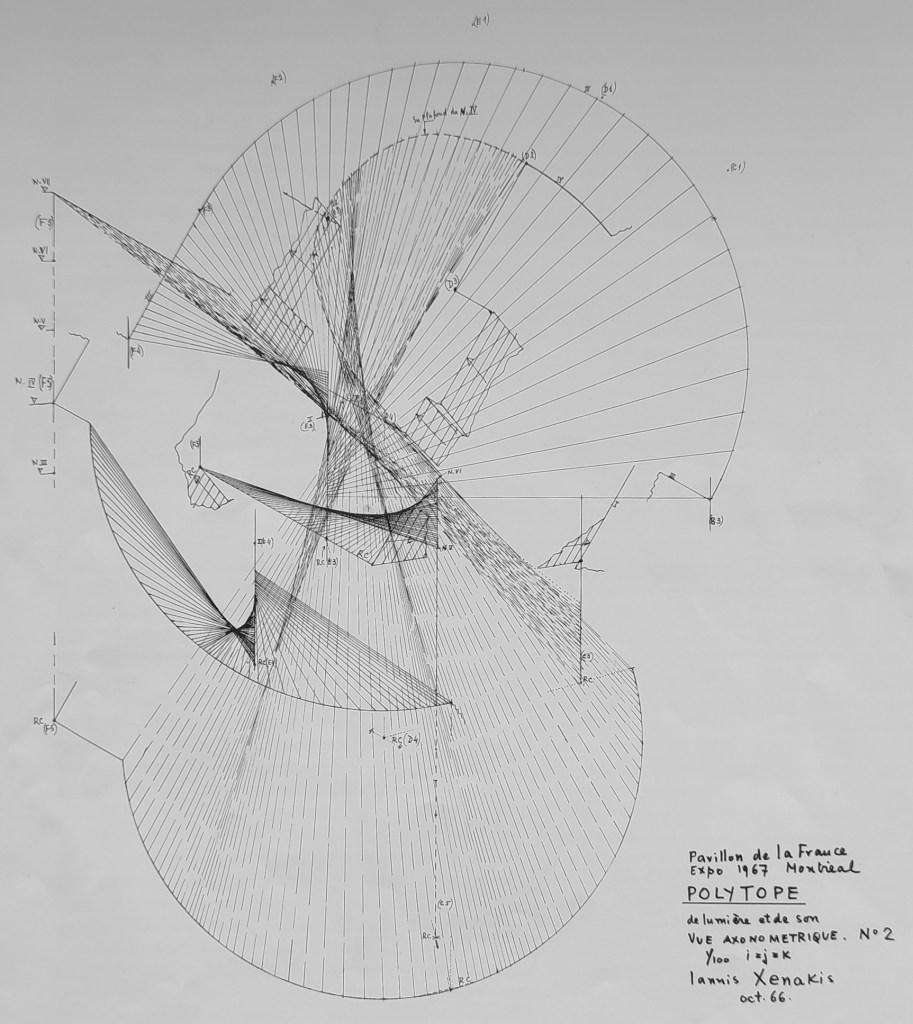
I would like to express my sincere thanks to Mâkhi Xenakis for kindly granting the authorization to reproduce the image of the design created by her father, Iannis Xenakis, for the Polytope de Montréal. Her generosity and support are deeply appreciated.
Marc Bollansee
11 Iannis Xenakis-1922-2001-Greece/France
Primary Forces: Orchestral-Ensemble-Vocal
Encountering the music of Xenakis for the first time can be a disorienting experience. Traditional points of reference such as melody, harmonic progression and thematic development often seem to dissolve into immense sonic architectures, violent eruptions of energy and masses of sound in constant transformation. For some listeners the impact is immediate and overwhelming. Others require time before entering this singular universe.
Yet few composers of the twentieth century transformed the act of listening so radically.
Xenakis approached music not as narrative or psychological discourse, but as the projection of forces in space and time. Sound behaves like a physical phenomenon: it collides, expands, accelerates, fractures and proliferates. The listener no longer follows themes in the traditional sense but is immersed inside evolving sound environments whose intensity can feel geological, cosmic or ritualistic.
This extraordinary physical power partly explains why Xenakis occupies such a unique position in contemporary music. Although his work is often associated with mathematics, architecture and formal systems, the experience of listening to it is never purely intellectual. Beneath the rigorous structures lies a music of elemental energy, deeply connected to nature, movement and collective human expression.
The range of his output is also far broader than is sometimes assumed. Alongside the massive orchestral works stand pieces of haunting stillness, intricate chamber works, spatial environments, electroacoustic experiments and dramatic vocal compositions rooted in ancient Greece. Throughout these transformations, Xenakis continually reinvented his musical language while preserving an unmistakable identity.
More than half a century after many of these works were written, their sound world still feels startlingly contemporary. Xenakis did not merely extend existing musical traditions: he opened new perceptual territories. His music remains a frontier experience, one that continues to challenge performers, listeners and composers alike.
The works presented here attempt to illuminate different facets of this immense creative universe.
1 Terretektorh for orchestra-1965-1966-17’-YT/hr SO-Pintscher
Marc’s Note:
After the ground-breaking stochastic works of the fifties, Xenakis started working on Terretektorh, a piece that proposes two fundamental innovations that would revolutionize composition for orchestra and listening possibilities.
90 Musicians are spread out among the public holding their instruments and sitting on an insonorous elevated platforms. The public was seated on folding chairs during the premiere, but was free to change positions in order to get a different experience.
This scattering of the music leads to a cinematic, radically innovative conception of music. Musical composition is enriched in many ways by the spatial dimension and the freedom of movement.
The orchestra is divided in eight groups, containing nearly equal proportions of string and wind instruments. Each player is armed with one of various small percussive instruments like woodblocks, marimbas, whips and small whistle-sirens which possess three registers and produce flame-like sounds.
Orchestral colour is thus moved to the spectre of dry sounds, full of noise, which enlarge the sonorous palette and make the scattering even more effective.
The score largely avoids traditional melody and harmonic progression.
There is however a lot of movement, both directional and stochastic, in dynamics, range density, timbre and spatial location. Movement is designed and calculated with precision by the use of logarithmic functions and Archimedean spirals for rotating sounds.
The percussive textures, including knocking and plucking sounds, add a raw and highly distinctive layer to the orchestral fabric.
Xenakis had a profound relationship with nature and sought here to evoke natural sonic phenomena. This partly explains the mystery of music that remains deeply compelling despite its mathematical foundations: the human and physical dimensions are never absent.
2 Polytope de Montreal-1967-6’-Spotify/Ensemble Ars Nova-Constant
Marc’s Note:
Xenakis designed the famous Philips Pavilion for the World Exhibition in Brussels in 1958 and his mentor, the Swiss architect Le Corbusier conceived a show with music by Varese and the projection of films and slides.
The composer was disappointed as he had started to visualize a radical light and sound show which would fit perfectly in the structure he had designed and which had no centre, no privileged vantage point.
The architect for the French Pavilion at the Montreal World Exhibition of 1967 was Jean Faugeron, whose design was several stories high, with an open interior space accessible on all levels.
Ideal conditions for Xenakis, who constructed five networks of intersecting steel cables each outlining curved geometrical shapes. The steel cables gave shape to the enormous void and supported his luminous points, which consisted of flashbulbs.
All his previous experiences were used to work with light: the calculation of probabilities, logical and group structures.
There were 1200 independent circuits (or lights) functioning through a board of photo-electrical cells where they were all reproduced.
The luminous composition is organized according to group theory principles.
Examples of these groups are: vertical and horizontal slices, differentiation in superposed layers, different lighting for each storey.
Xenakis wanted to create a luminous flow analogous to that of music. Therefore, the flashbulbs were triggered twenty-five times per second to achieve the necessary sense of continuity.
Xenakis insisted that the music should not merely illustrate the visual spectacle but remain structurally independent from it.
His music is a continuity, often with glissandi as building blocks, while the light is a multitude of points with stops and starts.
The composer has written a purely instrumental score, which is scored for four identical ensembles.
It shows some likeness with Terretektorh as the emphasis is on relatively static sonorities interspersed with dynamic fluctuations.
There are three contrasting sections and each of them contains sonic elements, spatialized according to different patterns and rates.
Intensity is the key feature of the music which is filled with registral extremes, dramatic accents and dynamic gestures.
Polytope de Montreal was a perfect symbiosis of architectural space and musical structures.
In this multimedia show the architect, composer, mathematician and specialist in electric connections join forces.
Quite a feat for one person.
3 Kraanerg for orchestra and tape-1968-1969-83’-YT/Ensemble 900-Tamayo
Marc’s Note:
Commissioned by the National Arts Centre in Ottawa, Xenakis was asked to compose a large-scale score for a ballet by Roland Petit and was granted complete artistic freedom.
There was no real plot for the ballet but Xenakis was conscious of the student demonstrations that took place during that period and extended the sense of intellectual struggle to global concerns.
The composer had developed a new framework for the structural organization of his music based on mathematical group theory and applied this theory to his compositional process.
He identified six categories of elements: timbres, register and pitch, sound quality, dynamic level, density, textures.
By multiplying the number of elements in each category together one can determine the huge range of possible combinations.
Kraanerg is a vast, continuous structure lasting 75 minutes and is built from the material alternating between recorded sounds on tape and a live orchestra. The tape consists of processed orchestral sounds that are similar to the live material.
There is a dialogue between these two elements but also a sub-dialogue between winds and strings in the live part. Xenakis wrote separate scores for winds and strings.
The music is full of extraordinary tension; it is even relentless as it unfolds in clearly outlined sound masses.
Dense textures, extremes of register and dynamics, aggressive accents and articulations combine with a constantly evolving structure which creates a very high concentration.
Moreover, Xenakis introduced silence in the form of about 20 pauses, including three that last at least 20 seconds.
The interaction of elements and the variation of their proportions contributed to making the music unpredictable.
In the last stages of the piece, the waves of taped material, always in contrast to the live sound, build to a peak like a force of nature.
Xenakis worked with limited musical material which guaranteed coherence and formal integrity.
The original choreography failed to secure a lasting place but a new choreography by Graeme Murphy in 1988 better reflected the awesome sweep of the music.
Kraanerg remains a key work in Xenakis’s repertoire.
4 Keqrops for piano and orchestra-1986-16’-YT/Dubov-State Academy SO of Russia-Lednev
Marc’s Note:
The title refers to Cecrops, the mythical half-man, half-serpent king ot Athens and also evokes the idea of interweaving musical layers.The dual nature of the title is reflected in one of Xenakis’s most aggressive creations, full of rhythmic energy, textural intensity and formal tension. Although the piano is rarely isolated in traditional cadenzas, the soloist plays almost continuously. It is a score of enormous difficulty for the soloist, who plays the most active music, particularly its recurring scales and active gestures. The orchestra plays mostly very concentrated material. Xenakis makes a lot of use of his sieve technique which is providing a harmonic anchor in the middle section. The sieve structures shift rapidly from one configuration to another. The final section provides a sense of structural coherence which is often absent in music of such intensity and volcanic energy. The orchestra gradually coalesces into a monumental cluster sonority while the piano recalls the chordal ostinato heard at the opening of the work, bringing the piece full circle.
5 Jonchaies for 18 musicians-1977-17’-YT/Luxemburg PO-Tamayo
Marc’s Note:
Jonchaies is one of Xenakis’s most imposing orchestral works and also one of his richest in sonorous invention. The title refers to a dense field of reeds and perfectly captures the organic proliferation that characterizes the music. The work opens in a strikingly unexpected manner. Instead of the brutal sound masses often associated with Xenakis, the strings unfold long, sinuous melodic lines of great intensity and continuity. The sonority is partly inspired by the Javanese pelog scale whose unequal intervals fascinated the composer. Xenakis attempted to recreate and expand this harmonic world through his sieve system, a method allowing him to organize pitch structures according to mathematical filtering processes. The result is one of the most compelling orchestral textures in his output. The string writing possesses an almost hypnotic quality as the melodic lines accumulate into vast shifting clouds of sound. Despite the complexity of the underlying construction, the music retains an immediately physical and sensual presence. As the work progresses, the orchestral landscape gradually changes character. Pulsating blocks of sound emerge and circulate through different instrumental groups in alternation, creating waves of energy and spatial tension. The music becomes increasingly dynamic and ritualistic, driven by sharp accents, repeated figures and violent orchestral surges. The brass section plays a particularly important role in the later stages of the work. Massive glissandi cut through the orchestral fabric like tectonic movements, while the rhythmic pulsations generate an atmosphere of mounting pressure and instability. Xenakis achieves an extraordinary balance between rigorous architectural control and the impression of unleashed natural forces. The conclusion is among the most remarkable in Xenakis’s orchestral music. After the accumulation of dense masses and explosive gestures, the texture rises toward the highest registers where the piccolos emit shrill chirping sounds that evoke a strange avian world or the cries of invisible creatures. The gigantic orchestral machine suddenly dissolves into nervous fragments of sound and air. Jonchaies stands at the crossroads of several aspects of Xenakis’s art: the mathematical organization of pitch through sieves, the fascination with natural phenomena, the physical projection of sound masses and the creation of orchestral textures of overwhelming intensity. It remains one of the composer’s supreme achievements for large orchestra.
6 Akrata for 16 wind instruments-1964-1965-14’-Spotify/EIC Paris-Simonovitch
Marc’s Note:
Akrata is written for eight woodwinds and eight brass instruments.
Traditional melody or harmonic progression do not appear in this work as its sonic material is forged of held pitches largely detached from traditional intervallic relationships. The focus is entirely on parameters such as timbre, dynamics and texture.
Its architecture is extra-temporal, based on the theory of groups of transformation, in particular the theory of sieves by which structures of pitch and time may be developed, like scales or pitches in ordered sets as well as temporal structures.
Instead of ordering notes through algorithms, like in the stochastic works, the new theory allows transformation to point to a succession of musical events. In Akrata one hears series of moments separated by silences.
The piece evokes gong colours and the blurred and multifaceted sounds converge towards forms which are designed beyond the wind ensemble giving the piece it’s out of time feeling.
The percussive character of the playing techniques (flutter-tongue, staccato, tight tremolo) lends a sharp and contrasted relief to the musical canvas.
Many consider the work to be a sketch that prepares the masterpieces that follow like Kraanerg and Nomos Alpha, but the purity of the subject and the held note impart a stark, radical expression to the music that appeals to listeners on a different level.
The architecture of Akrata results from a partly systematized process but it is a harbinger of a new deterministic approach in Xenakis’s oeuvre.
Simonovitch conducts his friend’s piece with the perfect slow pacing it craves.
7 Echange for bass clarinet and ensemble-1989-18’-YT/Freedman-Ensemble Asko Schönberg-Masson
Marc’s Note:
Echange occupies a unique place in Xenakis’s output as one of his rare concertante works for woodwind instrument. The composer sets out to make full use of the richly sonorous qualities of the instrument. Its resonance and harmonic qualities enable Xenakis to establish a special sensuality in the solo instrument, which engages in a dialogue with the ensemble. The splendid cadenza favors lyricism and sonorous exploration over sheer virtuosity. The soloist is featured almost continuously, while the involvement of the ensemble builds a structural momentum. At one stage, the ensemble briefly drops out, allowing the bass clarinet to make an extraordinary, unprecedented gesture: a major triad. An unexpectedly humorous gesture that is quite unusual for the rigorous composer. After a dancelike passage for the ensemble, the soloist spins long, smooth melodic contours and quickly alternates between registers. Again the ensemble accompanies with tutti chords. A fascinating widespread chord closes the piece and the instruments stop playing one after the other, leaving the high strings the task to bring the piece to a delicate conclusion. The success of the piece depends greatly on the soloist and Lori Freedman’ s long familiarity with the score results in a truly exemplary interpretation.
8 Nomos Alpha for cello-1965-1966-13’-YT/Rohan de Saram
Marc’s Note:
Whereas sieve theory appears in embryonic form in Akrata, Xenakis was fully in command of the technique in Nomos Alpha, his timeless masterpiece for solo cello
Ordered structures could be constructed and then subjected to a controlled sequence of permutations.
In addition, Nomos Alpha exemplifies an elaborate group structure based on the twenty-four rotations of a cube.
The score is substantial, but the music is highly fragmented and places exceptional demands on the cellist.
A great range of technical possibilities is explored, including double-stop glissandi, rapid con legno battuto and scordatura. The latter encourages Rohan de Saram to alternate 2 pre-tuned cellos to avoid lengthy re-tunings which would also change bow resistance and response. Moreover, Xenakis often writes immediately demanding material after the scordatura indication, leaving no recovery time.
Each scordatura effectively creates a new instrument as the resonance network changes completely. Xenakis was very sensitive to the physical-acoustic transformations: he thought in terms of masses, resonant states and sonic topology rather than traditional themes.
The piece is another major step forward in his approach to composition as the structures, values and relations are linked with temporal trajectories of various elements and parameters.
The result is a unique blend of compositional and instrumental concerns which create a musical experience of immense power.
One can safely say that each execution can showcase a different approach or reading of the piece. The performances of Palm, de Saram, Roy and Deforce demonstrate that Nomos Alpha still exceeds the full technical grasp of any single interpreter. Each performer uncovers different dimensions of the work and contributes to its evolving history.
9 Oresteia for baritone/countertenor, choir, percussion and ensemble-1965-1966-78’-YT/Scotting- UC Consortia-De Hart-UC School of Music Staff and Students-Menzies
Marc’s Note:
After composing incidental music for a Greek production of Aeschylus’s Oresteia, Xenakis quickly assembled a shorter suite containing choral and percussion sections from the score.
Two later additions: Cassandra (1987) and Athena (1992) incorporate solo voices, which enhance the dramatic impact of the later stage versions. These additions belong to a distinct aesthetic, a kind of homage to No theatre, where all the parts are sung by men.
The complements were written for the baritone Spyros Sakkas who often sang in falsetto. In the version recommended here, the singer alternates counter-tenor and baritone sounds, producing striking dramatic contrasts.
Vocal settings for the choruses range from speech-like chanting to modal monodies, two-part counterpoint, quartal harmonies and loud yelling and howling.
The singers were also requested to play small percussion instruments, introducing stochastic clouds of extraordinary sonorities.
There is much use of microtonal harmonies, glissandi and timbral-registral interplay in the instrumental parts.
Instrumental sections function as a temporal backdrop, while dramatic events and vocal expressions take place before it.
Xenakis keeps his usual exuberance in check and does not allow the music to dominate, thereby compressing the dramatic content, so that the ultimate crisis unfolds in full force.
12 Giacinto Scelsi-1905-1988-Italy
Primary Forces: Orchestral, Chamber, Piano, Solo
Giacinto Scelsi occupies a singular position in twentieth-century music. Although often associated with mysticism and esoteric thought, the true importance of his work lies above all in his revolutionary transformation of musical listening itself.
After an artistic and psychological crisis in the late 1940s, Scelsi progressively abandoned traditional compositional thinking based on thematic development, harmonic progression and architectural form. Instead, he began to explore the interior life of single sounds, discovering that a single note was never truly static but contained an entire universe of movement, tension, colour and energy.
This discovery altered the course of contemporary music.
Scelsi shifted the focus of composition from the external organization of sounds toward the exploration of sound as living matter. Microtonal fluctuations, beating frequencies, glissandi, unstable timbres and internal resonances became the essential substance of his music.
What appears simple on the surface is in reality extraordinarily complex. Beneath the apparent stasis, the music is in perpetual transformation. Tiny changes of register, bow pressure, dynamics or tuning generate immense expressive consequences.
His mature works often possess a ritualistic or ceremonial dimension. Yet this spirituality is never merely decorative or symbolic. It emerges directly from the physical behaviour of sound itself. Scelsi does not illustrate transcendence: he attempts to reveal it acoustically.
His orchestral works such as, Quattro Pezzi, Uaxuctum, Anahit and Konx-Om-Pax opened entirely new conceptions of orchestral sound, while his string writing transformed the possibilities of instrumental microtonality and resonance.
Many later composers absorbed aspects of his discoveries, including Radulescu, Grisey, Murail, Haas, Niblock, Sciarrino and numerous younger composers concerned with spectral, microtonal or sound-based composition. Yet none entirely resemble him because Scelsi’s music remains deeply personal and impossible to reduce to a technique or system.
At its greatest, his music gives the impression that sound itself has become conscious.
1 Quattro Pezzi for orchestra-1959-17’-Spotify/Vienna Radio SO-Rundel
Marc’s Note:
After his previous experiments with the piano, Scelsi extends them for the first time with a larger formation.
Quattro Pezzi is the pioneering work that opens the way for all his mature orchestral works.
The piece is for 26 instruments and favours low register instruments.
Certain instruments are absent in the three first movements, but all of them are present in the fourth and last movement which is a crowning achievement that synthesizes all preceding processes.
Each movement uses a different, single note modulated from within.
Sound material is simultaneously form and work, which was a revolution of unprecedented depth.
A compositional process takes place within the sound instead of the traditional combination of sounds.
The pieces elaborate their single notes by variations in tessitura, dynamics and timbre and also introduces microtonal fluctuations.
Climaxes appear in these domains and are derived from the golden ratio.
At times there is a flow in the music, but sometimes it halts in a glimpse of cosmic motion. Orchestral internal motion is the real miracle of the piece, while the “One note concept” is historically important.
Beating frequencies, tiny shifts in register and the use of colour to create tension are new elements that will later be absorbed by composers like Radulescu, Grisey, Haas or Szlavnics.
Each movement has a special characteristic: the first is melodic, the second dramatic, the third ethereal and the last one has an extreme finality.
The spontaneity of “Quattro Pezzi” and the sheer vitality of its sound processes make traditional formal constraints feel irrelevant.
2 Violin Concerto-Anahit-1965-YT -13-YT/Tosi-EIC-Pintscher
Marc’s Note:
Anahit is the ancient Egyptian name for Venus.
It is one of the few concertante works by Scelsi, but it is not a traditional violin concerto, rather a poem wherein the violin has purely sonorous tasks.
One year earlier he composed Xnoybis, his masterpiece for solo violin and Anahit develops its conquests and uses scordatura which allows the listener to hear the same note simultaneously on different strings.
The violin is tuned in a certain way that produces beats in the juxtaposition of certain intervals accompanied by the dense orchestral vegetation.
Anahit is one of Scelsi’s most refined creations and clearly refers to the divine. The violin is priestess, medium and a disembodied voice.
The music often seems to hover on the threshold between material sound and pure resonance.
There are three distinct sections which are built on the golden section.
The work is very lyrical and the soloist focuses on microtonal development and is supported in harmony by the orchestral accompaniment.
In the first movement the violin works out an ascending line, followed by an interlude dominated by brass at the golden section and ending with a more subdued interlude.
A major highlight of the piece is the following ethereal cadenza, which requires intense concentration from the soloist.
After the cadenza, the composer recapitulates material of the first section and then lets pulsating waves bring the music to its conclusion.
3 Uaxuctum for chorus, ondes Martenot and orchestra-1966-23’/Radio France Choir & Orch-Brizzi
Marc’s Note:
The title refers to the legend of the Maya City destroyed by its inhabitants for religious reasons.
In this piece Scelsi moves closer to pure ceremony rather than composition.
It is a complex, dramatic and incredible work for choir and orchestra in five movements.
The score for the chorus is written at an astonishingly difficult level and incorporates many varieties of microtonal manipulations next to breathing, guttural and nasal sounds.
Concerning the orchestra, it is the only piece by Scelsi in which the Ondes Martenot intervene and are entrusted with important solo parts.
The first movement begins in quiet contemplation, only to be interrupted by the violent mystical intervention of the chorus and then sinks back into meditative tones.
In the second movement we really enter the world of the Mayans and Scelsi develops his mystic side in an orchestral tour-de-force.
A special third movement opens in an atmosphere of foreboding and after a short silence the city is destroyed and abandoned. Despite its briefness it is the heart of the work with its brutal sparks of percussion and its uneven flow.
The next movement is dominated by the chorus and tries to make us imagine the wisdom gained by the Mayans after their courageous act. It starts a capella and lets the orchestra enter discreetly and progressively, to recede at the end.
The incantatory and obsessive sides of the second movement return. And rapid percussion evoking tablas give this elaborate movement a contrasting rhythmic element.
In the final movement Scelsi returns to the opening mood and gives us a recollection of the preceding events.
Soli and choirs remain constantly in the foreground, while the orchestra rises slowly to a summit of intensity, remains in sustained tutti, to fade away until the mysterious end. The return to silence is not merely atmospheric: silence itself becomes sacred space again.
The contrast between Anahit and Uaxuctum is enormous: the former is tender, intimate, transparent, transfigured while the latter is dramatic, flamboyant, contrasted and manifold.
4 Konx-Om-Pax for chorus and large orchestra-1974-18’-YT/Cracovia Radio-TV Orch-Wyttenbach
Marc’s Note:
The title of the piece refers to peace and is borrowed from three languages: Assyrian, Sanskrit and Latin.
It is Scelsi’s last piece with extended movements and large forms and is scored for large orchestra with full strings and organ. The chorus appears in the last of the three movements.
It is no coincidence that there are full strings as the composer wanted to assert his command of harmony and invent sound complexes, full of breathtaking beauty and expressive power.
Full harmonic complexes and glissandos abound in the first movement, which is entirely based on C.
Next comes a movement for the ages, lasting a mere two minutes, a real whirlwind of sound sweeping everything away.
The last, grandiose movement is among Scelsi’s most outstanding creations.
A chorus repeats the sacred syllable “Om” and the whole universe starts resonating and vibrating. The composer is a real master at liberating energy hidden inside sound and does it with extraordinary elementary power.
“Om” signifies peace and Scelsi aims at the surpassing of self and man’s union with the cosmos.
It certainly is the composer’s most metaphysical orchestral statement.
The monumental pacing of the work is essential and it unfolds slowly allowing the listener to enter a peaceful state.
5 SQ 4-1964-12’-YT/Quartetto Maurice
Marc’s Note:
In this work Scelsi uses string-by-string tablature notation for the first time and he thus achieves an orchestral view of quartet writing.
Sixteen strings become individual instruments with their own colour, which leads to an endlessly increasing subtleness of the sounds’ differentiation and a great richness of tone.
The quartet is another work based on the golden section and symmetric principles.
It is scored in one movement and is hyper-concentrated with fascinating elements like glissandi, tremor, unstable intervals and microtonal friction.
Pitch is no longer treated as a fixed point but as a living field of tensions, frictions and oscillations.
Scelsi was particularly proud of his fourth quartet and it is indeed a crowning achievement not only in his work, but in all quartet literature.
6 Kshara for 2 double basses-1975-9’-YT/Runyon-Kasten-Krause
Marc’s Note:
After 1974, Scelsi abandoned large orchestral forms and turned increasingly toward very small instrumental formations, often exploring the deepest and darkest regions of sound. The double bass became one of his privileged instruments because of its immense resonance and physical presence.
Kshara, written for two double basses, is among the most extreme realizations of this late style. The title refers to the transient and perishable aspect of existence in Indian philosophy, opposed to the immutable eternal principle.
Initially many performers recorded one bass part beforehand and played the second part live. The proposed version is performed by two players and reveals more clearly the unstable interaction between the instruments.
The music unfolds in very slow transformations of texture, register and microtonal tension. Tiny deviations in pitch generate beating frequencies and acoustic frictions that constantly alter the sound from within.
The low rumble often approaches the threshold of audibility and creates an almost subterranean vibration. One does not simply listen to the piece: one experiences it physically through the body.
Despite its austerity, Kshara is not static music. Beneath the apparent immobility the sound is in perpetual internal motion, as if hidden energies were slowly circulating inside matter itself.
7 Xnoybis for violin-1964-12’-YT/Tosi
Marc’s Note:
Xnoybis is one of Scelsi’s supreme achievements for solo instrument and one of the most radical violin works of the twentieth century.
Like the Fourth String Quartet, the piece uses string-by-string notation and extensive scordatura, allowing Scelsi to treat each string as an independent sound world with its own resonance, colour and tension.
Scored in three movements, the work evolves almost entirely through microtonal fluctuations, unstable intervals, glissandi and variations of bow pressure. Traditional melodic development virtually disappears and is replaced by the exploration of the inner life of sound itself.
The violin no longer functions as a lyrical instrument in the classical sense. It becomes a medium for the revelation of hidden acoustic phenomena: vibrations, pulsations, friction and resonance.
The music demands extreme concentration from both performer and listener because the smallest inflection becomes structurally decisive. Silence, attack, timbre and pitch instability acquire equal importance.
Due to its formidable technical and psychological demands, Xnoybis has only been mastered by a limited number of violinists. Yet its influence on later string writing has been immense, particularly in music concerned with microtonality and the physical behaviour of sound.
8 Ygghur for cello-1965-16’-Spotify/Uitti
Marc’s Note:
Ygghur is the final part of Scelsi’s vast cello trilogy, The three Ages of Man, a cycle that can be understood as a spiritual and psychological self-portrait of the composer.
While the two earlier parts of the trilogy often inhabit dark and tormented territories, Ygghur reaches a more transfigured and inward state.
The first movement possesses an intense poignancy and unfolds in long, concentrated gestures where every inflection of pitch and colour seems charged with expressive meaning.
The second movement echoes many earlier aspects of Scelsi’s musical world: ritualistic suspensions, gong-like resonances, fragmentary cries and disembodied sonorities that seem detached from ordinary instrumental behaviour.
The final movement, entitled “Catharsis,” is among the most restrained and visionary pages Scelsi ever wrote for strings. Played largely in the high register, it unfolds through slow microtonal glissandi and fragile oscillations that anticipate the extreme refinement of his late works.
The cello gradually seems to lose its material weight and become pure resonance suspended in space.
Ygghur is not only the conclusion of the trilogy, but also one of Scelsi’s clearest affirmations that the deepest musical expression may arise from the smallest possible transformations of sound.

I would like to express my sincere thanks to Ying Wang for kindly granting the authorization to reproduce her photo portrait taken by Sophia Hegewald. Marc Bollansee
13 Ying Wang-1976-China
Primary Forces: Orchestral, Ensemble
Ying Wang belongs to that relatively small group of contemporary composers whose music immediately reveals an individual sonic identity without ever falling into mannerism. Born in Shanghai and later formed artistically in Germany and at IRCAM in Paris, she has developed a language in which physical sound energy, timbral transformation, electronics and dramaturgical tension coexist in a highly organic way. Her work is neither “East-West fusion” in the superficial sense nor an academic exercise in sound research. Instead, it emerges as a deeply personal response to displacement, technological modernity, political anxiety and the instability of contemporary existence.
Her music often gives the impression of being in permanent mutation. Textures flow, dissolve and reassemble; instrumental colors are constantly destabilized; pulses appear only to vanish into friction, noise or resonance. Yet despite the sophistication of her techniques, the listener rarely experiences the music as abstract. There is almost always an underlying physicality and emotional pressure in her work, sometimes violent, sometimes contemplative, sometimes strangely fragile.
One of the remarkable aspects of Wang’s output is her ability to combine highly controlled structural thinking with a sense of raw immediacy. Even in her most electronically informed pieces, one feels the presence of gesture, breath and bodily movement. The sonic material often behaves like living matter: expanding, contaminating itself, colliding, decaying and regenerating.
Another important aspect is her relationship with sound space. Wang does not simply orchestrate; she sculpts acoustic perspective. Sounds emerge from depth, migrate through layers of density and transparency, and frequently create the sensation that the listener is moving inside a volatile sonic environment rather than observing a traditional musical discourse.
Her music also reflects a world shaped by acceleration, fragmentation and ecological uncertainty. Titles such as Re:Wilding, Schmutz, Copyleft or 528 HZ 8 va already suggest that Wang is interested not only in sound itself but also in the cultural, technological and political contexts surrounding sound production today. She is among those composers who understand that contemporary composition can no longer remain isolated from questions of media, digital circulation, environmental collapse and transformed human perception.
Stylistically, one could situate her at the crossroads of several traditions without reducing her to any of them. Certain works reveal traces of Lachenmann’s expanded instrumental thinking, the spectral concern for timbral evolution, and the post-industrial energy of composers fascinated by urban and technological noise. Yet her music remains unmistakably her own because of its fluid dramaturgy, its kinetic energy and its highly distinctive sense of sonic atmosphere.
What makes Ying Wang particularly interesting today is that she composes neither against technology nor in submission to it. Electronics, amplification and multimedia elements are integrated as natural extensions of instrumental thought. Her work suggests a world in which acoustic and electronic realities have already merged irreversibly.
In many respects, Wang’s music is music of transformation: transformation of timbre, transformation of perception, transformation of identity and transformation of the environment itself. Beneath the surface complexity lies a persistent existential tension; between control and chaos, transparency and opacity, nature and artificiality, memory and technological mutation.
1 Unermüdlich strömend, nahezu transparent for orchestra-2013-16‘-YT/ORF Radio SO Wien-Alsop
Marc’s Note:
This orchestral work can be heard as one of Wang’s earliest major statements of artistic maturity. The title itself “Tirelessly flowing, almost transparent” already reveals an essential duality in her music: continuous movement combined with extreme fragility.
The piece was inspired by the river Havel and by the composer’s perception of a dark, mysterious natural force hidden beneath an apparently calm surface. Rather than depicting nature in a descriptive or impressionistic manner, Wang transforms the river into a dynamic sonic process. The orchestra behaves less like a traditional symphonic organism than like an unstable ecosystem of currents, eddies and pressure zones.
One of the most striking aspects of the work is its control of density. Wang continuously alternates between highly saturated orchestral masses and moments of near-weightless transparency. Timbres appear to dissolve into microscopic particles before reassembling into larger accumulations of sound. This constant metamorphosis creates the sensation of listening to a living fluid structure.
The dramatic power of the piece does not depend on thematic development in the classical sense. Instead, tension emerges from transformations of texture, tempo and spatial depth. Rhythm is unstable and often internally fractured. Sudden surges of energy interrupt suspended states, suggesting hidden violence beneath the apparent calmness of the musical surface.
One can also hear in this work Wang’s fascination with materiality. Sound is treated almost physically: granular string textures, shifting orchestral layers and unstable harmonic spectra create a tactile experience. The listener is drawn into a sonic environment rather than guided through a linear narrative.
2 528 HZ 8 va for orchestra, minimoog and electronics-2021-2022-21’-YT/SWR SO-SWR Experimental Studio-Mayrhofer
Marc’s Note:
This work marks an important stage in Wang’s engagement with electronics, amplified sonorities and questions of acoustic perception. The title refers to the controversial idea of “528 Hz” as a supposedly healing or transformational frequency, but Wang’s treatment of the concept is far from naïve or mystical.
Rather than presenting a meditative “new age” atmosphere, the work interrogates the contemporary obsession with frequencies, vibrations and digitally mediated perception. The integration of mini-Moog, electric guitar, electronics and large orchestra creates a hybrid sound world in which acoustic and electronic identities constantly contaminate one another.
One of the most fascinating aspects of the piece is the ambiguity between organic resonance and artificial manipulation. Certain passages seem almost physically immersive, as if the orchestra itself were becoming an electronic instrument. Elsewhere, distorted sonorities and amplified textures create a sensation of instability and technological interference.
The “8va” extension in the title suggests elevation, displacement or altered register. Indeed, much of the work explores vertical expansion: spectral stretching, exaggerated resonance fields and extreme registral layering. Wang frequently pushes the orchestra into zones where instrumental color becomes unstable and partially electronic in character.
The dramaturgy is highly kinetic. Blocks of sound collide, dissolve and mutate. Unlike traditional symphonic discourse, the music evolves through energetic transformation rather than thematic argumentation.
The work can also be interpreted as a reflection on contemporary listening itself. In a world saturated with digitally manipulated sound, Wang seems to question what constitutes natural resonance today.
3 Coffee and Tea for ensemble and electronics-2013-11’-YT/Mam. Manufaktur für aktuelle Musik
Marc’s Note:
This chamber work with electronics reveals another side of Wang’s personality: humor, theatricality and subtle social observation.
The title immediately evokes everyday ritual and cultural exchange. Coffee and tea are not merely beverages here; they function as symbols of different temporalities, habits and modes of social interaction. One could even interpret the piece as a miniature study in globalization and intercultural coexistence.
Musically, the work juxtaposes contrasting energies and textures. There is often a playful friction between repetitive rhythmic gestures and unstable electronic interventions. The electronics do not simply accompany the instruments; they disturb, distort and occasionally parody the acoustic material.
The piece demonstrates Wang’s talent for transforming ordinary cultural references into complex sonic dramaturgy. Beneath the surface wit lies a sophisticated exploration of gesture, pacing and behavioral patterns.
An especially interesting aspect is the relationship between intimacy and fragmentation. Chamber textures create proximity, yet the electronic layer introduces distance and artificiality. The listener moves constantly between recognizable human gestures and technologically mediated sound objects.
4 Glissadulation for ensemble-2014-2015-8’-Spotify/Ensemble Phoenix Basel
Marc’s Note:
The title itself is highly revealing. By combining “glissando” with a quasi-biological or playful suffix, Wang invents a word suggesting continuous sliding transformation.
Indeed, the work is fundamentally concerned with unstable motion. Pitch in this piece rarely remains fixed. Sounds bend, slide, smear and mutate continuously. The result is a music of permanent transition in which identity itself becomes fluid.
What is particularly remarkable is Wang’s ability to transform glissandi from mere effects into structural principles. Entire formal trajectories emerge from the accumulation and interaction of sliding energies.
The piece also demonstrates her acute sensitivity to micro-instability. Tiny deviations of pitch, friction between instrumental layers and gradual timbral deformation become major expressive elements.
One can hear affinities with spectral thinking, yet Wang’s approach remains more physical and gestural. The glissandi are not purely harmonic phenomena; they often feel like bodily movements, stretches or fractures.
Electronics further destabilize the sonic field by blurring the distinction between acoustic continuity and digitally transformed resonance.
The work creates a fascinating paradox: despite the constant movement, there is also a strange sense of suspended time. The listener becomes immersed in an environment where stable orientation disappears.
5 Schmutz for violin and ensemble-2018-2019-13’-YT/Schafleitner-Klangforum Wien-Leroy
Marc’s Note:
Few contemporary titles are as provocative and revealing as SCHMUTZ (“dirt,” “filth,” “impurity”). The work appears to confront directly the aesthetics of contamination, excess and sonic pollution.
Rather than pursuing purity of sound, Wang embraces friction, distortion and residue. Noise is not treated as opposition to musical material but as an essential component of reality itself.
The violin, traditionally associated with refinement and lyrical expression, is placed within an environment of unstable, often abrasive textures. This tension between virtuosity and contamination becomes central to the work’s dramatic identity.
The music often gives the impression of systems breaking down or overloading. Layers accumulate aggressively; gestures become fragmented; sonic debris circulates through the ensemble. Yet the piece is carefully controlled. Wang does not celebrate chaos blindly; she composes the behavior of disorder.
The use of megaphones and electronics reinforces the political and social dimension of the work. Communication appears distorted, amplified and corrupted. One might hear the piece as reflecting contemporary media saturation, environmental toxicity or the impossibility of maintaining “clean” boundaries in modern life.
At a deeper level, Schmutz questions aesthetic hierarchy itself. Why should impurity be excluded from musical beauty? Wang transforms dirt into compositional material.
6 Re:Wilding for chamber orchestra-2020-22’-Spotify/Ensemble Reflektor-Bar Avni
Marc’s Note:
This is perhaps one of Wang’s most conceptually resonant works. The title immediately invokes ecological discourse and the idea of restoring uncontrolled natural processes.
Yet the piece is not simply “about nature.” Rather, it explores the tension between wildness and technological mediation. Electronics, amplified instruments and orchestral textures coexist in a landscape that feels simultaneously organic and artificial.
The prefix “RE:” is particularly important. It suggests return, reconstruction, reactivation or even digital communication. Thus “rewilding” becomes ambiguous: can nature truly return once it has been technologically transformed?
The music often behaves like an unstable ecosystem. Sonic events proliferate unpredictably, textures spread organically and rhythmic structures seem partially self-generating. Yet one also senses invisible systems of control.
An important feature is Wang’s treatment of sonic space. Sounds emerge from multiple depths and directions, creating an immersive environment rather than a frontal musical narrative.
The integration of video expands the ecological dimension beyond purely acoustic experience. Wang appears interested in how environmental perception itself is mediated through screens, technologies and fragmented attention.
The piece can also be interpreted politically. “Rewilding” here may imply resistance against excessive control, homogenization and digital standardization.
7 SQ-Copyleft-2021-17’-Spotify/Quatuor Diotima
Marc’s Note:
This string quartet with loudspeakers engages directly with questions of authorship, circulation and ownership in the digital age.
The title references the open-source concept of “copyleft,” which opposes restrictive copyright structures by allowing creative material to circulate freely under certain conditions.
For a composer deeply engaged with electronics and technological culture, this is an especially meaningful subject. The piece appears to question how musical identity survives in an era of endless reproduction, sampling and redistribution.
The string quartet, one of the most historically charged forms in Western music, becomes a fascinating site for this interrogation. Wang places the traditional acoustic ensemble inside an electronically mediated environment, effectively confronting historical continuity with digital fragmentation.
The loudspeakers function not merely as accompaniment but as agents of duplication, distortion and spatial multiplication. Musical gestures seem copied, displaced or transformed through technological mediation.
There is also an implicit critique of originality itself. Wang seems to recognize that contemporary culture is built upon layers of quotation, replication and circulation.
At the same time, the work retains strong physical immediacy. The friction between live performers and electronically reproduced sound creates a powerful dramaturgical tension.
8 Focus- Exchange for bass clarinet and electronics-2015-15’-YT/Janssen-Deinzer
Marc’s Note:
This work for bass clarinet and electronics is particularly interesting because it concentrates many of Wang’s broader concerns into a highly focused instrumental situation.
The bass clarinet already occupies an ambiguous sonic territory: dark, flexible, capable of both lyricism and noise. Wang exploits this ambiguity fully.
The notion of “exchange” is central. The electronics and instrumental performer appear engaged in a continuous negotiation of identity. Sometimes the electronics seem to extend the instrument; elsewhere they compete with it, imitate it or destabilize it.
Attention itself becomes part of the composition. The listener’s focus is constantly redirected between foreground and background, acoustic and electronic source, gesture and resonance.
The piece also reveals Wang’s fascination with thresholds. Sounds frequently hover between categories: tone and breath, pitch and noise, human gesture and machine process.
Unlike many works combining solo instrument and electronics, Focus-Exchange avoids simple opposition between human and machine. Instead, the two domains gradually hybridize.
This creates an almost psychological dimension. The electronics sometimes behave like an externalized subconscious of the performer, amplifying hidden resonances and unstable sonic shadows.
14 Helmut Lachenmann-1935-Germany
Primary Forces: Orchestral, Ensemble, Chamber
Lachenmann occupies a unique position in post-war music. While many composers sought new harmonies, new structures, or new technologies, he asked a more fundamental question: what is a musical sound?
His answer transformed contemporary music. Traditional instrumental techniques were no longer sufficient. Bow pressure, friction, breath noise, scraping, tapping, and countless intermediate states became legitimate musical material. What emerged was not simply an expansion of technique but an entirely new listening culture.
Lachenmann’s concept of musique concrète instrumentale treats instruments not as producers of notes but as physical objects capable of generating an enormous spectrum of sound phenomena. The listener is invited to hear not only the result but also the effort that produces it. Energy, resistance, and physical action become audible.
Yet Lachenmann is often misunderstood. Beneath the unconventional sounds lies a composer deeply connected to the great German tradition. Beethoven, Schubert, Brahms and Mahler remain important presences throughout his work. His music is not a rejection of history but a confrontation with it. Familiar gestures are dismantled and rebuilt so that they may be heard anew.
What distinguishes Lachenmann from many experimental composers is the extraordinary expressive power that emerges from this approach. His works are rarely cold. They often possess a dramatic intensity, a tension between destruction and memory, between noise and beauty. The listener experiences not merely new sounds but a new awareness of listening itself.
Few composers have altered our perception of instrumental music as profoundly as Lachenmann. His achievement is not simply a new style but a new mode of hearing.
1 Air for percussion and large orchestra-1968-1969 rev. 1994-19’-YT/Dierstein-State Orch Stuttgart-Zagrosek
Marc’s Note:
One of the earliest large-scale manifestations of Lachenmann’s mature language, Air explores sound as a field of forces rather than a collection of pitches. Percussion and orchestra interact in a constantly shifting landscape where attacks, resonances, and textures become the true protagonists.
The work already demonstrates Lachenmann’s fascination with physical energy. Sounds emerge, collide, and dissipate as though governed by natural processes. Traditional orchestral rhetoric is largely absent; instead, the listener encounters a world in which every sonic event possesses equal importance.Air represents the moment when Lachenmann begins to move decisively beyond post-war serialism toward his own revolutionary conception of sound.
2 Fassade for orchestra-1973 rev. 1987-22’-Spotify/SWR SO Baden-Baden und Freiburg-Gielen
Fassade is one of Lachenmann’s most radical examinations of instrumental sound. The title suggests a surface or exterior wall, yet the work constantly undermines the distinction between appearance and substance.
The orchestra becomes a laboratory of sonic behaviours. Conventional notes appear only intermittently, emerging from a dense network of friction sounds, breath noises, and unconventional articulations.
What makes the work compelling is its dramatic trajectory. The music is not merely experimental. It unfolds as a process of discovery in which hidden layers of sound gradually reveal themselves. The listener becomes increasingly aware of the physical mechanisms underlying instrumental performance.
3 Piano Concerto-Ausklang-1984-1985-47‘-YT/Neuburger-SWR SO-Roth
Marc’s Note:
One of Lachenmann’s greatest achievements, Ausklang reimagines the piano concerto tradition from within.
The piano is not treated as a heroic soloist opposed to the orchestra. Instead, soloist and ensemble participate in a vast exploration of resonance, attack, and decay. The title itself refers to lingering sound, to what remains after an event has occurred.
The work displays remarkable structural control. Moments of apparent fragility coexist with passages of immense power. Throughout the concerto, Lachenmann investigates the piano’s capacity to generate entire worlds of resonance.
Far from rejecting tradition, Ausklang engages directly with the concerto genre while transforming its underlying assumptions.
4 Mouvement for ensemble-1982-1984-25’-YT/EIC-Pintscher
Marc’s Note:
This ensemble work is one of the clearest demonstrations of Lachenmann’s ability to create musical motion from non-traditional materials.
Tiny gestures accumulate into larger processes. Fragments appear and disappear before they can stabilise. The subtitle (“before paralysis” or “before petrification”) suggests a state of perpetual becoming.
The work achieves extraordinary tension because it continually approaches stability without ever fully reaching it. Movement itself becomes the subject of the composition.
5 Notturno for cello and small orchestra-1989-24’-YT/Öhmann-WDR SO-Lin Liao
Marc’s Note:
One of Lachenmann’s most poetic works, Notturno reveals a more contemplative side of his musical personality.
The cello functions as both narrator and participant within a vast orchestral environment. Unlike the dramatic confrontations of many concertos, the relationship here is often introspective and reflective.
The work unfolds as a sequence of nocturnal visions. Sounds emerge from silence, linger briefly, and disappear again. The atmosphere is often mysterious, yet the underlying structure remains remarkably clear.
Notturno demonstrates how Lachenmann’s sonic innovations can serve deeply expressive ends.
6 SQ 3-Grido-2001-26’-YT/Quatuor Diotima
Marc’s Note:
Among the most accessible and immediately compelling of Lachenmann’s later works, Grido represents a culmination of his string quartet writing.
The title means “cry,” and the music indeed possesses an unusual emotional directness. Yet the cry is not expressed through traditional melody. It emerges through tension, pressure, and transformation of sound.
The quartet medium allows Lachenmann to achieve extraordinary refinement. Every gesture matters. Every sonic nuance contributes to a continuously evolving musical discourse.
Many listeners regard Grido as one of the masterpieces of contemporary quartet literature.
7 Allegro sostenuto for piano, clarinet and cello-1986-1988-30’-YT/Ensemble Recherche
Marc’s Note:
This remarkable trio demonstrates Lachenmann’s ability to generate large-scale structures from highly concentrated material.
The unusual instrumentation creates a constantly shifting balance between attack and resonance, between continuity and interruption.
The work combines intellectual rigor with exceptional vitality. Despite its complexity, the music never feels static. The interaction between the three performers produces a dynamic network of relationships that remains engaging throughout.
8 Opera-Das Mädchen mit den Schwefelhölzern-1990-1996-112‘-Spotify/SWR Vokalenensemble Stuttgart-SWR SO-Cambreling
Marc’s Note:
Lachenmann’s opera stands among the most important stage works of the late twentieth century.
Based loosely on Andersen’s fairy tale, the work transcends conventional narrative. The story becomes a meditation on suffering, exclusion, memory, and human dignity.
The score integrates virtually every aspect of Lachenmann’s musical language into a monumental theatrical synthesis. Instrumental sounds, voices, noise elements, and silence all contribute to the drama.
What makes the opera extraordinary is its emotional depth. Beneath the radical surface lies a profoundly human work that confronts themes of vulnerability and compassion with rare honesty.
15 Brian Ferneyhough-1943-England
Primary Forces: Orchestral, Ensemble, Chamber, Piano
If Lachenmann transformed the nature of sound, Ferneyhough transformed the nature of musical thought.
Frequently associated with the New Complexity movement, Ferneyhough has often been reduced to a stereotype: impossibly difficult scores performed by virtuoso specialists. While the technical challenges are undeniable, this description misses the essence of his achievement.
Ferneyhough’s music is not complex for its own sake. Complexity is the consequence of a deeper artistic goal: the creation of musical situations that exceed simple comprehension. Multiple layers of activity coexist, interact, and evolve simultaneously. The listener is confronted not with a puzzle to solve but with a rich and unstable field of possibilities.
His works often resemble living organisms. Information proliferates, fragments collide, and structures continuously transform themselves. Yet beneath the surface density lies extraordinary compositional discipline.
Unlike many modernists who sought clarity through reduction, Ferneyhough embraces abundance. His music reflects the complexity of perception itself. Listening becomes an active process of exploration rather than passive reception.
Although frequently viewed as an intellectual composer, Ferneyhough’s finest works possess enormous expressive intensity. Their energy, volatility, and dramatic unpredictability create experiences that can be both exhilarating and deeply moving.
Few composers have expanded the possibilities of musical notation, performance, and structure as radically as Ferneyhough. His influence on subsequent generations remains immense.
1 La Terre est un Homme for large orchestra-1979-13’-Spotify/BBC SO-Brabbins
Marc’s Note:
One of Ferneyhough’s first major orchestral masterpieces, this work already displays many characteristics of his mature style.
The orchestra functions as a vast network of interacting processes. Events emerge simultaneously on multiple levels, creating an extraordinary sense of density and motion.
Despite its complexity, the music possesses remarkable expressive urgency. The title suggests elemental forces, and the score often conveys the impression of immense energies struggling for articulation.
2 Carceri d’Invenzione III for wind ensemble and percussions-1986-11’-YT/The Ensemble Contrechamps-Nieuw Ensemble-Hempel
Marc’s Note:
Part of the celebrated Carceri d’Invenzione cycle, this work is among Ferneyhough’s most dramatic achievements.
Inspired indirectly by Piranesi’s imaginary prisons, the music constructs a labyrinthine environment in which the violin navigates constantly shifting perspectives.
The soloist is neither hero nor victim but an explorer moving through a world of unstable relationships. Virtuosity becomes a means of revealing hidden structures rather than displaying technical prowess.
3 Plötzlichkeit for large orchestra-2006-23’-Spotify/BBC SO-Brabbins
Marc’s Note:
One of Ferneyhough’s strongest late orchestral works, Plötzlichkeit (“suddenness”) investigates abrupt transformation as a compositional principle.
Events emerge unexpectedly, altering the musical landscape without warning. The work demonstrates a greater transparency than many earlier scores while retaining the composer’s characteristic richness.
The result is music of exceptional dramatic tension, constantly balancing continuity and rupture.
4 Funérailles I for 7 strings and harp-1969-11’-Spotify/Arditti SQ-Ensemble Recherche-Vis
Marc’s Note:
An early masterpiece already revealing Ferneyhough’s distinctive voice.
The reduced instrumentation allows unusual clarity. Individual lines retain strong identities while participating in larger structural processes.
The work combines emotional intensity with rigorous organisation, foreshadowing many later developments.
5 Terrain for violin and wind octet-1992-14’-Spotify/Jennings-Elision Ensemble-Oliu
Marc’s Note:
One of Ferneyhough’s most compelling chamber works, Terrain explores relationships between the solo violin and a surrounding ensemble environment.
The title is revealing. The music behaves like a landscape traversed from multiple perspectives. The violin continuously negotiates shifting conditions, encountering resistance, support, and transformation.
The work balances extraordinary detail with a strong sense of large-scale direction.
6 SQ 6-2010-26’-YT/Arditti Qt
Marc’s Note:
A late masterpiece demonstrating how Ferneyhough’s language evolved toward greater transparency without sacrificing complexity.
The quartet medium allows the composer to concentrate his ideas with exceptional precision. Every gesture contributes to a densely interconnected musical fabric.
The work reveals a mature composer capable of balancing structural sophistication with remarkable expressive immediacy.
7 Unity Capsule for flute-1976-16’-YT/Cesari
Marc’s Note:
Perhaps the most famous solo flute work of the late twentieth century.
Ferneyhough pushes the instrument to its limits, creating a piece that demands extraordinary control and imagination from the performer.
Yet the work is more than a technical challenge. It constructs a complete musical universe in which every gesture carries structural significance. The flute becomes capable of astonishing expressive variety.
8 Lemma-Icon-Epigram-1981-11’-YT/Hodges
Marc’s Note:
Widely regarded as one of Ferneyhough’s supreme achievements.
The title suggests three stages of transformation, and the work unfolds as a continuous process of evolution. Materials are introduced, expanded, and reinterpreted across the composition.
The piano writing is among the most inventive in contemporary music. Virtuosity serves structural and expressive purposes simultaneously.
Lemma-Icon-Epigram represents Ferneyhough at the height of his powers: intellectually rigorous, technically dazzling, and artistically profound.
16 Georg Friedrich Haas-1953-Austria
Primary Forces: Orchestral, Ensemble, Chamber, Opera
Among the major composers of the late twentieth and early twenty-first centuries, Georg Friedrich Haas occupies a singular position. While often associated with spectral music, his work ultimately transcends that label. Rather than treating sound as a vehicle for harmony, melody, or form, Haas approaches sound itself as a living phenomenon whose internal structure becomes the substance of the music. His compositions invite listeners into a world where pitch, timbre, resonance, and perception are inseparable.
At the heart of Haas’s language lies microtonality, particularly the use of just intonation. Yet unlike many composers who employ alternative tuning systems as a technical framework, Haas transforms microtonality into an expressive force. The tiny intervals between pitches create states of tension, instability, luminosity, and release that often feel almost physical. Sound seems to breathe, expand, contract, and shimmer. The listener is not simply hearing notes but experiencing the behaviour of sound itself.
One of Haas’s greatest achievements is his ability to unite rigorous construction with overwhelming emotional intensity. His music is meticulously organised, yet it rarely feels analytical. Beneath the sophisticated harmonic architecture lies a profound expressive world marked by longing, vulnerability, ecstasy, and darkness. Few contemporary composers have succeeded so completely in reconciling intellectual complexity with direct emotional impact.
Darkness itself has become one of Haas’s most distinctive compositional materials. In several works, performers play in complete darkness or under severely reduced lighting conditions. These are not theatrical effects but fundamental compositional decisions. By removing visual information, Haas encourages listeners to focus entirely on sound, allowing harmonic relationships and spatial phenomena to emerge with unusual clarity. Listening becomes an almost tactile experience.
Although connections can be drawn with Gérard Grisey and the French spectralists, Haas’s aesthetic trajectory is different. Where Grisey often explores the scientific and acoustic foundations of sound, Haas is more concerned with the psychological and emotional consequences of those acoustic realities. His music also shares affinities with Giacinto Scelsi’s fascination with the inner life of individual sounds and with Horatiu Rădulescu’s exploration of resonance and harmonic spectra. Yet Haas remains unmistakably himself: more dramatic than Scelsi, more structurally integrated than Rădulescu, and more emotionally exposed than most spectral composers.
A recurring feature of Haas’s oeuvre is the coexistence of opposites. Beauty emerges alongside violence. Clarity dissolves into ambiguity. Static harmonic fields coexist with powerful directional forces. Long spans of apparent stillness reveal intricate internal activity. This tension between motion and stasis gives many of his works their extraordinary sense of inevitability. The music appears suspended in time while simultaneously moving toward destinations that are often hidden from view.
Haas’s large-scale forms are particularly remarkable. Whether writing for orchestra, ensemble, chamber groups, or opera, he constructs musical architectures that unfold organically over long durations. Rather than relying on thematic development in the traditional sense, he shapes vast trajectories through evolving harmonic landscapes. Listeners often experience these works less as narratives than as journeys through changing states of perception.
His importance within contemporary music stems not only from his innovations in tuning and harmony but also from his redefinition of what listening itself can be. Haas asks us to hear differently: to attend to beating frequencies, resonance, shadow harmonies, and the subtle interactions between sounds. In doing so, he expands the very boundaries of musical experience.
Few living composers have created a sonic universe as immediately recognisable and as consistently compelling. Haas stands as one of the central figures of contemporary music, a composer who transformed the exploration of sound into an art of profound emotional and philosophical depth. His music reminds us that even within a single sustained tone there exist worlds still waiting to be discovered.
1 Limited Approximations for 6 tuned pianos and orchestra-2010-33’-YT/SWR SO-Cambreling
Marc’s Note:
This colossal concerto for six microtonally tuned pianos and orchestra is one of Haas’s defining masterpieces.
The pianos, each toned a twelfth of a tone apart, create a vast harmonic cloud in perpetual motion when combined. Six keyboards form an ultra-chromatical grid of 72 equal divisions of the octave.
The six pianos do not function as traditional soloists. Rather, they merge into a single gigantic hyper-instrument whose constantly shifting microtonal relationships generate beats, pulsations and acoustic shadows that seem to emerge from the sound itself.
The orchestra functions as a resonant field, amplifying and blurring the soloists’ microtonal vibrations.
The individual instrumental colours are often absorbed into the piano spectrum, making it difficult to distinguish where one sound source ends and another begins.
Haas acknowledges the acoustic impossibility of getting completely pure intervals within human-made tuning instruments. It is the equal temperament paradox which is a limited approximation of the infinite, continuous overtone spectrum.
In this piece, Haas does not adhere to a single dogma and mixes equal temperament, microtonal divisions and just intonation.
The piece is built as a massive macro-structure with specific harmonic tensions.
Over nearly 34 minutes, the listener inhabits a world of spectral shimmer that seems to breathe on its own.
The composer balances rigor and sensuality, transforming mathematical precision into luminous emotion and enveloping the audience in an overwhelming organic landscape of raw resonance.
2 Dark Dreams for orchestra-2013-33’-YT/Estonian Nat SO-Elts
Marc’s Note:
Here Haas engages more directly with the orchestra tradition. His trademark development of sound lasts about 17 minutes.
The music begins in shadow, whispered strings, tremulous beautiful winds, and gradually amasses energy in long dark waves.
The title suggests a nightmare, yet the work’s emotional spectrum is broader: it moves from fear to tenderness, from isolation to release.
Haas’s orchestration, always very refined, is a study in chiaroscuro, a Rembrandt of sound.
After seventeen minutes something very special happens: a clear melodic structure appears and the bassoon plays a solo melody. This linearity appears as an alien element but is soon transferred to the orchestra and we get a kind of Klangfarbenmelodie.
The appearance of melody is one of the most startling moments in Haas’s entire orchestral output. After nearly twenty minutes of harmonic turbulence and gradual transformation, linear musical thought suddenly emerges like a memory from another world.
Haas strives to let the listeners develop concrete associations when listening by reflecting on their lives, on difficult personal questions or suppressed thoughts. Those are the dark dreams.
In its closing measures faint harmonic glows replace dissonance, as if the dream had found its light.
The work demonstrates that Haas is not merely a composer of sound masses and microtonal processes. Beneath the complex surface lies an intensely lyrical imagination capable of producing moments of extreme vulnerability.
3 Ungefähr ganz genau for large orchestra-2022-29‘-YT/ ORF Radio SO Vienna-Alsop
Marc’s Note:
This compelling composition for large orchestra finds its conceptual inspiration in an 1885 international conference in Vienna, where the participants tried to determine a standard tuning pitch.
The composer explores the delicate friction between institutional tradition and personal sonic freedom.
He thus defends the cause of intentional imperfection which allows the musician to play subtly out of tune. The ultimate purpose is to increase the natural tension between divergent frequencies and to enrich the physical vibrations experienced by the listener.
Haas achieves acoustic unpredictability by alternating profound states of stillness with shattering blocks of sound. Striking glissandi create a highly saturated field of colour, while dynamic waves evoke raw physical sensations of convergence and divergence.
Throughout the work, pitches seem to drift in and out of focus. Chords never settle completely, creating a sense of instability that remains permanently alive. The listener is constantly suspended between certainty and ambiguity.
Approximate and exact are the philosophical paradox of the title and the composition captures the elusive spot where human error collides with mathematical precision.
The piece ultimately suggests that absolute precision may be less truthful than controlled imperfection. Human expressivity resides precisely in the space between the exact and the approximate. That idea lies at the heart of Haas’s philosophy.
4 In Vain for 24 instruments-2000-2002-56‘-YT/Argenta Chamber Ensemble-Galante
Marc’s Note:
As always with Haas, titles have meanings that deeply influence the musical piece and In Vain is an explicit commentary on history and human behaviour.
The success of the far-right party in the 1999 Austrian elections created a state of emotional despair for the composer and many of his compatriots.
He also felt that society and music slided backwards into familiar, rigid traps. There is a cyclical aspect of progress and failure that is conveyed by upward and downward spirals.
The work is also structured around a battle between the contrasting sonic worlds: equal temperament and just intonation.
These opposing tuning systems never fully reconcile. Their coexistence creates a permanent state of tension, mirroring the social and political conflicts that inspired the work.
The core concept however is light and darkness.
There is a connection between the visual lighting and the musical progression. Then, for about 20 minutes the hall is plunged into darkness, forcing the musicians to play extremely demanding scores from memory.
The absence of vision increases the listener’s acoustic awareness and makes the sound world more visceral.
In Vain radically transforms the listening experience and the role of the concert hall, from a site of passive listening into a space of shuddering mystery.
More than two decades after its composition, In Vain remains one of the defining statements of contemporary music: political engaged without becoming programmatic, technically revolutionary without sacrificing emotional power.
It is one of the most significant and hauntingly beautiful musical achievements of the 21 st century.
5 Ich suchte aber fand ihn nicht-2011-26‘-Spotify/Ensemble Phoenix Basel-Henneberger
Marc’s Note:
The title of the work refers to Chapter 3 of Solomon’s Song, where the speaker is searching through the city for the one her soul loves.
Historically, the verse has also been interpreted as a spiritual allegory for the union between man and the divine.
Haas tries to capture the experience of absence, yearning and the psychological terror of an unsuccessful search.
To achieve this goal, he uses an immersive sonic architecture with complex overtone series and microtonality.
The result is a fluid, but unstable acoustic environment.
Searching sonic textures mimic a blind journey through dark city streets or an unsettled mind at night.
Acoustic masses move between floating overtone structures and dark dissonances, which represent the cycle of hope and despair.
The ensemble often appears to wander through unstable harmonic territories, as if every attempted destination immediately dissolves into another path.
There are moments of intense beauty which dissolve suddenly, sonically representing the tragedy of searching for something which can’t be found.
The tension built by the composer fades away, the musical processes he introduced dissipate.
Like the Czech composer Alois Haba, one of the pioneers of microtonality, Haas lets forms appear like a stroll through forest and meadow.
These spontaneous and intuitive forms are bound to change progressively according to new perspectives.
The orchestration is fully in line with these principles as Haas organises the ensemble to achieve variation and colourfulness.
Unlike many sacred works that culminate in revelation, Haas deliberately withholds resolution. The search itself becomes the substance of the music, while fulfilment remains permanently beyond reach.
6 Weiter und weiter und weiter-2022-47‘-YT/Ensemble Modern-Kaziboni
Marc’s Note:
The title captures Haas’s obsessive sense of continuity and he builds it entirely around an unbroken cascading structural acceleration.
While writing the piece, Haas was working on his memoirs during a period of profound reflection.
The work feels like a meditation on persistence, both artistic and human.
Every structural cycle lasts a few minutes and the composition reaches a peak tempo at one stage.
Metric modulations drop the tempo back down, only to see it accelerate all over again.
Besides his trademark microtonality, Haas also features an acoustic drone, consisting of two pianos equipped with electronic bows which keep vibrating without human interaction and produce an acoustic resonance that underlines the shifting tempos.
The continuous drone functions as a sonic horizon against which all temporal activity unfolds. While tempos accelerate and contract, this underlying resonance remains remarkably stable, creating the impression of motion occurring within a large state of permanence.
There is no real climax, only the deepening of awareness: an art that does not seek catharsis but transformation through endurance.
The relentless pacing reflects a kind of psychological agony and results in a transformative listening experience that pushes both performers and audiences to their limits.
The listener gradually loses any conventional sense of musical destination. What remains is a heightened awareness of time itself and of the subtle psychological changes produced by prolonged listening.
7 SQ 8-2014-21’-YT/Jack Qt
Marc’s Note:
Haas has written one of the most important and innovative string quartet cycles of the 21st century. He has already published eleven string quartets.
After some monumental masterpieces like the third quartet performed in total darkness, Haas has consistently added new elements to the following quartets.
Whereas earlier quartets often focused on darkness, spatial perception or extreme duration, the SQ 8 places tuning itself at the centre of the musical discourse. The quartet becomes a laboratory in which harmonic relationships are continuously tested, destabilized and rediscovered.
Haas is obsessed with the physical properties of sound, acoustics and unconventional instrument tunings.
The latter is precisely the element that stands out in the eighth quartet with its radical use of scordatura.
Sixteen strings are tuned to entirely different pitches and thus decoupled from standard equal temperament to generate unstable, irregular microtonal scales.
The opening microtonal intervals and sliding pitches create a very dissonant start, but as the piece unfolds the web of overtones slowly align to achieve moments of pure just intonation.
Pure chords, thus generated, are in contrast to the surrounding unstable textures.
Balancing the microtonal demands against a delicate but dynamic spectrum is the challenge that only the best quartets will attempt to achieve.
The result is not merely an exploration of alternative tuning systems but a profound reimagining of what a string quartet can be in the twenty-first century.
8 Opera-Bluthaus-2010-2011-102‘-YT/Wegener-Hartmann-Katzameier-Gloger- SWR Radio SO Stuttgart-Blunier
Marc’s Note:
Bluthaus marks the beginning of Haas’s long collaboration with librettist Händl Klaus and stands among the most psychologically penetrating operas of the early twenty-first century. Premiered in 2011, the work centres on Nadja, a young woman attempting to escape the devastating legacy of abuse and trauma associated with her family home. The opera unfolds less as an external drama than as an exploration of memory, guilt and psychological fragmentation.
What makes Bluthaus remarkable is the restraint with which it handles extraordinarily difficult subject matter. The opera concerns incest and its aftermath, yet Haas and Klaus avoid sensationalism. Instead of depicting events directly, they focus on the lingering psychological consequences. The real drama occurs within Nadja’s consciousness. Past and present become inseparable, memories intrude upon reality, and the house itself acquires an almost symbolic presence as a repository of suffering.
Musically, Haas creates an atmosphere of almost unbearable tension. His microtonal language proves ideally suited to the opera’s emotional landscape. Slight deviations in pitch generate a feeling of instability that mirrors Nadja’s fractured inner world. Harmonies often seem suspended between attraction and resistance, producing a continuous sense of unease. The listener feels that the music is searching for resolution while simultaneously denying it.
One of the opera’s greatest achievements is the way orchestral sound becomes psychological space. Rather than accompanying the action, the orchestra exposes hidden emotional states. Dense harmonic clouds, spectral resonances and fragile instrumental textures function almost as extensions of Nadja’s subconscious. The boundary between external reality and inner experience gradually dissolves.
The vocal writing is equally remarkable. Haas avoids conventional operatic display in favour of heightened speech and highly expressive vocal contours. The singers become carriers of psychological truth rather than theatrical archetypes. Every phrase seems shaped by emotional necessity. The result is a drama of extraordinary intimacy, despite the large forces involved.
Viewed within Haas’s oeuvre, Bluthaus demonstrates that his exploration of sound is never purely technical. The same sensitivity to microtonal relationships that animates his instrumental music becomes, in the operatic context, a powerful vehicle for human expression. The opera transforms subtle acoustic phenomena into emotional meaning. Trauma, memory and longing for liberation are not merely represented; they are embodied in the sound itself.
Bluthaus remains one of Haas’s most moving achievements because it unites his sophisticated harmonic imagination with a profoundly humane understanding of psychological suffering. The result is an opera that is both musically innovative and emotionally devastating.
17 Tristan Murail-1948-France
Primary Forces: Orchestral, Ensemble, Chamber, Piano
Tristan Murail stands among the most influential composers of the late twentieth and early twenty-first centuries, not simply as a pioneer of spectral music but as one of the great re-imaginers of orchestral sound. His achievement lies in transforming the very notion of musical material. Where earlier generations organised music primarily through melody, harmony or serial structures, Murail begins with sound itself: its internal life, its resonance, its hidden colours and its capacity for continuous transformation.
Drawing inspiration from acoustics, psychoacoustics, natural phenomena and later computer-assisted analysis, Murail developed a musical language in which timbre becomes a structural force. Harmonic spectra, instrumental resonances and complex sound morphologies generate forms that seem to grow organically rather than being imposed from outside. His music often unfolds as a living process in which one sonority gradually evolves into another, creating the impression of constant becoming.
Yet Murail’s art is far more than the application of scientific principles. Beneath the acoustic research lies a profoundly poetic imagination. Seas, clouds, dreams, light, distant landscapes and symbolic images recur throughout his oeuvre. Scientific investigation and sensory wonder remain inseparable. The composer studies sound with the precision of a researcher while shaping it with the intuition of a painter.
A central characteristic of Murail’s music is its reconciliation of opposites. Instrumental and electronic sound intermingle. Structure and sensuality coexist. Complexity is balanced by immediacy. His works often achieve a rare state in which highly sophisticated compositional processes remain perceptible as vivid and tangible experiences. The listener may not understand the underlying techniques, yet instinctively perceives the logic of transformation.
Over the decades Murail’s language evolved from the fluid continuities of his early spectral works toward increasingly fragmented, unpredictable and multidimensional forms. Nevertheless, a constant remains: the conviction that music should reveal hidden aspects of perception and allow listeners to hear the world anew.
In Murail’s finest works, sound ceases to be merely a vehicle for musical ideas and becomes a phenomenon worthy of contemplation in itself. Few composers have expanded our understanding of orchestral colour, resonance and sonic metamorphosis so profoundly. His music invites us to inhabit sound from within, transforming listening into an act of discovery.
1 Le Partage des Eaux for orchestra-1995-22’-Spotify/BBC SO-Valade
Marc’s Note:
In Le Partage des Eaux, Murail started to study very complex sounds: noisy sounds, natural sounds. The sounds that are analysed originate from natural phenomena: a wave breaking softly on the shore or a backwash effect. They are transformed, dilated or compressed and contain strangely coloured, alien, yet entirely organic harmonies. Other musical structures of the work, coming from the metaphorical or more abstract perspective often create powerful orchestral movements. Although timbre was a major concern for the composer it is probably more correct to talk about a sonic synthesis, a new orchestral sound. Synthetic sounds are mixed with the instruments, initially by a synthesizer and later by a computer.These sounds supplement the orchestra and clarify, enrich or smoothen the score.They are fully integrated in the orchestration and are perhaps the first steps toward a computer-assisted orchestra. Thus, the orchestra acts like a giant acoustic synthesizer and the instruments fuse into composite sound masses that shift from glass-like transparencies to dense, violent crests. The composer feels that the work can be heard in different ways:
-the metaphorical with the analysis of aquatic movements
-the geographical with the line that parts the waters
-the psychological with life’s ruptures
2 Piano Concerto-Le Désenchantement du Monde-2012-31’-YT/Aimard-BRSO-Benjamin
Marc’s Note:
The title refers to the writings of the brilliant German sociologist Max Weber (1864-1920), who considered the dawning of a clearly more scientific era as the access to a world without magic. That would undermine the feeling of freedom and human responsibility. Le Désenchantement du Monde unfolds as both lament and liberation.
The concerto constantly blurs the traditional opposition between soloist and orchestra.
The piano, initially brilliant and assertive gradually dissolves into the orchestral fabric, a metaphor for the fading of the human voice in a mechanised universe. Yet Murail’s music resists despair: its harmonics shimmer with fragile radiance, as if disenchantment could give way to new wonder. The piano’s resonance merges with spectral textures of winds and strings, forming irridescent fields that hover between tonality and noise. In this interlacing of rationality and imagination it is no doubt the artistic fantasy that has the last word. After a kind of thunderous false finale, the work concludes in an unexpected calm. This is music of dissolution as renewal, a meditation on the vanishing of illusion and the rediscovery of light.
3 Serendib for ensemble-1992-17’-YT/EIC-Robertson
Marc’s Note:
Serendib named after the ancient Persian and Arabic word for Sri Lanka, is a sonic topography, a voyage through imagined geographies and unexpected discoveries. The title alludes to the notion of serendipity, the finding of something valuable that was not being actively sought, and this principle lies at the heart of the work’s musical design.
A watershed moment in Murail’s evolution, Serendib marks a departure from the fluid continuities of his earlier spectral works toward fractured processes, abrupt transitions and a deliberate cultivation of surprise. Yet these discontinuities never feel arbitrary. They emerge from the internal transformation of the material itself, creating a music that is constantly unpredictable while retaining a profound organic coherence.
The entire structure is generated from five elemental wave forms of differing durations. Through processes of dilation, compression and recombination, these basic components generate the musical discourse in its entirety. The listener is thus carried through a succession of sonic landscapes whose contours seem simultaneously inevitable and unforeseen.
Its sonorous universe is among the most richly coloured conceived by the composer. Brilliant halos of bell sounds, bird-like figurations and intricate wind textures in the highest registers create an atmosphere of luminous instability. Two synthesizers are integrated into the orchestra, extending its palette with shimmering harp-like resonances and metallic sonorities that blend seamlessly with the instrumental writing.
The work’s exoticism does not arise from imitation of distant cultures but from the continual transformation of sound itself. Harmonic spectra shift like changing tropical light, instrumental colours appear and disappear like mirages, and musical objects emerge unexpectedly before dissolving into new configurations. What the listener perceives as accidental discovery is in fact the result of an extraordinarily precise compositional process.
In Serendib Murail achieves a rare synthesis of sensual immediacy and structural rigour. The music unfolds like an exploration of an unknown territory where every turn reveals a new perspective, yet where all paths remain mysteriously connected.
4 La Barque Mystique for flute, clarinet, violin, cello and piano-1993-12’-YT/Jullion-Comte-Siot-Lauridon-Cottet-Bourgogne
Marc’s Note:
The mystical boat is in fact a reference to the French painter Odilon Redon’s several pastels on the subject. Complexity and evidence of coloured relations mix well, despite the ” a priori” incompatible hues. Rhythms of forms, where blurred beaches and foggy colours contrast with incisive lines and vividly coloured flat washes, find their equivalent in the architecture and the harmonic palette of Murail’s music. It is one of the composer’s most poetic creations scored for ensemble as it floats between stillness and motion, sound and silence. The title evokes a vessel suspended on luminous waters, an apt image for Murail’s harmonic world, where resonance guides form. Each gesture emerges from the previous one, like a wave from a wave: continuity without repetition. The timbres are translucent, the rhythms breath-like, the piece seems to hover outside time, a meditation on the act of listening itself. In La Barque mystique, Murail attains a rare equilibrium between spirituality and science, physics as a prayer.
5 L’Esprit des Dunes for ensemble-1994-16’-YT/EIC-Ward
Marc’s Note:
Each of the micro-vibrations in a note produces its own distinct frequency, known as a partial. These partials play an essential role in spectral music and in this piece, Murail was able to follow the evolution of a sound through the technique known as the monitoring of partials. This technique allowed him to generate electronic sounds as a new type with unusual sonorities that possess a life characteristic of acoustical sounds. The act of composition was thus able to intervene in the heart of the sound. Two sonorous objects were starting points for the piece. Extracts of Mongol and Tibetan music and granulous sounds (like friction, rain sticks, Brazilian percussion instruments like maracas). Thanks to micro-surgical sound techniques, these sonorous objects of diverse origins interpenetrate and create continuity in the music. Murail extends his spectral palette to the cultural and geographical and integrates field recordings and instrumental imitations into a vast harmonic continuum. Voices of winds, bells and overtone singing dissolve into orchestral resonance, rather than exoticizing. Murail absorbs these materials into his own syntax: timbre as a memory of landscape. The result is hauntingly organic: a music of migration and transformation. The dunes of the title are metaphors for Murail’s art itself: forms shaped by invisible forces, continually shifting, never still.
6 Un Sogno for ensemble-2014-20’-YT/Radio France PO-Diakun
Marc’s Note:
Un Sogno is a seminal composition, that serves as a unique aesthetic dialogue across generations, bridging Murail’s advanced computer-assisted spectral analysis with the raw, archival tape recordings of the Italian visionary master Giacinto Scelsi. Murail used computer musical techniques to analyze the sound spectrum of Scelsi’s piece and his composition is an organic expansion of the frequencies he found. True to Murail’s style, the form avoids fragmented short movements. Instead Un Sogno flows like an uninterrupted, dreamlike trajectory. By merging historical analog synthesis with 21st century tools, Murail validates Scelsi’s early work while delivering a dazzling masterclass in contemporary spectral music.
7 Territoires de l’Oubli for piano-1977-29’-Spotify/Nonken
Marc’s Note:
This work is a massive exploration of the piano’s resonance unfolding in a huge curve of continuously evolving textures. The piece is not divided into traditional movements: It moves through continuous, organic transformations. A psychological landscape is suggested in the title: wandering through vast, untamed territories of memory, where musical materials emerge, dissolve and are forgotten. Murail pushes the envelope and treats the the piano like an electronic synthesizer. His revolutionary piano techniques include:
-a depressed right pedal
-rapid finger control
-rhythmic waves
By making harmony become inseparable from resonance, Murail focuses entirely on the physical behaviour of sound, waves, overtones and resonance. The harmonic language is generated by overtone relationships instead of traditional chord progression.
Territoires de l’Oubli is a demanding and perceptually transformative work that radically redefined how composers and audiences listen to the instrument.
8 Les Travaux et les Jours for piano-2002-39’-Spotify/Nonken
Marc’s Note:
The piece was composed over a large period of time as suggested by the title which was borrowed from Hesiod, the ancient Greek poet. Its large-scale form unfolds through slowly evolving harmonic fields, each sonority growing out of the resonance left by the previous one. The title suggests the rhythms of human activity described by Hesiod: work, waiting, cultivation and renewal. Murail translates these ideas into musical time. Rather than progressing through dramatic contrasts, the music advances through gradual transformations whose significance becomes apparent only over long spans.
The piano is treated as a resonant organism. Harmonic spectra emerge, overlap and decay, creating an intricate network of relationships between sound and silence. What appears simple on the surface reveals an extraordinary richness of internal detail. Unlike the dreamlike fluidity of Un Sogno or the exploratory character of Territoires de l’Oubli, Travaux et les Jours possesses a quiet wisdom and sense of balance. The music seems less concerned with discovery than with contemplation, less with movement than with the patient observation of change itself. In this late masterpiece, Murail demonstrates that the spectral imagination can illuminate not only the hidden life of sound but also the experience of time. The result is a work of rare depth and serenity, where every resonance becomes a measure of passing life.
18 Morton Feldman-1926-1987-Orchestral, Chamber, Piano, Vocal
Primary Forces: Orchestral, Chamber, Piano, Vocal
Morton Feldman transformed one of the most fundamental assumptions of Western music: that composition is a process unfolding through development and direction. Instead, he created works that inhabit time rather than travel through it. Influenced by painting, particularly the abstract canvases of the New York School, Feldman conceived music as a field of relationships in which sounds coexist rather than compete. His mature works abandon traditional narrative and replace it with an art of attention, memory, and subtle variation.
What appears at first to be simplicity gradually reveals extraordinary complexity. Feldman’s music operates through minute changes in rhythm, register, duration, and timbre. Repetition is never literal, and variation is rarely obvious. The listener is invited into a state where certainty gives way to perception itself. Sounds emerge, resonate, and vanish like fragile objects illuminated for a brief moment before returning to silence.
The great achievement of Feldman’s late works is their redefinition of musical time. Duration becomes structure, memory becomes form, and listening becomes an active exploration of the limits of consciousness. Few composers have so profoundly altered our understanding of what music can be. The works presented here are among Feldman’s finest achievements; each represents a fundamental discovery. Together they reveal how he gradually transformed our understanding of musical time, instrumental colour, repetition, resonance and listening itself. Read in sequence, they chart one of the most original artistic journeys of the late twentieth century, each work opening a new territory in Feldman’s ever-expanding musical universe.
• Piano Concerto: listening inside resonance.
• Violin Concerto: listening beyond virtuosity.
• Coptic Light: listening inside orchestral colour.
• String Quartet No 2: listening beyond memory.
• For Philip Guston: listening beyond psychological time.
• Piano and String Quartet: listening to fragile relationships.
• Palais de Mari: listening to microscopic difference. • Rothko Chapel: listening to silence itself
1 Piano and orchestra-1975-19’-Spotify/Hinterhäuser-Frankfurt SO-Tamayo
Marc’s Note:
Although called Piano and Orchestra this is not a concerto in any traditional sense. The piano never seeks to dominate or challenge the orchestra. Instead, it inhabits the same fragile acoustic space, becoming one colour among many.
Feldman described the piece as a still life and the comparison is revealing. Like a painter arranging a few ordinary objects on a table, he presents isolated sonorities whose significance lies not in narrative development but in their subtle relationships. Each sound appears almost detached from what came before, allowing the listener to experience it with extraordinary clarity.
The orchestra functions less as an accompanying body than as an extension of the piano’s resonance. Tiny instrumental groups emerge and disappear, while silence becomes as important as the notes themselves. Harmonic events seem suspended outside conventional musical time, creating an atmosphere in which every attack, every decay and every register acquires equal importance.
The work also reveals Feldman’s fascination with touch. The piano writing is never overtly virtuosic but depends on the most delicate control of weight, attack and resonance. Sound is treated almost as a physical substance whose texture changes according to the slightest variation in touch. The listener gradually becomes aware not of melodies or harmonic progressions, but of the living qualities of individual sounds themselves.
In this remarkable work, Feldman transforms the concerto into an exercise in listening. Rather than following a musical argument, we contemplate a succession of sonic objects whose quiet presence continually renews our perception of time. It is one of the clearest demonstrations that an orchestra can become a vast resonating space rather than a vehicle for dramatic expression.
2 Violin and orchestra-1979-51‘-YT/Widmann-Frankfurt Radio SO-Pomarico
Marc’s Note:
Violin and Orchestra extends Feldman’s still-life concept onto a much larger canvas. Lasting nearly an hour, it marks the beginning of the immense late works in which musical time itself becomes the principal subject.
Once again, the solo instrument is not a heroic protagonist. The violin neither competes with nor rises above the orchestra. Instead, it drifts through an ever-changing landscape of delicate instrumental colours, entering and leaving the surrounding texture almost imperceptibly.
Despite the large orchestral forces, Feldman rarely employs them collectively. Instruments appear in constantly shifting combinations, producing an astonishing transparency in which every sound retains its individual identity. The orchestra behaves less like a mass than like an immense collection of finely balanced timbres whose interactions continually alter the listener’s perception of space.
The music unfolds through minute transformations rather than thematic development. Similar gestures return with tiny variations of register, duration or instrumentation, creating the impression that one is observing the same object under continually changing light. Nothing seems to happen in the conventional sense, yet everything is constantly changing. The listener gradually abandons expectations of destination and becomes immersed in the continuous present of the music.
What makes Violin and Orchestra one of Feldman’s supreme achievements is its redefinition of musical time. Duration is no longer a framework through which events pass, but a medium that allows sounds to reveal their full existence. The work invites an exceptionally concentrated form of listening, where memory, expectation and immediate perception become delicately balanced. In doing so, Feldman transforms the orchestra into a vast acoustic environment in which every sound is allowed simply to be.
3 Coptic Light for orchestra-1985-21’-YT/RCO-Eötvös
Marc’s Note:
Coptic Light is Feldman’s last orchestral piece and is perhaps the culmination of his attempt to make an orchestra sound like a single breathing organism rather than a collection of instrumental sections.
Influenced by ancient Coptic textiles, seen at the Louvre, Feldman was intent on conveying an essential atmosphere of another realm.
He was in fact interested to question what elements of Western music could likewise transpose the instrumental imagery of his own culture into the future.
Prompted by Sibelius’s remark that an orchestra has no pedal, like a piano, he set out to create an orchestral pedal, continually varying in nuance.
Rather than sustaining a single note mechanically, Feldman creates an orchestral pedal through constantly shifting instrumental combinations. The harmony appears motionless, while its internal colour is in perpetual transformation.
The extremely soft dynamics generate a remarkable chiaroscuro of sound.
Instrumental colours overlap and dissolve into one another, creating a continuously glowing orchestral mass whose internal details are constantly changing.
Rhythmic and pitch motifs are pervasively repeated but are almost never identical.
There is a combination of stasis and motion as the stable harmonic foundation is kept alive by tiny, microscopic ripples of sound.
The listener no longer observes the music from the outside but inhabits the sound itself, experiencing time as an almost physical dimension.
Feldman took great pains to keep his scores from sounding man-made.
Traditional themes, climaxes and formal development disappear in favour of an astonishing exploration of timbre, resonance and acoustic perception.
4 SQ 2-1983-332’-YT/Flux Quartet
Marc’s Note:
Feldman’s Second String Quartet is one of the longest works in the entire classical repertoire, lasting around five to six hours. Yet its vast duration is not conceived as a feat of endurance or a monumental statement. Rather, Feldman uses extreme length as a compositional tool, creating a listening situation in which memory gradually loses its grip and the distinctions between repetition and variation become increasingly blurred.
The music unfolds through countless small gestures: brief melodic fragments, delicate chords, and recurring patterns that seem familiar yet never return in exactly the same form. Instead of progressing toward a goal, the quartet drifts through a continuously changing landscape where every event appears both new and remembered. Feldman often spoke of the influence of oriental carpets, whose intricate patterns reveal subtle differences within apparent repetition. The quartet functions in a similar manner. Tiny alterations in rhythm, register, articulation, or harmony become the true substance of the work.
As the hours pass, ordinary perceptions of musical time begin to dissolve. The listener is no longer concerned with where the music is heading but with the experience of inhabiting its present moment. Silence, resonance, and decay become as important as the notes themselves. The quartet thus creates a unique psychological space in which concentration alternates with daydreaming, attention with forgetfulness.
Far from being static, the work is in constant motion at a microscopic level. Its achievement lies in transforming duration into form and memory into musical material. The String Quartet No. 2 stands as one of Feldman’s supreme masterpieces and perhaps the most radical exploration of musical time ever undertaken by a composer.
5 For Philip Guston for flutes, percussion, piano and celesta-1984-55’ (excerpt)-YT/Chase-Schick-Rothenberg
Marc’s Note:
For Philip Guston is one of Feldman’s long duration pieces for ensemble and features instruments like a vibraphone, chimes and celesta to contrast with traditional instruments.
His connection with visual artists, particularly abstract expressionists, was very strong.
Guston was a close friend with whom he frequently discussed how the fluidity of paint could translate into the transience of sound.
When Guston introduced raw representational elements in his paintings, they had a painful falling out.
The posthumous tribute to Guston must therefore be seen as a kind of reconciliation and a massive monument to their shared history.
The immense scale of the piece is used by Feldman to alter the listener’s perception of time.
The delicate instrumentation allows the music to be played extremely quietly and to create a fragile, but luminous and dreamlike sound world.
What we deal with is a vast, continuous landscape of sound with the aim of achieving a state of contemplation.
Musical phrases are repeated but always slightly altered, mirroring slight variations found in handmade rugs or nearly identical brushstrokes.
Due to the length of the piece, memory fades and the boundaries between silence and sound blur.
The listener gradually loses the ability to distinguish between what has just been heard and what is being heard now. Memory itself becomes one of the compositional materials
The result is one of the twentieth century’s greatest meditations on friendship, memory and loss, but also on the mysterious way human consciousness reconstructs the past through fragments that are never quite the same.
6 Piano and string quartet-1985-85’-YT/Ensemble New Babylon
Marc’s note:
Composed during the final years of Feldman’s life, Piano and String Quartet represents one of the most refined and intimate statements of his late style. Lasting approximately eighty minutes, the work inhabits a world of extraordinary fragility in which sound appears almost weightless.
The piano and string quartet do not engage in dialogue in the traditional chamber-music sense. Instead, they coexist within a shared acoustic space, exchanging isolated gestures, soft chords, and fleeting melodic traces. Feldman avoids thematic development and dramatic interaction. Rather, he allows sounds to emerge, linger, and disappear with the inevitability of natural phenomena.
The piece is built from delicate patterns that continuously shift beneath the surface. Chords return in altered forms, rhythms subtly change their proportions, and instrumental colours merge and separate with remarkable precision. As in much of Feldman’s late music, the listener is drawn into a state where memory becomes uncertain. One constantly feels that something has been heard before, yet exact recognition remains elusive.
Particularly striking is Feldman’s treatment of resonance. The piano’s decaying sonorities blend with the sustained tones of the strings, creating an ever-changing halo of sound. Harmony is not used to generate tension and release but as a field of colour whose shades evolve almost imperceptibly. The music seems suspended between movement and stillness, between presence and disappearance.
The work possesses a quiet elegiac quality that many commentators have associated with Feldman’s awareness of mortality during his final years. Yet there is no overt expression of grief. Instead, the music projects an atmosphere of extraordinary calm, contemplation, and acceptance. Every sound appears precious because it is fleeting.
Piano and String Quartet is one of Feldman’s most beautiful late compositions: a work of immense concentration and subtlety that distills his lifelong fascination with memory, pattern, resonance, and the mystery of musical time into a single, luminous statement.
7 Palais de Mari for piano-1986-27’-YT/Inoue
Marc’s Note:
Feldman’s final solo piano composition is dedicated to his friend, the Italian painter Francesco Clemente.
Palais de Mari combines the characteristic ambiguity and suspended time of his late style with an unusual transparency and lyricism.
It is not as massive as his earlier piano masterpiece “Triadic Memories”, Instead it is a mesmerising twenty-five-minute tapestry of gently resonant harmonies whose consonance is continually coloured by subtle ambiguity.
Feldman was impressed by a photography of the ancient Mesopotamian Palace at the Louvre Museum and felt a profound sense of magic and deep time, an aura he tried to translate into sound.
A delicate four-note figure opens the work. It never functions as a conventional theme but returns throughout the piece like a distant memory, continually transformed.
This motif and other chordal entities are repeated throughout the piece with slight variations in rhythm, order and register.
The sound hovers in a liminal space between consonance and dissonance.
The piece possesses a timeless dimension where ideas appear, fade and return.
Although certain sound constellations recur some minute changes force the listener to learn to recognize even the smallest shift as an important occurrence.
Feldman trains our aesthetical perception within the smallest imaginable range of change. His ultimate goal was to offer the possibility of a world that would totally differ from the frantic, noisy excesses of modern life.
8 Rothko Chapel for soprano, alto, viola, celesta, percussion and choir-1971-25’-YT/Schappé-Czinczel-Darzins-Stange-Maier-swr Vokalensemble-Creed
Marc’s Note:
In the sixties, Feldman started to write works that used long tones and wordless singing. They were played very quietly, bringing out sounds, harmonic content and other elements that could not be otherwise heard.
He created surfaces with a minimum of contrast and Rothko’s Chapel fits this pattern and is designed as a meditative work to be heard by the listener surrounded by the sounds of the chapel itself.
The piece is a perfect acoustic mirror to Rothko’s monumental, monochromatic dark 14 abstract paintings exhibited in the octagonal chapel in Houston.
Feldman’s music requests a slow attentive focus, just like the paintings demand that the viewer sits still to perceive the minute shifts in the massive colour fields.
He achieves this by using a mixed choir that sings long unchanging chords, by avoiding any rhythmic pulse, by suspending time echoing the timeless, spiritual void of the chapel.
The work unfolds as a succession of quietly evolving sound fields. A solitary viola introduces the meditative atmosphere, after which the mixed chorus enters with sustained wordless harmonies of extraordinary purity. Chimes, vibraphone and restrained percussion articulate the musical space without imposing a conventional pulse, while the soprano emerges only briefly like a distant human presence.
Near the conclusion, the viola recalls a haunting quasi-Hebraic melody that Feldman had apparently composed as a teenager. It introduces a sudden current of personal memory into the otherwise anonymous musical landscape, transforming the work into both an elegy for friendship and a meditation on remembrance itself.
Economy of means and deep emotional depth characterize this masterpiece. Few works unite architecture, painting and music so completely into a single contemplative experience.
Rothko Chapel stands among the supreme spiritual compositions of the twentieth century, inviting listeners of every belief, or none, to inhabit silence as a place of shared human reflection.
19 Catherine Lamb-1982-United States
Primary Forces: Orchestral, Ensemble, Chamber, Vocal
Among the most original musical thinkers of her generation, Catherine Lamb has transformed just intonation from a specialised tuning system into an entirely new philosophy of listening. While earlier composers often approached microtonality as an alternative harmonic language, Lamb treats tuning as the foundation of a living acoustic ecology in which every sound exists through its interaction with every other. Her music is less concerned with composing musical objects than with revealing hidden structures already present within vibration itself.
Her works unfold with extraordinary patience. Traditional musical parameters such as melody, harmony, rhythm and orchestration never disappear, but gradually lose their independence and become different expressions of the same continuously evolving harmonic field. Time no longer functions as a sequence of events leading towards a climax. Instead, musical forms resemble slowly rotating crystalline objects whose changing perspectives reveal ever new internal relationships. What initially appears static gradually discloses an astonishing richness of movement as beats, combination tones, overtones and subtle shifts of timbre emerge directly from the physical behaviour of sound.
As her music has evolved, Lamb has steadily expanded the scope of this exploration. Early works investigate the interactions between individual pitches before broadening towards resonant objects, architectural space, environmental sound, orchestral resonance and ultimately the human voice itself. The listener is invited to experience hearing as an active process in which perception continually reorganises itself. Rather than imposing expression upon sound, Lamb allows emotional depth to arise naturally from prolonged attention. In her finest works, rigorous acoustic investigation and profound human intimacy become inseparable, creating a musical world in which sound, space, body and consciousness participate in a single luminous continuum.
1 Portions Transparent/Opaque for orchestra-2014-2023-31’-YT/BBC Scottish SO-Volkov
Marc’s Note:
The first part of this monumental orchestral composition emerged out of experiments with micro-macro structures in 2014 and the piece was later refined and completed into its final version in 2023.
It is divided into three distinct structural portions that gradually expand the instrumentation and increase the density of the acoustic field.
The opening for strings alone, tuned in just intonation, is the most transparent part and the music moves from individual frequencies to connections between frequencies.
There is constant change, although the music feels almost motionless. Harmonics continually generate new combination tones, beats and resonances inside the listener’s ear. An acoustic object is being constructed.
Lamb adds brass instruments in the second part to provide a more defined harmonic core.
Brass instruments’ sound contains stronger upper partials and an extraordinary stability. They introduce new harmony and make the existing harmonic relationships more obvious, thus illuminating the internal architecture.
This corresponds well to Lamb’s descriptions of harmonic space as crystalline structures.
She describes musical forms as objects whose different faces gradually become visible rather than as narratives unfolding through time.
In the third part she introduces woodwinds, which bring in melody, more complexity and a sense of forward motion.
The woodwinds move through the architecture, allowing harmonic space to become melodic.
Each layer continues to resonate underneath the next in this piece and the work grows organically.
It is not primarily about orchestration, harmony or melody taken separately. It is about how hearing itself develops over time.
The orchestra becomes a laboratory for perception.
At first, we hear individual sounds, then we hear relationships followed by an entire harmonic landscape.
Finally, we hear melodic movement within that landscape.
Few contemporary orchestral works transform the act of listening so fundamentally.
2 Curvo Totalitas for ensemble-2016-2017-22’-YT/Yarn-Wire
Marc’s Note:
In Curvo Totalitas the instrumentation is scored for one circular tam-tam, one square steel sheet and two synthesizers.
Lamb filters noise as the acoustic overtones of the resonant metals are filtered and carved out by the synthesizers to reveal hidden interactions within the noise.
The performers use acoustic friction and precise bowing techniques, rather than traditional sticks or hard mallets as the latter would ruin the transparent blend with the synthesizers.
The hair of an acoustic string bow is drawn firmly across the edges of the steel square to coax out long, eerie, beautifully focused drones.
Soft mallets are used to avoid harsh sounds and the performers use their free hand to touch or press against specific areas of the vibrating steel to isolate the microtonal frequencies needed to match the synthesizers.
The synthesizers provide steady electronic frequencies which interact with the unpredictable complex physical partials of the tam-tam and the steel sheet.
This interaction reveals new acoustic shapes and altered perspectives of the same core sound world.
A perfect overlay and balance of synthesizers and percussive elements make it difficult to distinguish between the end of the metal vibrations and the electronic synthesis.
Lamb successfully merges the acoustic and electronic fields into a singular entity.
Curvo Totalitas is not a totality because every sound is heard simultaneously. It is a totality because every sound belongs to a continuously connected field.
The curve is the gradual bending of one sonic identity into another.
In her earlier Point/Wave she investigated relationships between individual pitches while in Curvo Totalitas she investigates relationships between resonant bodies themselves.
3 Prisma Interius VIII for ensemble-2018-20’-YT/Plus-Minus Ensemble
Marc’s Note:
The work is scored for a specific chamber ensemble: clarinet, violin, cello, guitar and two synthesizer keyboards, but the core of the piece relies on a specialized software instrument conceived by Lamb’s long-time collaborator Bryan Eubanks.
Microphones capture ambient noise, like traffic, wind, rain or birds and the synthesizer filters them, converting noise into lush, microtonally-tuned harmonic chords.
The live musicians tune their acoustic instruments directly to these chords and dissolve the boundary between the outside world and the inside performance.
In her remarkable Prisma Interius series Lamb maps out an architectural space where the musicians often explore the long introduction, borrowed from Indian classical Dhrupad music.
Lamb moves beyond purely structural intervallic thinking toward a more embodied and environmental experience of tuning.
Melodies unfold slowly within specific time frames and standard boundaries of noise and tone are entirely blurred.
4 Prisma Interius IX for ensemble-2018-53’-YT/Ensemble Dedalus
Marc’s Note:
The work is scored for a specific chamber ensemble: clarinet, violin, cello, guitar and two synthesizer keyboards, but the core of the piece relies on a specialized software instrument conceived by Lamb’s long-time collaborator Bryan Eubanks.
Microphones capture ambient noise, like traffic, wind, rain or birds and the synthesizer filters them, converting noise into lush, microtonally-tuned harmonic chords.
The live musicians tune their acoustic instruments directly to these chords and dissolve the boundary between the outside world and the inside performance.
In her remarkable Prisma Interius series Lamb maps out an architectural space where the musicians often explore the long introduction, borrowed from Indian classical Dhrupad music.
Lamb moves beyond purely structural intervallic thinking toward a more embodied and environmental experience of tuning.
Melodies unfold slowly within specific time frames and standard boundaries of noise and tone are entirely blurred.
5 Curva Triangulus for ensemble-2018-2021-Another Timbre/Ensemble Proton
Marc’s Note:
In Curva Triangulus, Lamb explores how geometric structures, ancient acoustical instruments and extreme instrumental ranges redefine the threshold between melody and harmony.
She models the piece after the British artist, Bridget Riley’s op-art piece Tremor from 1962, translationally shifting a flat plane of layered triangles into acoustic space.
Lamb’s structural triangles map out a physical, multidimensional architecture in the air. The sensation is architectural, yet fluid: a crystalline structure made of air.
A single wandering melodic line flows freely from behind and introduces soft curvatures to the strict boundaries of the acoustic structure.
Lines vibrate outwards and the distinction between melody and harmony entirely dissolves.
Bern’s Ensemble Proton has access to old instruments and the rare instruments contrast historical overtone paradigms with contemporary acoustic design.
Lamb replaces the piano by the microtonal organ, called arciorgano and thus creates a new acoustical landscape, where old tuning systems feel simultaneously archaic and futuristic.
Deep overtones from the modern lupaphone, a variant of the oboe, and the contraforte generate highly unusual multi-layered overtones and further push the boundaries of human perception.
Curva Triangulus stands among Lamb’s most luminous creations, a music of elemental grace, revealing the cosmos within vibration.
6 Point/Wave for guitar-2015-25’-YT/Aschour
Marc’s Note:
Point/Wave is a turning point in Lamb’s oeuvre as for the first time she bases the composition on an interaction between a single acoustic instrument, the electric guitar, and an interactive electronic environment.
It is also the first piece which uses the Secondary Rainbow Synthesizer developed by Eubanks.
She extends her investigation of acoustically derived tuning and bridges the mathematical precision of acoustic physics with the unpredictable ambient space.
Closely related frequencies rub against one another and cause acoustic beating.
Live microphones capture ambient noise, either acoustic properties of the room or external sound which are then filtered by the synthesizer which creates four overlapping environmental chords.
As the software continuously shifts the duration of the cord overlaps, each performance is different.
Although the piece was conceptualized for steel-string acoustic guitar in order to capture maximum harmonic decay, the piece has also been performed with nylon strings like in the version which is featured.
The Italian guitarist, Giacomo Fiore, went even further and substituted live room feeds with processed ambient sounds from his neighbourhood in San Francisco to add an ecological element. In this version the electronics are no longer a sterile computer tone; they are literally made of the city traffic and wind outside Fiore’s window.
Point/Wave became the prototype for Lamb’s nine-pieces Prisma Interius cycle.
7 Divisio Spiralis for SQ-2019-139’-YT/Jack Qt
Marc’s Note:
In this epic, 90-minute string quartet Lamb deconstructs classical structures and replaces them with an evolving harmonic field.
The quartet is played in just intonation, opening from a narrow band of frequencies in the higher range, then introducing some discernible melodic fragments before slowly sinking to the lower depth registers.
Every pitch is a mathematical overtone of a 10 Hz fundamental tone, a frequency so low that it functions as a rhythm rather than an audible pitch. The piece behaves like a vortex, starting extremely high and spiralling downwards.
Lamb refines the harmonic language into chamber-scale intimacy. The instruments sustain tones that intersect in spiralling proportions, creating slow-beating harmonics that shimmer with quiet radiance.
The form is circular rather than linear: growth is achieved through resonance, not through event.
Listening feels like tracing the turning of light rather than following musical events.
For75 minutes the microtonal intervals create a punishing, heavily beating dissonance. Only in the final 15 minutes does the music resolve into a radiant, soaring consonance.
The quartet’s serenity conceals immense precision, achieved by the composer’s disciplined patience.
Divisio Spiralis is a hymn to the spiral as a symbol of infinity: sound folding upon itself in endless renewal.
It takes the harmonies, the spatial discoveries and the ecological thinking and fuses them into an extraordinary organic structure. Nothing feels imposed; every sonority seems to emerge naturally from what precedes it. It has earned its status as one of the greatest string quartets of the century.
8 The Being/The World-2023-2024-59’-YT/Fraser-Ensemble MusikFabrik-Volkov
Marc’s Note:
The being/the world is a poignant 60-minutes composition for a soprano and a chamber ensemble of 16 musicians.
The title suggests that the relationship between individual existence and the surrounding environment has become Lamb’s principal concern.
It was written in a state of profound grief and dedicated to the memory of the Dhrupad singer Amelia Cuni, a close friend of the composer.
The piece no longer studies harmony, space or perception separately. Instead, everything belongs to one continuously unfolding organism.
Lamb uses structural patterns that imitate Shepard tones, creating an unsettling but beautiful illusion of an endless, indefinite fall.
She also explores how vocalized phonemes and human breath interact with the external, rigid timbres of the instruments, bridging the inner bodily world with the outer sonic one.
Lamb extends her investigation of acoustically derived tuning and the chamber ensemble acts as a simple, breathing organism.
Acoustic instruments and synthesizers shade and shadow the soprano’s lines, making it difficult to hear where the human voice ends and the instruments begin.
The role of the soprano is central to the work.
Juliet Fraser does the following:
Rather than projecting a text or assuming the traditional role of a soloist, she becomes another resonant body within the ensemble. Juliet Fraser sings with astonishing microtonal precision, matching the harmonic field so accurately that subtle difference tones emerge between her voice and the surrounding instruments. Isolated vowels, consonants and fragmented syllables replace conventional language, while minute changes in the shape of her mouth, tongue and vocal tract continually filter the overtone spectrum to merge seamlessly with the ensemble’s shifting frequencies. Singing at the threshold of audibility with exceptional breath and diaphragm control, she sustains long descending glissandi that reinforce the work’s illusion of an endless downward spiral. The listener is often unable to distinguish where human breath ends and instrumental vibration begins, making the voice itself an extension of the work’s continuously unfolding acoustic organism.
The extraordinary fusion of soprano and ensemble gives rise to a work of rare emotional power. Beneath its apparent stillness lies an overwhelming sense of grief, acceptance and renewal, making the being/the world not only one of Lamb’s most deeply personal compositions, but also one of the most haunting and beautiful vocal works of the twenty-first century.
20 Sofia Gubaidulina-1931-2025-Russia
Primary Forces: Orchestral, Chamber, Solo, Vocal
Sofia Gubaidulina occupies a unique place in contemporary music by transforming composition into an act of spiritual inquiry. Rather than developing a recognisable style, she discovered a field of exploration in which sound, symbolism and form became inseparable. Every major work investigates the relationship between the visible and the invisible, the earthly and the transcendent, conflict and reconciliation. Mathematical structures such as the Fibonacci sequence provide an architectural framework, yet never dominate the expressive purpose. Whether writing for a solo instrument, string quartet or large orchestra, Gubaidulina creates music that continually seeks transformation rather than resolution. Her artistic trajectory remained remarkably consistent over four decades, each new work revealing another facet of the same profound spiritual vision while expanding the expressive possibilities of contemporary music. Her music does not seek to describe spiritual experience but to enact it, inviting the listener to participate in an ongoing process of transformation
1 Stimmen…Verstummen-1986-40’-YT/ WDR SO-Macelaru
Marc’s Note:
This monumental symphony in 12 movements marks the moment when Gubaidulina’s mature musical language crystallised.
The work unfolds as a succession of spiritual states that gradually move from earthly agitation toward silence.
The title derives from a poem by the Austrian writer Francisco Tanzer, whose texts also attracted composers such as Schnittke and Cage, reflecting the spiritual and existential concerns throughout the symphony.
Instrumental groups emerge as individual voices before gradually dissolving into increasingly sparse textures. The orchestra expands into overwhelming climaxes before withdrawing into moments of profound stillness, particularly in the 9th movement.
The composer namely wrote a cadenza for the conductor and apart from a few rumblings from bass drums, the orchestra is silent in this movement while the conductor’s waving hands trace patterns that resemble a cosmic or priestly blessing.
Consonance is present in several movements and pure chords represent a state of pristine, divine harmony.
Dissonance acts as an antithesis and relies heavily on microtonality, dense clusters and glissandi which suggest the unstable and often chaotic condition of human existence.
Rhythmic proportions are strictly calculated through Fibonacci counts, while the rhythmic consonance is based on the golden ratio. The calculations remain inaudible but are structurally decisive.
Three spiritual dimensions underpin the piece: the connection of the human soul to God, socio-political concerns and the trajectory of human life.
Musically one must admire the composer’s control of tension. The work is built from powerful contrasts: violence and contemplation, density and emptiness, darkness and illumination. However, these oppositions never become theatrical effects. Instead, they represent stages in an inner spiritual journey.
The famous concluding silence is not an ending but the point at which sound has fulfilled its purpose and can finally disappear.
Like Mahler’s late symphonies, Stimmen…Verstummen transforms the symphony into a philosophical statement. Yet where Mahler speaks through human psychology, Gubaidulina directs the listener towards transcendence.
2 Stufen for orchestra-1972, rev. 1986 and 1992-18‘-YT/Royal Stockholm PO-Rozhdestvensky
Marc’s Note:
Stufen is an early orchestral work that marks an important stage in Gubaidulina’s exploration of improvisation, symbolic form and the convergence of text and sound.
It is an important document of her survival as an avant-garde composer under the Soviet Regime as Stufen created an alternative musical universe, where the fragmentation of contemporary reality is counterbalanced by an uncompromising artistic vision.
For Gubaidulina the step was a transition, an ascent from the physical world to a spiritual realm.
The title is both descriptive and metaphorical and was inspired by Rilke’s poetry.
At the end of the piece a poem by Rilke is read aloud and the reading is overdubbed several times, creating a shimmering web of vocal interference and acoustic delay.
As it relies on a partially open notation system Stufen creates space for guided improvisation by the performers.
Gubaidulina already uses a large orchestra and builds expanded sound fields, dense microtonal clusters and complex polyrhythms.
Rather than relying on unified beats, she uses statistical pizzicati to produce scattered textures.
Long before applying the Fibonacci series, she resorted to the holy number 7, which represents the biblical number of Creation.
There is a striking contrast between her rigorous approach and the moments of raw human activity.
Stufen occupies a pivotal place in Gubaidulina’s development. Although it still reflects her early fascination with open notation and guided improvisation, these techniques are never employed for their own sake. Instead, they serve an emerging vision in which sound becomes a living, evolving organism rather than a fixed musical object. She had already discovered her field of inquiry but was still searching for the most compelling ways of exploring it.
The successive revisions over two decades suggest a composer refining, not replacing, her original intuition and gradually bringing more clarity to her ideas.
Stufen therefore stands not simply as an experimental work, but as one of the first decisive milestones on the path towards Gubaidulina’s mature artistic universe.
3 Viola Concerto-1996-36’-YT/Power-Orquestra Simfonia de Barcelona-Volkov
Marc’s Note:
The viola seems almost destined for Gubaidulina’s imagination. Its dark introspective timbre becomes the voice of a solitary individual searching for spiritual orientation within an immense orchestral universe.
This piece showcases her synthesis of religious mysticism and architectural precision rooted in symbolic proportion and adventurous sonic exploration.
She again relies on the Fibonacci sequence to determine its formal proportions and rhythmic durations.
There is a clear narrative thread which revolves around a journey from darkness to light, a sonic manifestation of spiritual transformation.
The soloist rarely seeks domination. Instead, the viola continually negotiates its relationship with the orchestra, sometimes resisting, sometimes merging, sometimes disappearing altogether.
Gubaidulina divides the orchestra into three distinct instrumental choirs: the string section which creates an unstable acoustic cloud, the percussion section which provides a ritualistic atmosphere and the Wagner tubas whose dark colours give the work an existential gravity.
Throughout the work the viola appears less as a protagonist than as a pilgrim navigating a chaotic universe. It is perfectly suited for this role due to its warm, melancholic and intrinsically human vocal quality.
Gubaidulina uses an array of extended techniques: microtonality, sul ponticello and fortissimo passages followed by whispered harmonics.
Towards the end of the piece there is an expansive, emotional cadenza, executing double-stops and aggressive bowing patterns.
After this climax, the music sublimates into an ethereal atmosphere, gradually finding a fragile equilibrium and ending with a transcendent fade into silence.
The viola concerto stands alongside Bartok and Schnittke’s pieces as one of the defining works ever written for the instrument.
4 The Light of the End for orchestra-2003-30’-YT/London PO-Masur
Marc’s Note:
This single-movement orchestral work demonstrates Gubaidulina’s extraordinary ability to translate abstract spiritual ideas into purely musical experience as it explores the metaphysical boundaries between the physical world and the spiritual realm. The title refers to an image of light that appears not only at the beginning of existence but beyond it, suggesting fulfilment rather than arrival.
Gubaidulina creates a dramatic conflict between two tuning systems. The natural overtone series represented by the cello and the French horn and the equal temperament tuning championed by the rest of the orchestra.
The first system evokes a primordial nature, divine perfection and cosmic truth, while the second system represents human construction and earthly limitation.
Interaction, friction and eventual transfiguration of the two systems drive the narrative arc of the piece.
When the two systems clash, the music produces jarring dissonances and audible beatings that transform acoustic interference into an expressive metaphor for human anxiety and suffering.
The vast space between the extremes of pitch creates a palpable sense of emptiness, vastness and awe.
The harmonic language is characterised by continual transformation. The listener has the impression of moving through successive veils towards increasing clarity.
Perhaps most impressive is the work’s handling of orchestral colour. Gubaidulina employs the orchestra not simply as a collection of instruments but as a living organism whose timbral identity continually evolves. Every transformation appears both surprising and inevitable.
As the piece draws to its conclusion, the complex textures of the equal-temperament orchestra start to dissolve. There is a kind of purification as the human structures give way to the pure, resonant intervals of the resonant overtones.
The piece gradually fades into silence, suggesting that it has finally crossed the threshold into the light of the eternal.
The end refers simultaneously to the end of the piece, the end of human life and the eschatological end of time.
This is orchestral music of immense expressive power, combining overwhelming physical energy with profound spiritual aspirations.
5 Violin Concerto-Ich und Du-2018-20’-YT/Skride-hr SO-Altinoglu
Marc’s Note:
The title of the concerto is an homage to the book “Ich und Du” written by the Jewish philosopher Martin Buber in 1923.
Inspired by his philosophy of dialogue, Gubaidulina explores between self and the Eternal Thou through one of her most sophisticated and intimate concerto designs.
The I is embodied by the violin, while the Thou is channelled through the orchestra and the conductor.
Gubaidulina builds the core structure and the temporal lengths of the 11 sections on the Fibonacci sequence, while the structural climaxes are positioned according to the golden ratio.
The 11 sections consist of 4 framing pillars (sections 1, 2, 10, 11) and 7 variations which occupy the exact centre of the work (sections 3 to 9).
In the four first sections the violin introduces a plaintive, melodic line, while the orchestra remains distant.
From sections 5 to 7 the separate orbits intersect, generating massive harmonic friction, including violent percussion at the end of section 5, which signals a refusal of dialogue.
There is clear distancing in section 8 indicating that an ultimate understanding cannot be reached.
Section 9 which is the final variation announces the devastating crisis of section 10.
Section 10 is the structural climax, where heavy brass and crushing percussion push the violin to its limits.
In the last section the violin and orchestra drift further apart, fading out gradually.
It is a rather pessimistic resolution underscoring the difficulty to establish a perfect I-Thou relationship in a fractured world.
Throughout the work the violinist plays a psychological role and switches between three different states: the searching individual who attempts intimate conversation with instrumental groups, the victim who has to resist against the monolithic mass of the orchestra and finally the soul that retreats into an internal, cosmic space.
Intense high-registers achieved by the violinist function as a sonic bridge between the earthly and the divine realms.
The violinist also plays at extreme fragile pianissimo dynamics, exposing him/her to an apparently unequal dialogue with the orchestra.
Gubaidulina also sometimes reduces the violin to a near whisper forcing the listener into a state of prayer and contemplation.
The orchestra responds not as an accompaniment but as an equal partner in the unfolding dialogue.
The work reveals a composer whose spiritual concerns had become increasingly universal. Rather than presenting religious symbolism directly, Gubaidulina explores the very possibility of communication itself.
6 The Wrath of God-2020-19’-YT/RCM Orch-V.Petrenko
Marc’s Note:
Gubaidulina’s orchestral work originates as an instrumental part of her oratorio “Über Liebe und Hass” which she amplified and structurally expanded into a new piece. She later enriched it by adding the Beethoven Prologue, enhancing its apocalyptic weight.
The work is dedicated to Beethoven and is a response to the question posed in his SQ 16: Must it be? It must be. Gubaidulina’s version is: Must it be so? It must not be this way. Gubaidulina refuses the inevitability of human failure.
Her piece is a meditation on divine judgment, human hubris and spiritual decay.
Rather than depicting divine punishment in a literal sense, the work explores forces that vastly exceed human control.
Immense orchestral blocks collide with terrifying energy before dissolving into passages of extraordinary fragility. Throughout the work, rhythmic momentum and harmonic tension generate an almost elemental power that recalls natural catastrophe as much as biblical imagery.
Yet beneath its violence lies remarkable structural discipline. Every climax prepares the next stage of the musical argument, preventing the work from becoming merely spectacular. The destructive energy ultimately serves purification rather than devastation.
In the opening snarling tubas and low brass instruments establish a stern marching momentum that has reminiscences of Beethoven’s and Mahler’s openings.
What follows is an ascending tension, moments of fragile beauty on the violin and the French horn and then a final fanfare worthy of the last movements of the last movements of Beethoven’s fifth and ninth symphonies.
Like often in her work, Gubaidulina does not offer us reconciliation or resolution.
As a late work it possesses a rare combination of uncompromising intensity and complete artistic assurance.
7 SQ 4-1993-12’-YT/Molinari Qt
Marc’s Note:
The fourth quartet occupies a unique place within Gubaidulina’s chamber music as it blends live performance, multi-layered electronics and optical elements.
These three layers, alongside unconventional techniques, serve a deeply philosophical inquiry into the nature of reality and illusion.
There are two pre-recorded versions and one live performance. The former are tuned a quarter-tone apart from one another and from the live quartet, generating a dense shimmering sound mass. To explore how the real arises from the unreal she uses three trinities: the battle between the acoustic and the electronic versions, the contrast between traditional and extended techniques, including the bouncing of a flexible plastic ball, and the colour projection system, which is optional but present in the selected version. Gubaidulina maps musical values to a spectrum of seven colours plus total light (white) and total darkness (black).
Reality is represented by the seven colours while black and white represent the limits of perceptible reality.
The conventional intimacy of the string quartet is transformed into something ritualistic. Individual instrumental gestures often appear isolated before gradually connecting across long spans of silence, creating an atmosphere of heightened expectation,
What further distinguishes the work is its extraordinary treatment of resonance. Sound is allowed to continue beyond the physical act of performance, suggesting dimensions that remain inaccessible to direct perception. The quartet therefore becomes not simply four musicians playing together but an exploration of the threshold between material sound and spiritual presence.
It is among the most original string quartets of the late twentieth century.
8 Canticle of the Sun for cello, chamber choir, percussion, celesta, flexatone -1997-43’-YT/Faganel-Slovenian Chamber Chorus-Putnins
Marc’s Note:
The work is dedicated to Rostropovich, the greatest cellist of the twentieth century who was illuminated by sunlight and solar energy. This personality trait led Gubaidulina to Saint Francis of Assisi’s praise poem.
It is no wonder that the cellist is entrusted with the full expressive weight of the piece while the choral parts are very restrained, merely acting as reactions to the cellist.
The instrument undergoes a lifecycle of birth, degradation, death and transfiguration. The symbolic journey imposed upon the cellist divides the work into two halves.
Creation and life come first and the cellist dialogues with the choir playing overtone row motives, then de-tunes the lowest string to create an unstable pitch, making the cello lose its singing tone.
A passage with celesta functions as the representation of light, matching St. Francis’s glorification of the celestial bodies.
By forcing the cellist to hit the body, rub the strings raw, Gubaidulina makes the cello a percussive generator of raw sound energy.
At the height of his decline the cellist abandons his instrument for a few minutes. He strikes a bass drum with a friction stick, which sounds like the low rumbling of earth or wind, and bows a flexatone with a double-bass bow creating ghostly, weeping glissandi that stir a response from the choir.
After this symbolic death he returns to the cello, which ascends to its highest stratospheric register in the Glorification of Death.
The final pages achieve extraordinary serenity. Instead of offering dramatic resolution, Gubaidulina allows the music to dissolve into radiant simplicity, leaving the listener with a profound sense of spiritual peace.
21 Gérard Grisey-1946-1998-France
Primary Forces: Orchestral, Ensemble, Chamber, Vocal
Gérard Grisey transformed the course of contemporary music by shifting the composer’s attention from musical objects to the inner life of sound itself. Rather than treating notes, harmonies and rhythms as independent building blocks, he investigated how a single sound is born, evolves, changes colour and eventually disappears. The discoveries of acoustics, psychoacoustics and human perception became the foundations of an entirely new musical language.
Although Grisey became associated with spectral music, his achievement extends far beyond the use of overtone spectra. Spectral thinking provided him with a method rather than a style. Throughout his career he continually expanded its possibilities, moving from the reconstruction of instrumental spectra to the continuous transformation of sound, from harmonic organisation to the perception of musical time, and finally from the microscopic behaviour of sound to vast philosophical reflections on humanity’s place within the universe.
His music unfolds through organic evolution rather than thematic development. Instead of constructing form from contrasts and repetitions, Grisey allows one sonic state to grow naturally into another. Harmony gradually becomes timbre, timbre becomes noise, rhythm expands into breathing, and musical time itself emerges from the speed at which these transformations occur. The listener is therefore invited not merely to hear musical events but to inhabit the continuous process of their becoming.
Few composers have explored the psychology of listening as profoundly. Grisey constantly challenges our perception of duration, colour, density and resonance, revealing that music exists not only in the score but in the listener’s evolving experience of sound. Human perception becomes one of the principal materials of composition.
His artistic trajectory is remarkable for its coherence. The instrumental spectra of Périodes lead naturally to the orchestral synthesis of Partiels, the continuous metamorphoses of Modulations, the multiple temporalities of Talea, the cosmic reflections of Le Noir de L’Étoile and Le Temps et l’Écume, the extraordinary synthesis of Vortex Temporum, and finally the serene meditation on mortality in Quatre Chants pour franchir le Seuil. Each work expands the discoveries of its predecessor while opening new horizons.
Grisey’s legacy reaches far beyond spectral music itself. He fundamentally redefined orchestration, transformed the relationship between acoustics and composition, and demonstrated that scientific understanding and poetic imagination can become inseparable. His music invites us to listen differently: not to melodies or harmonies alone, but to sound as a living phenomenon whose continuous transformations reveal entirely new dimensions of musical experience.
1 Périodes for 7 instruments-1974-17’-YT/Ensemble Modern-Cambreling
Marc’s Note:
In the second part of Les Espaces Acoustiques, written for 7 musicians, Grisey truly finds his own language. The music no longer develops themes but allows sound itself to generate form.
One already hears the slow breathing that will become characteristic of his mature works.
The central discovery is that musical time can emerge from the evolution of sound itself rather than from rhythmic construction.
Grisey used acoustic analysis to look inside a single musical sound, decomposing it into its fundamental pitch and its overtones.
He modelled the temporal structure on the human respiratory cycle: inspiration, expiration and rest. This established a dilated sense of time which makes the listener very much aware of the passage of time.
The chamber ensemble functions as a single giant instrument whose purpose is to synthesise one evolving sound.
A low E on the double bass starts the piece and serves as its fundamental tone. Gradually other instruments enter, playing microtonal pitches that correspond to the upper overtones of the low E.
The entire ensemble is perceived as one massive, vibrating string or electronic synthesizer.
One of Grisey’s objectives in this piece is to blur boundaries between musical parameters:
-instruments transition from pure, clear tones into noise
-the distinction between harmonic progression and tone colour is dissolved
-quarter-tones and sixth-tones introduce microtonality and step outside the traditional Western music system.
Périodes opens up a new universe of sonic exploration and remains a vital reference point for contemporary composers.
2 Partiels for 8 musicians-1975-22’-YT/Ukho Ensemble Kiev-Gaggero
Marc’s Note:
The title refers to both a part of a larger work (Les Espaces acoustiques) but also to partial tones of a sound.
It is a pivotal work whose fundamental breakthrough lies in its use of instrumental additive synthesis.
Grisey used a sonogram (a picture generated by an ultrasound) to analyse the acoustic profile of an E2 struck on a trombone, then mapped out the overtones revealed by the machine and assigned the partials to different instruments of the ensemble.
The low E2 produces a deep, rich and resonant sound that is often described as warm and grounding.
Microtonal tunings blend the instruments together and the listener gets the sensation that the ensemble is breathing as a single organism: He hears a simple, massive, evolving timbre instead of individual pitches.
Rather than resorting to electronic tape, Grisey uses an 18-instrument chamber orchestra as a giant, human-powered synthesizer.
The fundamental trombone sound combines with repeated, aggressive bass strikes at the opening and then the ensemble enters sequentially.
As the piece progresses, there is a transfer of electroacoustic techniques to the instrumental domain through simulated ring modulation (the addition of the sum and differences of two given frequencies), creating uncanny, destabilized chords.
Different instrumental sources disappear into a newly invented synthetic timbre. These fusions allow the articulation and organisation of a whole scale of colour tones and establish relationships among them from the overtone spectrum to various spectra with inharmonic partials and even white noise (a random signal with equal intensity at different frequencies).
The final cycle undergoes total disintegration into a state of structural chaos and pure, unpitched friction before the music finally dies away.
Grisey had chronic difficulties to find suitable endings to his early pieces and this is why the 6 parts of Les Espaces acoustiques blend into each other.
In Partiels the spectacular, theatrical ending is provided by the percussionist who freezes and is unable to execute the final cymbal blow.
3 Modulations for 33 musicians-1976-1977-17’-YT/Ensemble Modern-Cambreling
Marc’s Note:
With Modulations Grisey transformed the discoveries of computer-assisted spectral analysis into one of the great achievements of live orchestral writing. Instead of using electronics to manipulate sound, he demonstrated that an acoustic orchestra could itself reproduce the complex internal behaviour of sound. The orchestra is no longer treated as a collection of instrumental sections but as a single living acoustic organism whose identity continually evolves.
The work originates from Grisey’s detailed analysis of the sonograms of brass instruments and their various mutes. These analyses revealed not only the harmonic components of each sound but also the subtle transitions through which one timbre gradually becomes another. Rather than quoting these spectra literally, Grisey redistributed their partials throughout the orchestra, allowing hundreds of instrumental colours to merge into what he called a macro-timbre: a single composite sound too large to belong to any individual instrument.
This conception fundamentally redefined orchestration. Colour is no longer applied to musical ideas after they have been composed. Timbre itself becomes the material from which the music is built. Harmony, instrumentation and orchestral colour cease to function independently and instead become different manifestations of the same acoustic phenomenon.
The title Modulations refers not to traditional modulation between tonal centres but to continuous transformation. Every musical parameter remains in motion. Pitch gradually dissolves into noise, harmonic spectra slowly deform into inharmonic ones, dense textures become transparent before accumulating new layers, and one orchestral colour imperceptibly evolves into another. The listener rarely encounters abrupt contrasts. Instead, sound exists in a permanent state of becoming.
One of the work’s most remarkable discoveries is the deliberate blurring of boundaries between musical parameters. Pitch, harmony, timbre, resonance and noise are no longer perceived as separate categories but as points along a continuous acoustic spectrum. What previously appeared to be fundamentally different musical elements reveal themselves as interconnected aspects of a single sonic reality. This dissolution of categorical boundaries became one of the defining ideas of spectral music.
Equally revolutionary is Grisey’s treatment of musical time. Time is no longer articulated primarily through melody, rhythm or formal divisions, but through the speed of sonic transformation itself. The listener measures duration by listening to evolving colour. Some changes occur almost imperceptibly, inviting heightened concentration, while others unfold more rapidly, constantly reshaping the acoustic landscape. Time thus becomes a psychological experience rather than a mechanical framework.
Although the music appears to unfold as one uninterrupted continuum, its evolution is carefully organised into five large transformational processes separated by a single interruption. These sections are not independent movements but successive phases of a single developmental trajectory. Each explores a different mode of transformation while preserving the impression that the music is engaged in one immense organic process. The interruption functions not as a conventional structural break but as a moment of suspension that heightens the listener’s awareness of the continuous evolution surrounding it.
Perhaps the work’s greatest achievement lies in its conception of form. Traditional musical architecture depends upon contrast, thematic development and recurrence.Modulations proposes an alternative model in which form emerges from continuous metamorphosis. Nothing simply repeats; every sonic state contains the seeds of its successor. Musical structure therefore arises from transformation itself rather than from the juxtaposition of contrasting ideas.
In Modulations, Grisey demonstrates that the orchestra can think acoustically rather than instrumentally. The work establishes macro-timbre as a compositional principle, dissolves the traditional boundaries between pitch and colour, replaces static orchestration with perpetual transformation, and reimagines musical time as the perception of evolving sound. It stands as one of the decisive milestones of twentieth-century orchestral music, proving that the discoveries of spectral analysis could be fully realised within the expressive richness of a live acoustic ensemble.
In Périodes, Grisey discovers instrumental spectra. In Partiels, he reconstructs a spectrum inside the orchestra. In Modulations, he no longer treats the spectrum as an object but as a process. Sound itself acquires a life cycle: it is born, grows, mutates, destabilises and transforms into another sound. That shift from spectral harmony to spectral behaviour is, in my opinion, the deepest discovery of Modulations. It is also the reason why the work became such a turning point in the history of orchestral composition.
4 Talea-1986-17’-YT/Ensemble Linea-Wurtz
Marc’s Note:
Title and subtitle create a double meaning that dictates the work’s structural and philosophical framework.
In medieval isorhythmic motets, the Talea was a recurring rhythmic pattern, while the colour was a melodic sequence that usually had a different length.
Grisey dissociates colour and durations, isolating rhythm into a rigid container.
The subtitle symbolizes the core conflict between sterile human machinery and the unpredictable incursions of nature.
In Talea, both colour and duration become autonomous parameters that can evolve independently.
In the earlier “Espaces Acoustiques” the works were driven by the internal evolution of a single sonic phenomenon.
Talea goes a step further and independent processes coexist, intersect and diverge: Time itself becomes plural, as Grisey investigates the coexistence of different kinds of time.
The piece also introduces a thrilling narrative dialectic of raw speed, violence and dramatic rupture.
It is scored for flute (3 different ones), clarinet (3 different ones), violin, cello and piano.
The work is divided into two parts: the machine (after Deleuze) and the wild grass.
The first part sounds schematic, mechanical. It starts with staggered microtonal ascents and eventually the frantic rhythms compress and collide into a singular unified explosion.
The second part is launched by a low-frequency roar in the piano. The section is structured through an additive ten-fold spiral process which is always introduced by the piano.
Each of the ten iterations varies and elongates the material, allowing the acoustic space to expand and dissolve.
The previous slow transformations of harmonic sound spectra have been replaced by frantic tempos, violent discontinuities and visceral dramatic arcs.
Talea is the harbinger to Grisey’s late-period crowning achievement, Vortex Temporum.
In Talea, human perception is stretched from the usual subconscious entrainment to hyper-focused, conscious listening, which I believe is one of Grisey’s major contributions to contemporary music.
5 Le Temps et L’Ecume for 4 percussionists, 2 synthesizers and orchestra-1988-1989-21’-Spotify/Ensemble S-Alvares-Kobler-WDR SO Köln-Pomarico
Marc’s Note:
Le Temps et L’Ecume is scored for four percussionists, two synthesizers and chamber orchestra.
The title alludes to the “foam” of space-time proposed by quantum physics: from afar the universe appears continuous, yet at microscopic scale it is turbulent and unstable
Grisey’s goal is to translate this into music by contrasting micro-level details with massive macro-textures.
Like in the later Vortex Temporum, there is the same underlying temporal structure: the slow time of whales, the familiar time of humans and the hyper-accelerated time of birds and insects.
However, in this piece, Grisey does not treat these zones as separate movements.
The hybrid orchestration bridges acoustic instruments and electronic synthesis to create a maze of different directions, warping and shifting between these speeds.
It is clear that the composer attaches a lot of importance to the listener’s perception and he really challenges the listener’s internal clock this time.
Microtonally tuned instrumental writing allows electronic sounds to fuse into a single evolving sonic fabric.
The two synthesizers expand or freeze the acoustic sound to create scintillating harmony.
Four percussionists provoke great shifts from orderly pulses to white noise.
The work is a manifestation of Grisey’s philosophical essay “Tempus ex Machina”, where musical time is represented by the score, the psychological emotions injected by the performers and the real-time experience of the listener.
The music unfolds as overlapping layers of sound whose constant interaction resembles the ceaseless movement of a natural landscape.
6 Le Noir de l’Etoile-1989-1990-56’-YT/Les Percussions de Strasbourg
Marc’s Note:
Grisey became fascinated by pulsars, rapidly rotating neutron stars whose radio emissions produce astonishingly regular pulses. Working with astronomers he obtained recordings from the signals of two pulsars: Vela and 0329+54 and decided to integrate them in a musical work, without manipulating them, but rather letting them exist as beacons inside the musical setting.
He endeavoured to utilise their frequencies as tempi and develop the ideas of rotation, periodicity, deceleration, acceleration and glitches.
Percussions imposed themselves because like pulsars they are primeval and relentless.
The piece is structured around three temporalities: the rigid unchanging astronomical time of the pulsars, the structured and composed time manipulated by Grisey and finally psychological time represented by the perception of time experienced by the performers and the audience.
Diverging from his usual working method which consists in a focus on the micro-structure of sound and harmonics, he applies spectral principles to time and rhythm rather than pitch.
The performers use a large arsenal of instruments, including bass drums, tam-tams, tom-toms and metal plates to colour the periodic cosmic clicks of the pulsars.
The two pulsars have different functions. The fast pulses of Vela serve as the ultimate part of friction for the musicians. There is a dramatic tension between elastic human time and the immutability of the cosmos.
Pulsar 0329+54 rotates much slower and its role is to create a void of human absence. At its peak entry, Grisey briefly silences the percussion and the pulsar sounds in absolute isolation, leaving the listener alone with the raw passing of cosmic time.
The piece functions as a scientific ritual and an act of cosmic mourning.
Signals of the pulsars are presented raw, crackling and unedited through a tape.
By confronting the audience with these ancient, dead heartbeats, Grisey creates a deeply humbling experience that reminds humanity of its fleeting place within the vast universe.
7 Vortex Temporum-1994-1996-40’-YT/Ensemble der gelbe Klang-Kazuboni
Marc’s Note:
This piece for piano and five instruments (flute, clarinet, violin, viola and cello) develops a radical meditation on the nature of sound and the human perception of time.
From an instrumental point-of-view, we note the scordatura of four notes in the piano, each lowered a quarter-tone to integrate the piano with the microtonal glissandi and overtones of strings and winds.
The entire work grows from a brief flute arabesque borrowed from Ravel’s Daphnis and Chloe.
Grisey subjects this gesture to an acoustic vortex, stretching, compressing and filtering it until the melody dissolves and only its physical energy remains.
Vortex Temporum is divided into three parts and each of them is dedicated to an important personality in contemporary music (respectively Zinsstag, Sciarrino and Lachenmann).
The acoustic model of the first movement (Insect Time) consists of three sonic waveforms: sinusoidal, square and sawtooth. The energy of the instruments is built up in very fast ostinati and erupts in a highly explosive, virtuosic piano solo at the end.
In an extremely slow, nearly ritual second movement (Whale Time), an arc is built upon pulsing piano chords which get a floating, unworldly tone.
There are a synthesis and growing intensity in the last movement (Human Time): Grisey returns to the speed of the first movement but stacks the sound flows upon each other in more complex and dense textures until the work fades away in a state of pure acoustical depth.
Philosophically, Grisey explores the musical material through three different lenses, which are in fact biological time structures: the time of humans we are familiar with, the extremely compressed time of birds and insects, the cosmic, stretched time of whales.
At extreme speeds the ear can no longer distinguish individual events, while in the immense slowness of whale time the listener gradually ceases to perceive rhythm and instead inhabits the inner vibration of sound itself.
Vortex Temporum is Grisey’s compositional testament, which proves that spectral music is not only a mathematical-physical experiment with overtones, but a deeply emotional, physically perceptible journey through the relativity of our existence.
8 Quatre chants pour franchir le Seuil-1997-1998-41’-Digital Concert Hall/Hannigan-Members of the Berlin Philharmoniker-Rattle
Marc’s Note:
Quatre chants pour franchir le Seuil is a 40-minute song-cycle, scored for soprano and 15 instruments.
It serves as a universal meditation on death and the passage into the unknown. Rather than a lament, it is a peaceful transition between life and death.
Fragmentary texts from ancient civilizations (Christian, Egyptian, Greek, Mesopotamian) are used for this purpose.
The soprano stands before a dark chamber ensemble dominated by low winds and percussion whose deep sonorities evoke the weight of the netherworld.
The cycle consists of four principal chants linked by instrumental interludes and concludes with a final Lullaby that functions as a postlude.
-The Death of the Angel is based on texts by the French poet Christian Guez-Ricord. Obsessive word repetitions and intricate instrumental sounds are featured
-The Death of Civilization. The text of this chant is composed out of an assembly of funerary inscriptions found on Egyptian sarcophagi and of Middle Eastern poems.
-The Death of the Voice. This is the setting of a fragment of a poem by Erinna from Telos. The music is lyrical, fragile and isolated.
-The Death of Humanity. The Epic of Gilgamesh is the source here and we hear rain, thunder rumble and the fury of the Great Deluge through dramatic percussion.
-The Lullaby is an extension of the fourth movement and should be considered as a postlude. Grisey described it as music for the dawn of humanity, a lullaby to awaken us.
The work is an extraordinary farewell.
Knowing that Grisey died shortly after finishing it inevitably influences our listening, but even without that knowledge the work possesses remarkable serenity.
Death is approached from four perspectives rather than as a single event.
The atmosphere is often luminous rather than tragic.
Although grounded in the acoustic discoveries of his earlier works, Grisey here embraces dramatic gesture, lyrical expression and an unprecedented emotional vulnerability.
It is, no doubt, one of the most sublime vocal masterpieces of the late 20th century.
22 Horatiu Radulescu-1942-2008-Romania
Primary Forces: Orchestral, Ensemble, Chamber, Piano
Horațiu Rădulescu belongs to the small group of composers who did not simply develop a personal musical language but proposed a fundamentally different way of understanding what music could be. For him, sound was not primarily a note, a harmony or an instrumental colour. It was a living universe whose internal components could be released, magnified and set into interaction. Composition therefore became an exploration of what already exists inside sound but normally remains hidden from perception.
Central to this conception was what Rădulescu called sound plasma. Instead of constructing music from discrete notes and then combining them into larger structures, he treated sound as a continuously changing substance. Harmonic spectra, microtonal intervals, difference tones, acoustic beats, unstable resonances and shifting densities interact so intensely that the listener can no longer always distinguish what is actually being played from what is being generated acoustically in the performance space. Some of the most extraordinary events in his music are therefore not directly produced by the performers at all. They emerge from collisions between frequencies. The acoustic environment itself seems to become an additional instrument.
His invention of the sound icon was perhaps the most radical physical embodiment of this idea. A grand piano placed vertically and played directly on its exposed strings becomes an immense resonating body. Freed from the keyboard and the conventional action of the hammers, the instrument reveals another identity: strings, resonance, friction and harmonic energy. Works such as Clepsydra demonstrate how far Rădulescu could extend this principle, creating immense, almost electronic fields of sound entirely through acoustic means.
But the importance of Rădulescu’s music cannot be reduced to spectral technique. Acoustic investigation was inseparable from a spiritual and philosophical search. Taoist thought, Byzantine traditions, Romanian folk materials, Christianity, Hindu philosophy and ideas of cosmic order enter different works without forming a conventional religious system. What connects them is the conviction that the audible world provides access to realities larger than itself. The harmonic spectrum becomes simultaneously a physical fact and an image of an underlying universal order.
This explains the extraordinary treatment of time throughout his work. Musical events frequently cease to behave as points within a conventional progression. Instead they expand into states. Slow transformations contain intense microscopic activity, while beating frequencies and interference patterns generate pulses that seem to arise spontaneously from within the sound. Macrocosm and microcosm coexist: what appears static from a distance can be turbulent when heard from inside.
Rădulescu consequently transforms the act of listening. The listener is encouraged to penetrate sound rather than follow it. A pitch becomes a field; a resonance reveals further resonances; apparently continuous tones begin to tremble with hidden rhythms and phantom frequencies. The distinction between harmony, timbre and rhythm becomes increasingly unstable because each can emerge from the same acoustic phenomenon.
Yet beneath the complexity of this language lies an unexpectedly powerful expressive world. Rădulescu’s music can be ecstatic, violent, mysterious, meditative or intensely vulnerable. In works such as Frenetico il Longing di amare, the physical friction of microtonal sound becomes inseparable from emotional longing, while the Fifth String Quartet projects four instruments into an almost immeasurable cosmic space. The later Cinerum turns towards mortality and ritual with an extraordinary serenity.
Rădulescu’s achievement ultimately lies in this union of acoustic discovery and metaphysical imagination. He does not use the physics of sound merely as compositional material. He asks the listener to experience that physics are something mysterious and transformative. His music repeatedly crosses boundaries between the measurable and the immeasurable, the material and the spiritual, the microscopic vibration and the imagined cosmos. Sound itself becomes both the subject of the music and the doorway through which the music attempts to pass beyond itself.
1 Mirabilia Mundi for 7 large ensembles-1986-14’-YT/Students and Teachers of the Darmstadt Summer Courses and guests
Marc’s Note:
Mirabilia Mundi is inspired by a Persian miniature painting in the British Museum and evokes the Seven Wonders of the Ancient World through seven immense groups of sound.
For Rădulescu music was a ritual involving all the senses and ultimately reaching beyond them. Few works embody this conception more completelytha Mirabilia Mundi. Written for seven large groups comprising up to 88 performers, the work transforms musical performance into a spatial and acoustic event.
The piece was conceived specifically for the massive Romanesque space of Speyer Cathedral and received its first performance there on 24 July 1986 as part of the Darmstadt Summer Courses. The architecture was therefore not simply an inspiration for the work but an active element within its realization.
Rădulescu was fascinated by the cathedral’s extraordinary reverberation, which can last approximately fourteen seconds. He distributed the seven groups around the building, in concentric formations and at what he called “sacred” points in the space. Instead of hearing a conventional ensemble projecting music towards an audience, the listener was placed inside a vast field of sound.
The seven groups are radically different: strings, flutes, organ, trombones, metallic percussion including crotales, enormous tam-tams and a group of bass voices. The singers provide a particularly striking spatial element because they move through the cathedral, turning the human voice itself into a travelling sound source.
Rădulescu was aware of Xenakis’s experiments with spatialized music, but his purpose is fundamentally different. Space is not primarily used to clarify opposing musical forces or to create dramatic movement between instrumental groups.In Mirabilia Mundi, space becomes resonant. Sounds produced in different parts of the cathedral remain suspended in its enormous reverberation and encounter sounds arriving from elsewhere.
The building consequently participates in the music.
Individual attacks generate long acoustic shadows. Harmonics accumulate, instrumental identities become blurred and sounds that originate separately begin to fuse. The listener can no longer determine precisely where one sound ends and another begins. The cathedral becomes an enormous resonating body in which instruments, voices, architecture and reverberation form a single continuously changing sonic environment.
This is particularly important for understanding Rădulescu’s spectral thinking. He does not merely analyse the internal structure of sound and use its harmonics as compositional material. He creates the physical circumstances in which these components can interact in real acoustic space. The spectral relationships are therefore not only written into the score: they are generated and magnified by the building itself.
The seven groups also connect with the symbolic world of the composition. The Seven Wonders are not represented through conventional musical description. Rădulescu instead translates the idea of wonder into seven “global sources”, each occupying its own physical and acoustic territory. The number seven therefore becomes simultaneously symbolic, structural and spatial.
The experience is less that of following a composition from beginning to end than of entering an acoustic universe that already seems to exist around us. Events emerge from this universe, resonate, combine with other events and disappear back into it. Time becomes secondary to resonance.
Mirabilia Mundi therefore brings together several fundamental aspects of Rădulescu’s imagination: spectral harmony, ritual, spatialization, symbolic numbers, unusual instrumental groupings and the transformation of sound through resonance.
Its most radical idea, however, may be remarkably simple. The cathedral is not a container in which the music happens. The cathedral becomes part of the instrument.
The musicians activate the space, but Speyer itself completes the sound.
2 Piano Concerto-The Quest-1986-51’-Spotify/Stürmer-Frankfurt Radio SO-Zagrosek
Marc’s Note:
The Quest, Radulescu’s Piano Concerto of 1996, is one of the clearest demonstrations of how his music changed during his later years without abandoning the discoveries of his earlier work. The radical exploration of the harmonic spectrum remains fundamental, but it is now brought into contact with older musical memories: the concerto tradition, Romanian folk music, repetition, melody and even gestures that occasionally suggest Beethoven. The result is not a retreat from experimentation but an extraordinary attempt to reconcile different musical worlds.
The piano itself is central to this reconciliation. Rădulescu had previously reinvented the instrument in increasingly radical ways, most famously through the sound icon, in which the grand piano is turned on its side and its strings are bowed directly.In The Quest, however, the instrument stands normally, is normally tuned and is played from the keyboard. The challenge is therefore much more subtle: how can Rădulescu’s spectral conception of sound inhabit an instrument whose pitches are fixed by equal temperament?
His solution is not simply harmonic. The piano becomes a generator of resonance, repetition and energy. Notes and chords acquire meaning through their position inside larger fields of sound, while the orchestra enlarges, colours and sometimes destabilizes what the piano produces. The orchestra magnifies the cosmic vibrations initiated by the piano.Spectral thinking has moved beyond the production of unusual microtonal sonorities. It has become a way of hearing relationships between sounds.
The concerto unfolds in four large movements. The opening immediately establishes its monumental character. The piano advances through persistent, strongly articulated figures while the orchestra surrounds it with powerful blocks and resonances. Brass interventions give parts of the movement an almost ritual or hieratic character. There is a strange coexistence of forward movement and stasis: the music seems to be travelling, yet much of its power comes from remaining inside a particular harmonic or resonant space and examining it from different perspectives.
This paradox is essential to the the work.The quest is a journey, but its destination may already be contained within the sound itself. Rădulescu’s earlier idea of discovering the hidden universe inside a vibrating sound has therefore not disappeared. What has changed is the scale on which the idea operates. Instead of isolating a spectrum and exposing its internal components, he allows entire musical traditions to become part of the resonating body.
This becomes particularly apparent through the presence of Romanian material. In the third movement Rădulescu incorporates eighteen traditionalRomanian colinde. These melodies do not appear as picturesque quotations added to an otherwise modern language. They enter into heterophonic and polyphonic textures in which versions of a melodic line coexist, overlap and resonate against one another. Folk melody and spectral thinking become surprisingly compatible: both can be understood as starting from a fundamental identity and revealing the multiplicity contained within it.
This is one of the most important developments in Rădulescu’s later music. His Romanian past is no longer something that has to be left behind in order to discover a new musical language. It can be absorbed into that language. The archaic and the experimental begin to sound like different manifestations of the same search.
The final movement transforms this search into an extraordinary repetitive ritual. Ostinato becomes a source of accumulating energy. Instead of moving towards a conventional concerto resolution, the music seems increasingly possessed by its own repetitions. Piano and orchestra participate in a collective state whose intensity comes less from dramatic conflict than from the continuous renewal of similar material.
This also changes the traditional relationship between soloist and orchestra. The piano is certainly a protagonist, but The Quest is not fundamentally a drama of individual against collective. At different moments the piano initiates processes, becomes absorbed into the orchestral resonance, emerges from it again or seems to propel the entire ensemble forward. The boundary between soloist and environment continually changes.
The title therefore has a wider significance. The quest is not simply a musical journey through four movements. It reflects Rădulescu’s lifelong search for what might exist inside sound and beyond sound : the possibility that acoustic phenomena, human memory, ritual, folk tradition and spiritual experience are not separate territories.
In The Quest, Rădulescu no longer needs to invent an entirely new instrument to reveal that possibility. He takes one of the most familiar objects in Western classical music, the concert grand piano, places it in front of an orchestra and makes both participate in the universe he had spent decades discovering.
That may be the work’s most remarkable achievement.Radulescu does not return from his spectral universe to tradition. He discovers that tradition itself can exist inside that universe.
In Quest, Radulescu is bringing apparently incompatible worlds into coexistence without forcing them to surrender their individual entities.
3 Clepsydra for 16 sound icons-1984-24’-YT
Marc’s note:
The title (Water Clock) is a metaphor for Radulescu’s conception of musical time, which is never measured mechanically but seems to flow continuously.
Clepsydra, an otherworldly 22-minute work reimagines acoustic space through a singular philosphical lens, redifining harmony as the internal relationships within the spectrum. The work is conceived for sixteen sound icons: grand pianos placed vertically, their exposed strings activated with bows rather than hammers.
Sound icons are resonant bodies and Radulescu extracts from them strata upon strata of harmonic material: rising, shifting and disappearing into the lower frequencies.
Radulescu scales the concept of the water clock into a macro-architectural timeline for his music. He starts with an incredibly dense, wide spectrum of sound and gradually narrows it down into a single, highly concentrated pitch. Once the sound passed through a bottleneck, it explodes outward again, expanding into a new, richer spectral landscape.
The players who can be divided into sub-groups execute the same micro-tonal patterns but at differing, independent speeds, creating friction, generating difference tones and producing a shifting sonic tapestry.
Clepsydra is the perfect example of his broader aesthetic, called sound plasma, which views sound as a living organism or a fluid, continuous substance.Clepsydra demonstates how acoustic instruments can achieve cosmic, electronic-like sonic densities purely through physics and imagination.
4 Frenetico il Longing di Amare for double-bass flute and sound icon-1984-24’-YT/Artaud-Orch Français de Flutes-Radulescu
Marc’s Note:
This work is one of Radulescu’s most emotionally direct ones. Instead of being austere or abstract, it reveals the ecstatic, almost mystical lyricism that lies beneath his spectrum language.
It encapsulates his philosophy of transforming raw, natural acoustic phenomena and transcendental emotional experiences.
A highly unconventional chamber setup is used to explore microtonal resonance. It consists of a double-bass flute and his famous sound icon, a concert grand piano laid vertically on its side, played on by bows.
The score is constructed as a figurated chorale based on the components of an E-spectrum. Radulescu restricts the music to the natural non-equal intervals of that E-spectrum.
The sound icon plays a structural role like the tampura in Indian ragas and provides a shimmering, continuous drone of harmonic pitches. The flute interacts with the resonances of the sound icon so that the distinction between instrumental tone and the acoustic field becomes increasingly uncertain.
There is also a deep tension in Frenetico, that comes from psychoacoustic phase-shifting. Through the frenzied, microtonal friction the piece achieves an intense primal vulnerability, that evokes an ancient, universal longing which is physical and entirely spiritual.
5 Occult Pulses for ensemble-2007-42’-YT/Hyperion Ensemble-Avram-Dumitrescu
Marc’s Note:
A visionary work that translates the complex physics of sound into a deeply spiritual, occult experience.
In Radulescu’s cosmology, traditional metrical rhythm is discarded and replaced by spectrum pulse, an organic, trembling, microtonal phenomenon achieved by the microscopic collision of frequencies.
The ensemble, consisting of flutes and strings on spectral cordatura generates intense acoustic friction. Instability produces sub-tones, difference tones and psychoacoustic artefacts. Pulse is never obvious and is not explicitly played by the musicians’ bows or breath. It comes from inside the resonance itself. The pulses emerge as rhythmic phantom beats, fulfilling Radulescu’s dream of concealing the relationship between cause and effect.
Individual virtuosity is avoided and instead the wind and string players play continuous, slow glissandi, overblowing and flautando techniques. Their unique timbres create the singular sound plasma Radulescu wanted in order to trigger different cognitive layers in the audience.
The music unfolds in a slow macro-form, while a micro-form crackles with hyper-fast microscopic timbral explosions of sonic energy.
The musical timeline seems to operate outside historical time, acquiring something of the incantatory character of ancient chant.. The required microtonal precision and the physical strain of the performance give way to a state of incantatory transfiguration.
The resultant music is dark, hovering and spectral.
6 SQ 5-1990-1995-30’-YT/Jack Qt
Marc’s Note:
The subtitle already points beyond music toward cosmology. It is an explicit nod to ancient Taoist philosophy. Quotations from Laozi’s Tao Te Ching are printed on every page of Radulescu’s score.
His music creates a numinous, ritualistic and meditative atmosphere which evokes genesis and a state of pre-material timelessness.
The quartet is organised in 29 distinctive short sections which function as a series of fluidly shifting, luminous landscapes.
Pitch organisation relies on Pythagorean principles and partial numbers map onto the Fibonacci sequence. Microtonal, purely tuned relationships generate their own acoustic resonance, resonating in a psychoacoustic blend that is stable and material, rather than dissonant.
The music is operating in an arrhythmic world dominated by texture and timbre. A complex lexicon of extended string techniques achieve the ethereal sound plasma which is Radulescu’s trademark. Glassy harmonics, bow placement fluctuations (shifting from sul ponticello to sul tasto) and varying bow pressures (generating white-noise textures) are the techniques Radulescu favours in this string quartet.
The work reaches a strange, radiating beauty where the notion of time takes another dimension, static, impalpable, nearly lost in space. The tiny sonorities of the quartet evoke an interstellar music, that satisfies the technical requirements of the composer and his spiritual aims, tending towards the cosmos and eternity.
The remarkable thing aout this quartet is that four conventional string instruments are made to suggest a scale vastly larger than themselves.
7 Piano Sonata 5-Settle your Dust, this is the primal Identity-2003-19’-Spotify/Pace
Marc’s Note:
The sonata represents a manifestation of his plasmatic musical philosophy and relates to his deep obsession with Lao Tzu’s ancient texts. Through uncompromising exploration, the piece transcends traditional music to create an immersive, psychoacoustic sound world.
It demonstrates how Radulescu’s piano writing had become increasingly integrated into his mature spectral language. Radulescu had no sound icon here. Because the piano is equal-tempered and its pitches decay immediately after being struck, it would seem almost hostile to Radulescu’s conception of continuously evolving spectral sound. His solution is to exploit register, resonance, pedalling, density, sympathetic vibration and accumulated overtones until the piano begins to behave less like a keyboard and more like an enormous resonating body.
Heavy, dense textures in the lower registers are present in the opening segment. The short central movement is dark and functions as a meditative core, using pitch concentration and microscopic shifts in texture to create a highly resonant stasis. The finale shifts to a shimmering field of high-frequency resonances. Rhythmic pulses mimic a sense of infinite, cyclic expansion. Bell-like sonorities create a sense of natural harmonic resonance.
Some radical innovations appear in the sonata. Spectral harmonies include ghost-like microtonal intervals and phantom melodies. Beats emerge directly in the performance space. The polyrhythmic plasmatic texture avoids traditional meters and blurs distinction between individual notes, transforming them into a fluid of sound.
Technically the sonata remains a monumental hurdle for performers. Vast dynamic contrasts, immense hand spans and a precise control of resonance decay are strong challenges.
Radulescu’s cycle of piano sonatas ushers in a new approach and underlies the infinite, untapped potential of the instrument.
Piano Sonata 5 reveals how radically Radulescu could rethink even the most historically familiar of instruments, uncovering within the conventional piano an apparently inexhaustible world of resonance.
8 Cinerum for voices and ensemble-2004-92’-YT/Hilliard Ensemble-European Lucero Soloists
Marc’s Note:
The piece occupies a unique position in Radulescu’s work as it is tethered to a strict Catholic ritual (Ash Wednesday). This content grounds its broader thematic exploration of mortality, purification and spiritual transcendence.
The unusual orchestration creates a hauntingly ancient, yet futuristic acoustic space. It consists of a vocal core, a customized string quartet with two violas, two trombones, a theorbo and microtonal percussion (bronze plates and crotales).
Musically Cinerum operates within the composer’s signature spectral technique. Instruments are microtonally tuned to mirror the upper partials of a natural harmonic spectrum.
The performance alternates meticulous notations with pockets of freedom, allowing the musicians to pace the acoustic evolutions of the space.
While other works feature a pan-religious perspective, Cinerum achieves the same spiritual raw power through the lens of a traditional western liturgy. Acoustic friction and slowly merging overtones create a timeless suspension in which the physicality of sound itself seems to undergo a process of purification and transformation.
This late work possesses an extraordinary serenity and is therefore a magnificent conclusion to the overview of his oeuvre.
23 Kaija Saariaho-1952-2023-Finland
Primary Forces: Orchestra, Ensemble, Chamber, Opera
Kaija Saariaho’s music begins with an act of listening: not to melody or harmony as separate categories, but to the internal life of sound itself. From her early work with computers and spectral analysis at IRCAM, she learned to regard every sound as a complex and unstable phenomenon, containing within itself harmonics, noise, colour and the possibility of transformation. Yet technology was never her destination. It provided her with a microscope through which she could discover relationships that eventually became part of an intensely personal musical language.
One of Saariaho’s fundamental achievements was to transfer this microscopic understanding of sound into the physical world of instruments and voices. In du Cristal and … à la Fumée, the orchestra becomes an immense resonating organism in which harmony, timbre and noise continually change into one another.In Nymphea, the spectral analysis of a cello sound generates an entire harmonic environment for string quartet and electronics. What begins as scientific observation is transformed into sensuous experience.
Central to this language is the continuum between pure sound and noise. Saariaho rarely treats these as opposites. A flute tone can acquire breath, a cello note can become friction, a harmonic can dissolve into noise and an orchestral mass can gradually clarify into luminous resonance. Form consequently emerges not only through themes or harmonic progression but through transformations in the physical condition of sound. The listener hears music changing its state.
Yet Saariaho’s development cannot be understood simply as the refinement of spectral techniques. Her trajectory is one of continuous expansion. Sound becomes space, space becomes perception and perception increasingly becomes human experience.In d’Om le vrai Sens , the clarinetist physically moves through an orchestral world associated with the senses.In Sept Papillons, enormous expressive weight is concentrated into fleeting gestures hovering between resonance and silence.In Oltra Mar, the human voice exists simultaneously as language and acoustic material.
This expansion is particularly evident in her treatment of time. Saariaho can create vast, slowly evolving orchestral landscapes, but she can equally compress an entire expressive world into the brief lifespan of a single sonic gesture. Her music therefore alternates between immersion and event, stasis and sudden energy, contemplation and violence. Beneath its frequently luminous surfaces lies considerable tension.
Her orchestration is inseparable from this way of thinking. Saariaho does not simply assign colours to an existing musical structure: colour itself helps generate the structure. Harp, percussion, keyboards, woodwinds, strings, voices and electronics create shifting degrees of brightness, density, friction and transparency. Even when electronics disappear from later scores such as Vista, the lessons learned from electronic and spectral investigation remain embedded in the orchestra itself. The acoustic ensemble has absorbed the computer’s ability to magnify, filter and transform sound.
The late works reveal the full human consequences of this evolution. Saariaho’s fascination with perception, distance, memory, longing and transformation increasingly moves beyond acoustics toward psychology and drama. In Innocence, perhaps the most radical destination of this journey, the orchestra no longer primarily examines the interior of a sound. It examines the interior of memory. Different languages, vocal techniques and temporal realities coexist within a fractured dramatic space, while the orchestra exposes connections that the characters themselves struggle to confront.
Saariaho’s artistic trajectory can therefore be understood as an extraordinary enlargement of the act of listening. The computer first allowed her to enter sound and examine its hidden structures. She then projected those discoveries into instruments, orchestras, spatial environments, voices and finally human consciousness. Across this journey, analytical precision and poetic imagination were never contradictory forces. Saariaho’s particular achievement was to make each intensify the other.
1 Du Cristal for orchestra-1990-17’-Spotify/LA PO-Salonen
Marc’s Note:
Du Cristal is a work for large orchestra and electronics which forms a conceptual diptych with its companion piece… à la Fumée.
It is a milestone in Saariaho’s career as she adapts the microscopic, timbral technique of spectral music, developed at Ircam in Paris, to the scale of a symphonic orchestra.
Cristal symbolizes repeated order, symmetry, a structure of permanence, dense and compact.
Her experience with computer-assisted composition allowed her to regulate the movement and interaction of individual parameters with extraordinary precision, while translating these processes into rich, many-layered orchestral textures.
Saariaho introduces two crucial elements: a highly prominent percussive section and a vital embedded part for a synthesizer.
Within her score the electronic synthesizer behaves as a harmonic and timbral guide, as it bridges the gap between acoustic instruments and contemporary sound design.
Du Cristal operates on an axis between clear tone and noisy tension. The composer manipulates musical parameters so that they are in a constant, organic competition for dominance.
Instead of traditional melody, the audiece is presented with slowly unfurling vistas which will later on also appear in several other pieces.
Rapid momentum and complete stasis shift seamlessly, instrumental groupings collide, shift and adjust like tectonic plates or celestial bodies, mimicking the beautiful patterns found in the natural world.
Du Cristal establishes the foundation of Saariaho’s orchestral language. Sound is no longer simply the material from which music is constructed: its internal transformation becomes the music itself. The orchestra behaves like a vast resonating body in which harmony, timbre, texture and noise continually flow into one another. What Saariaho had explored through electronics could now live and breathe within the acoustic orchestra.
2 A la Fumée for orchestra-1990-21’-Spotify/Alanko-Karttunen-LA PO-Salonen
Marc’s Note:
…à la Fumée is the second half of the orchestral diptych alongside Du Cristal.
It is written for flute, cello and a large symphony orchestra and shifts the perspective completely with these two instrumental protagonists which guide us through a dissolving landscape.
Du Cristal was sharply defined, but à la Fumée is gaseous, airy and elusive.
Progression is built along a fluid sound/noise axis with extended techniques like breath sounds, tongue clicks, overblowing on the flute or harsh scratch tones (sul ponticello) on the cello.
The flute and the cello are here rather in the role of microscopes with which the composer delves deep into her material, throwing light on it from different angles.
Textures and structural form are built as the instruments transition between pure pitch and unpitched noise.
Saariaho again gives the synthesizer a prominent role, serving as a harmonic and timbral anchor.
While the flute and cello are captured live, the computer stretches their acoustic overtones, space-reverbs them and diffuses them.
The electronics stretch, magnify and spatialize properties already contained within the instrumental sounds, until the boundary between acoustic source and electronic extension becomes increasingly difficult to locate. Sound seems to disperse through space like smoke.
Instead of coldness, Saariaho offers us rich and luminous textures.
The piece is deeply meditative and spellbinding, cementing Saariaho’s reputation as one of the most important contemporary orchestrators.
3 Clarinet Concerto-D’Om le vrai Sens-2010-37’-YT/Krikkuu-Radio France PO-Salonen
Marc’s Note:
Saariaho has written a trilogy of three exceptional concertos (violin, cello and clarinet). D’Om Le vrai Sens for clarinet stands out as one of her most immersive orchestral compositions, which bridges the worlds of medieval allegory, spectral acoustic exploration and physical music theatre.
The inspiration for the concerto is a famous French 15th century tapestry series “The Lady and the Unicorn”.
Five tapestries represent the human senses while the sixth is inscribed with the motto “To my only Desire”.
She used an anagrammatic rearrangement of the letters for her title, but went further as she framed her work as an artistic meditation on human perception.
Anyway, the concerto is divided in six movements, each one corresponding to a tapestry panel and featuring the five basic senses plus the emotional and conceptual climax (To my only Desire).
The different movements trigger the following responses:
-Resonance and deep listening establish a dialogue to represent hearing.
-Shimmering textures, translating the behaviour of light into glittering orchestral colours are metaphors for sight/vision.
-Floating and sonic vapours define smell and microtonal shifts evoke a sense of drifting fragrance.
-Touch is explored by sharp contrasts in texture and sound physics.
-Taste elicits the concerto’s liveliest and most virtuosic movement. Rough sonic surfaces, dramatic tremolos and piercing trills are part of the sonic extravaganza.
In the last movement the music moves away from the physical world: The clarinet is detached from the earlier frenzy and dissolves into a state of quiet, introspective lyricism.
The soloist does not merely play the six senses; he physically travels through them.
In this clarinet concerto, Saariaho blends the acoustic properties of the clarinet with a large orchestra. The extended techniques allow the clarinet to act as a magician, conjuring and altering the massive orchestral environment surrounding it.
4 Vista for orchestra-2019-26’-YT/Helsinki PO-Mälkki
Marc’s Note:
Vista is one of Saariaho’s purely orchestral scores without soloists or electronics.
Challenging her own established status quo, she barred her signature colouristic anchors (the harp, piano and celesta) from the score and found entirely new ways of cohesion, relying on the woodwind family which she expanded into a triple woodwind section.
This results in a radically fresh, crystalline sonority, where textures are sharply defined and the raw grain and individual lines of the instruments are exposed.
The title of the work was inspired by a road trip along the southern Californian coastline, where Saariaho was deeply affected by the scenery and the recurring highway signs, labeled vistas.
She felt that an internal experience of new musical ideas was flooding her consciousness.
Vista is scored in two contrasting movements that seamlessly flow into one another.
Horizons opens with a long oboe melody, to give way to the strings which unfold Saariaho’s trademark harmonics. Microtonal glissandi and overtones create a sense of atmospheric pressure.
A transforming terrain is punctuated by a trans-like meditative section.
The contrasting second movement, called Targets, is a place of confrontation with high friction and dramatic urgency, disrupting the vistas of the first movement.
Saariaho reaches a crossroads, where different vectors of kinetic energy collide, thus revealing the underlying forces of nature.
Vista is not only a masterclass in orchestration, but above all a testament to a composer who constantly searched for new horizons, leaving the audience with a deeply resonant vision of the contemporary orchestra.
5 Nymphea (Jardin Secret III) for SQ and live electronics-1987-22’-YT/Ensemble Connect
Marc’s Note:
The subtitle refers to a broader development in Saariaho’s early work, as it is the third and last part of the Jardin Secret Trilogy.
It represents a breathtaking fusion of acoustic string writing and sophisticated digital sound manipulation and expands the boundaries of the string quartet into an ethereal, ungraspable landscape.
As a composer who was deeply involved with spectralism, she was used to analyse the acoustic properties of sound and used custom software to perform spectral sound analysis on complex, multiphonic cello tones.
The data served as the foundational harmonic framework for Nymphea.
She translated the microscopic architecture of the cello into a larger multi-instrument ecosystem.
The quartet thrives on extreme contrast shifting from delicate textures to violent, shattering masses of sound.
These contrasts require changing bow pressures, complex trills, sul ponticello bowing and scratch tones, thus shifting the timbre from clear pitch to harsh noise.
The live electronics send the quartet’s acoustic signals through processes of delay, spatialization andspectral transformation. This processing reflects and amplifies the acoustic gestures into a dense, multi-layered polyphony.
A literary dimension is added as the performers are instructed to whisper lines from a poem by Arseny Tarkovsky, evoking an intimate interior world, the secret garden implied by the subtitle.
Nymphea is an astonishing manifestation of Saariaho’s ability to extract deep, poetic beauty from the analytical precision of a computer code.
6 Sept Papillons for cello-2000-12’-YT/Karttunen
Marc’s Note:
Sept Papillons was the first piece Saariaho wrote after her celebrated opera “ L’Amour de loin” and one can sense the desire to find a new more intimate world.
From the metaphors of the opera which all have an eternal quality, she moved to a metaphor of the ephemeral.
Her piece is a breathtaking exploration of fragile soundscapes and redefined the contemporary grammar and possibilities of the cello.
She also traded the long-time span of opera for seven fragile miniatures, that act as a study of a different aspect of microscopic, floating motion.
Saarahio bypasses traditional heavy cello resonance to create an atmospheric, glassy smoothness that teeters on the edge of silence and raw white noise.
Various techniques are needed to achieve a butterfly-like weightliness: sul ponticello bowing, natural and artificial harmonics, variable bow pressure and left-hand tapping on the fingerboard. The latter evokes the microscopic, physical rustle of insect wings.
Each miniature seems less a movement in the traditional sense than the observation of a transient sonic organism: it appears, changes state and disappears before it can become stable.
Sept Papillons is more than a technical exercise as it exalts fragility and creates a deeply expressive, meditative space. It requires the total and un-divided attention from the listener as the piece offers him/her a respite from a loud and hurried world.
The piece remains a benchmark test of contemporary musicianship and is also a perfect example of the intense collaboration between a composer and a performer.
7 Oltra Mar for orchestra and choir-1999-22’-YT/Finnish Radio SO-Tapiola Chamber Choir-Saraste
Marc’s Note:
Oltra Mar means beyond the sea in old French and is a historic phrase used to describe the crossing of the Mediterranean.
The work is a precursor and thematic sibling to Saariaho’s opera L’ Amour de loin.
It addresses the human condition, framing the new millenium through ancient and timeless themes of human travel, physical longing and spiritual transition.
Oltra Mar has a sectional structure, being divided into seven clearly separated parts.
The seven preludes create a remarkable alternation between worldless collective sound and culturally/historically situated language.
The text about Death is dedicated to Gérard Grisey who passed away while Saariaho was writing this piece.
Musically Saariaho fuses her spectral roots with large-scale vocal writing.
The human voice is treated as a fluctuating acoustic colour and delivers phonetic text, heavy breathing, whispering and shimmering harmonic clusters.
The massive orchestration calls for an expanded section, celesta, harp and piano, which illuminate and articulate the orchestra to create complex, undulating textures that mimic the literal and metaphorical movements of ocean waves.
8 Opera-Innocence-2018-109’-YT/Rasilainen-Kozena-Farahani-Piau-Estonian Philharmonic Chamber Choir- London SO-Mälkki
Marc’s Note:
Innocence is the fifth opera by Kaija Saariaho. It is structured as a psychological thriller in five acts without intermission.
The work features a harrowing exploration of collective trauma, guilt and the elusive nature of healing.
The narrative is split across two timelines that violently collide:
-The present is a wedding reception in Helsinki. The Finnish groom is marrying his Romanian bride. However a toxic secret is hidden from the bride, namely the groom’s older brother’s role in a school massacre, thirteen years before.
-The past is the massacre, wherein 10 people were murdered.
The collision takes place when the Czech waitress, the grieving mother of one of the victims, recognizes the family and forces a devastating confontation.
Suppressed memories, denials and shifting levels of accountability are brought out into the open.
The multilingual fresco design is one of the defining aspects of the opera, as nine different languages are woven into the libretto. Saariaho and her librettist Sofi Oksanen, more importantly, construct different modes of vocal utterance corresponding to different psychological realities.
Traditional opera singers perform in lyrical, operatic styles at the wedding party.
Survivors recount their memories, using speech-song in their native tongues.
The deceased daughter of the witress appears as a spectre and is played by a Finnish folk musician, who utilizes a haunting, raw folkloric singing style.
Musically, Innocence is a late-career evolution for Saariaho. While the opera retains her spectral signatures, it introduces a visceral, raw realism.
Sharp rhythmic shifts, percussive jolts and contemporary beats anchor the tragedy in our present reality.
The orchestra acts as a psychological canvas, unifying the different vocal styles without suffocating the distinct emotional weights.
Saariaho has seized the subject of pervasive anxiety of mass violence with the gravity of a Greek tragedy.
She paved the way.
Innocence offers no resolution because its subject admits none. Saariaho’s final operatic achievement is to transform the orchestra that once revealed the inner life of sound into an instrument capable of revealing the fractured inner life of human beings.
24 Dieter Ammann-1962-Switzerland
Primary Forces: Orchestral, Chamber
Dieter Ammann’s music exists in a state of controlled combustion. Few contemporary composers have made such extreme physical energy coexist with such meticulous compositional thought. His scores can appear volatile, overloaded and almost dangerously spontaneous, yet beneath their surfaces lies an extraordinary degree of structural concentration. Ammann does not seek to eliminate instability. He constructs conditions in which instability itself can become form.
This paradox originates partly in his background as a jazz musician and improviser. Improvisation taught him to trust immediacy, physical response and the unpredictable consequences of musical interaction. Composition, however, allows those impulses to be examined, transformed and placed within structures of enormous precision. Ammann therefore occupies an unusual territory between instinct and calculation. Improvisatory material can enter his music as a found object, as in Core, but it is subsequently subjected to such extensive transformation that spontaneity becomes inseparable from compositional architecture.
This tension is already implicit in the revealing title Piece for Cello (Imagination against Numbers). Ammann does not reject calculation: his music can be extraordinarily rigorous. What he resists is the surrender of imagination to a predetermined system. Numbers may establish constraints, proportions or points of orientation, but they cannot be allowed to determine the expressive necessity of the music. The final authority remains the composer’s ear and imagination.
Consequently Ammann composes slowly despite the extraordinary velocity often encountered in the finished works. His music is built through an intensely tactile process in which material is repeatedly tested, reshaped and reconsidered. Every gesture must justify its presence. The apparent abundance of events is therefore deceptive: what sounds like excess is the result of relentless selection.
Energy itself becomes compositional material. In Core, Glut and Gran Toccata, rhythm, density, orchestral mass and instrumental virtuosity generate enormous kinetic forces. But Ammann understands that uninterrupted intensity would eventually neutralize itself. He therefore opposes saturation with transparency, acceleration with suspension, massive collective structures with chamber-like formations and violent eruptions with areas of harmonic stability. Energy is accumulated, interrupted, redirected and released.
The same thinking extends to relationships between individuals and groups. Violation investigates attraction, repulsion, absorption and isolation between cello and ensemble. Unbalanced Instability radically destabilizes the traditional hierarchy between violin soloist and orchestra. In the Distance Quartet, four independent musicians can suddenly fuse into a single sixteen-string organism. Across very different works Ammann repeatedly asks where an individual voice ends and a collective identity begins.
Transformation is equally fundamental. Turn demonstrates this under unusually slow conditions: rather than propelling the music forward through relentless motion, Ammann accumulates pressure within dense sustained textures until the musical environment fractures and changes state. The work reveals that his characteristic intensity does not depend upon speed. Even near stasis, his music contains latent energy.
This explains the unusual emotional force of Ammann’s work. Virtuosity is rarely present merely to astonish. Physical extremity has consequences. Instruments struggle to emerge from orchestral masses, identities form and dissolve, textures approach saturation and apparently stable environments suddenly collapse. The listener experiences musical form not simply as architecture but as a sequence of changing physical and psychological states.
Across these works a remarkably consistent trajectory emerges. Ammann has spent decades investigating the boundary between freedom and control, imagination and calculation, individual and collective, instability and form. He has not resolved these oppositions because their resolution would destroy the very conditions that make his music possible.
Instead he keeps them alive.
Ammann’s achievement lies in making rigorous composition retain the danger of improvisation and spontaneous energy acquire the inevitability of form. His music continually seems capable of escaping its own boundaries, yet somehow every explosion, fracture and silence remains part of a larger organism. It is precisely within that precarious equilibrium that his unmistakable musical identity resides.
1 Violation for cello and ensemble-1999-20’-YT/Öhman-Ensemble Neuverband-Svoboda
Marc’s Note:
This early piece for cello and ensemble requires a specialized chamber orchestra consisting of flute, clarinet, violin, a second cello, percussion and piano.
Ammann’s purpose was to explore the various degrees of attraction and repulsion between the individual and the collective.
This leads to instrumental interactions that replicate sociological events and states:
-The density and the volume of the ensemble can completely overwhelm the cello
-A disintegration of the ensemble into smaller formations shifts the power dynamic
-There are passages in which the cellist is practically left entirely vulnerable, stripped of any texture from the ensemble
Ammann draws connections to some of his previous works, like the string trio “Gehörte Form” which exemplifies the splintering in subgroups or “Piece for Cello” where an internal monologue captures the individual in a state of profound uncertainty.
Ultimately Violation turns virtuosity into something more fundamental than display: a struggle for presence.
The cello is repeatedly absorbed, confronted and abandoned by an ensemble whose changing formations continually redefine the space around it.
What emerges from this unstable relationship is music of considerable emotional weight, in which isolation and resistance become two sides of the same condition.
Ammann pushes ideas already present in “Gehörte Form” and the “Piece for cello” toward a more dramatic extreme: sound itself becomes a field of forces and the soloist survives within it not by dominating the ensemble, but by continuously asserting its identity against the threat of disappearance.
2 Core for orchestra-2002-9‘-YT/Lucern Festival Orch-Boulez
Marc’s Note:
Core is a seminal orchestral work which serves as a structural and thematic anchor of his famous orchestral triptych: Core-Turn-Boost.
Ammann’s composing style is intensely intuitive and tactile.
Inner sonic ideas are sketched by hand with a pencil, thus allowing the form to develop dynamically.
His extensive background in jazz and avant-garde improvisation allows him to make a ground-breaking integration of external music sources in Core.
Recorded fragments from the famous Swiss improvisation trio, Koch-Schütz-Studer, are used in this piece.
Ammann poses the question of how to integrate found objects into the contained form of a short orchestral piece.
These fragments had to be structurally reshaped into organic components of his own musical language.
The raw, unpredictable energy of the improvised music is sublimated into the classical orchestra, challenging transitional boundaries between spontaneous creation and precise notation.
Musically this results in high velocity rhythmic drive, extreme friction and complex layering of perception. There are moments of sound explosions and others of suspended microscopic clarity, which push the limits of standard orchestral execution.
Core ultimately asks what allows heterogeneous materials to cease sounding borrowed and become constituents of a single musical organism.
3 Turn for orchestra-2010-13’-YT/Basel Sinfonietta-Brönnimann
Marc’s Note:
Turn lies at the centre of Ammann’s orchestral triptych and serves formally and structurally as an expansive evolving adagio.
Contrary to other pieces, Turn relies on a rigid formal blueprint.
The formal design exposes an intentional overloading of the orchestral texture to create a dense sonic aura, which is then subjected to a fundamental change or even entirely fractured.
A slow quiescent tempo weaves a dense web of overlapping motifs. Central bass and drone tones anchor the music.
When the music reaches its point of ultimate harmonic clarity, the texture suddenly implodes.
Soundscapes then fracture into a totally new sonic landscape.
This is comparable to a radical shift to a stage scene, where lightning and backdrop snap and create a new atmosphere. The shift ensures a moment of transcendence, a radical act of transformation.
In Turn Ammann blends notation with wild spontaneity. The piece is less aggressive than the other parts of the triptych, because harmonic changes shift more fluently and gradually.
Turn demonstrates that Ammann’s characteristic intensity is not synonymous with speed. Slowed almost to stasis, energy becomes pressure accumulated inside sound until the entire musical environment is forced to change state.
4 Violin Concerto-Unbalanced Stability-2012-2013-26’-YT/C.Widmann- Musikkollegium Winterthur-Zehetmair
Marc’s Note:
This violin concerto is celebrated for its explosive energy, intricate textures and the subversion of standard concerto forms.
The multi-layered work foregoes the repetition of syntactical passages and seeks that which is unpredictable and changeable.
A continuous dialogue is created between the music and external sound worlds, while critically questioning its own internal structures.
Raw, spontaneous improvisations are reshaped into a meticulously engineered contemporary musical language.
The orchestra occasionally overpowers the soloist, whose performance is then turned into a purely visual, silent theatre of physical motion.
Brief, chamber-like partnerships are formed between the violinist and the single instruments.
Instead of an overarching grand scheme, the piece features an episodic, highly dramatic narrative thread.
The opening offers an opportunity to shine for the violinist with a violent fortissimo, pizzicatos and percussive taps on the body. The ensemble replies with resonant sonic spaces.
One of the work’s great eruptive peaks consists of violent brass outbursts, piercing shrieks and sudden timpani rolls.
Then comes the magical solo cadenza in brief, stylized quotes of virtuosic violin parts from famous modern and contemporary composers.
Near the finish there is a quiet dialogue between the violin and the cello.
The piece melts away, ending abruptly on a raw pizzicato chord, leaving the instability beautifully unresolved.
5 Glut for orchestra-2015-2016-18’-YT/Deutsche SO Berlin-Stockhammer
Marc’s Note:
In German Glut means glow, while in English it signifies overabundance or excess.
The title describes an unrelenting kinetic energy, while the music condenses Ammann’s energy into pure heat and unfolds in waves of incandescent density.
The composer’s method is a constant negotiation between improvisational spontaneity and meticulous control of excess.
He treats the orchestra as a vast piece of machinery and makes the music shift like a changing landscape. There are plenty of complex sonic cross-references that point both forward and backward.
Ammann’s orchestration is tactile as sound becomes material, pulsing with kinetic friction.
In order to prevent the massive walls of sound to cause chaos, Ammann inserts prolonged steady harmonic fields which give the listener structural anchor points to process the formal sequence.
Glut glows long after it ends, its resonance lingering like metal cooling in the dark.
6 Piano Concerto Gran Toccata-2016-2019-32‘-YT/Haefliger-BBC SO-Oramo
Marc’s Note:
The pianist, Andreas Haefliger, shares a strong artistic chemistry with Ammann and urged him to write a piano concerto, which turned out to be a contemporary pinnacle of the concerto genre.
It is an explosive, highly energetic work of dazzling virtuosity.
The desire of the composer was to eschew rigid compositional frameworks and historical models in favour of relentless intuition.
Toccata refers to the Italian verb toccare, which means to touch and indeed the concerto features rapid, percussive keyboard articulation, relentless forward momentum and volatile rhythm.
There is also a message imparted by the composer as the core fire of the music should be perceived as a symbolic beacon to fight climate change.
The fire burns with white heat through the heavily layered orchestration.
Rather than a simple dialogue, the concerto sometimes lets the piano function as a massive, self-contained mini-orchestra facing the full orchestra.
At other points it is absorbed into the shifting textures of the overall canvas.
The score demands a vast, colourful orchestral palette to bridge a wide, expressive topography:
-brief, bird-like melodic fragments, reminiscent of Messiaen
-sliding micro-tonal string textures
-an extended coda, where the frantic pace gives way to a slow meditative landscape
-the piece starts and ends with a sharp, percussive piano motif, resembling a fading musical heartbeat.
After traversing multiple waves of sheer kinetic force, the concerto comes full circle.
7 SQ 2-2009-18’-YT/Moser SQ
Marc’s Note:
SQ 2 is subtitled “Distance Quartet” and serves as an exploration of sonic geography, vast gulfs between musical elements, registers and emotional extremes.
Ammann’s goal is the establishment and bridging of immense distances.
Friction is generated between polar opposites:
-the collision between harmonical sounds and complex, raw noise textures
-unexpected moments of tonality are stretched to volatile quasi-harmonies
-kinetic, hyper-energetic, volatile passages coexist with eerie moments of complete stillness
The most monumental achievement in the quartet is however, the way it is frequently fused together into a singular, colossal organism and becomes a large instrument with sixteen strings.
This requires tremendous synchronization and control from the performers. A fierce physical and intellectual commitment is needed.
The quartet is not only a major contribution to 21st century chamber music, but also a testament to Ammann’s philosophy.
He works like a sculptor who slowly ensures that every micro-gesture carries maximum intentionality in his works.
Despite its density, the music speaks with transparency; every gesture is audible, every silence charged.
Ammann achieves the rare balance between intellect and vitality.
8 Imagination against Numbers for cello-1994/1998-9’-YT/Hornung
Marc’s Note:
The subtitle of the work expresses Ammann’s resistance to compositional systems in which predetermined numerical procedures threaten to supersede imagination.
In this piece for solo cello the composer builds an overarching structure that permits expressive freedom.
However, he also applies a highly rigorous methodology to the pitch layout, using that constraint as a foundational anchor.
The role of imagination is vital as the piece champions sonic exploration, physical gesture and performance intuition.
The cello is treated as a physical generator of acoustic possibilities.
Sound is produced, using a vast array of techniques, like varied bowing and articulation, percussive use of the body of the instrument, microtonality and glissandi which create a fluid, shifting spectrum of sound.
Imagination against numbers bridges the gap between raw, visceral physical energy and intellectual acoustic architecture.
25 Karlheinz Stockhausen- 1928-2007-Germany
Primary Forces: Orchestra, Electronics, Opera
Few composers of the second half of the twentieth century expanded the definition of composition as relentlessly as Karlheinz Stockhausen.
His importance lies not simply in serialism, electronic music or the technical innovations with which his name is usually associated. More fundamentally, Stockhausen repeatedly questioned what could constitute musical material in the first place. Individual pitches could become statistical groups; orchestras could become spatial bodies; a tam-tam could become an unexplored acoustic universe; national anthems could become raw material; language could dissolve into phonemes and overtones; a melodic formula could generate an entire large-scale structure; and eventually days, planets, characters and cosmological cycles could become compositional categories.
This explains the extraordinary differences between works such as Gruppen, Mikrophonie I, Stimmung, Hymnen, Mantra and Syrius. Their surfaces hardly seem to belong to the same musical language. What connects them is not style but a persistent method of discovery. Stockhausen establishes a new field of possibilities, investigates its internal laws and then moves elsewhere.
Space was one of his fundamental materials.In Gruppen, three orchestras transform the concert hall into an active compositional dimension. In Mikrophonie I amplification penetrates the microscopic interior of a single resonating object. In Hymnen, electronic transformation creates an imaginary geography in which recognizable cultural objects migrate through continuously changing acoustic environments. Stockhausen did not merely place sounds in space. He increasingly composed the relationships between sound, location, movement and perception.
Equally important was his search for systems capable of generating increasingly large structures. The highly organized procedures of the 1950s eventually gave way to the formula technique exemplified by Matra. A relatively compact melodic configuration could contain the genetic information for an entire composition. This principle subsequently expanded enormously: Syrius derives its musical universe from the twelve melodies of Tierkreis while Licht grows from a three-layered superformula associated with Michael, Eve and Lucifer.
Yet Stockhausen’s systems rarely resulted in musical uniformity. On the contrary, they became mechanisms for producing difference. This paradox runs throughout his work: extreme organization repeatedly generates extreme diversity.
Another trajectory leads inward. Stimmung reduces the musical world largely to the overtones of a single fundamental pitch. Natural Durations, written almost four decades later, reduces the field differently, concentrating attention upon the natural decay and temporal existence of individual piano sounds. Between these works lies a profound continuity. Composition becomes an act of listening to phenomena that conventional musical organization can easily conceal.
During his later decades, Stockhausen’s ambitions became increasingly cosmological and theatrical. Music was no longer simply something occurring within time. It could represent vast cycles of human, planetary and spiritual existence. The culmination is Licht, the seven-part cycle occupying approximately twenty-nine hours and composed over a quarter of a century. Its scale can appear excessive, but the excess is inseparable from Stockhausen’s trajectory. Having progressively enlarged the parameters available to composition, he ultimately attempted to construct an autonomous musical universe.
Across more than fifty years, Stockhausen therefore presents an unusually consistent trajectory without maintaining a consistent style. The continuity lies deeper: an almost obsessive refusal to accept inherited limits concerning what music is, what can be composed and what listeners can be asked to perceive.
His greatest discovery may consequently be possibility itself.
1 Gruppen for three orchestras-1955-1957-25‘-YT/EIC-Pintscher-Fitzsimon-Mantovani
Marc’s Note:
Gruppen represents one of the decisive attempts of the 1950s to rethink the orchestra from its foundations.
The work divides a large instrumental body into three orchestras positioned separately around the audience, each controlled by its own conductor. The separation is not merely practical or spectacular. It turns physical space into a structural parameter. Musical events can originate in one orchestra, answer one another across the hall, overlap independently or travel between the three groups.
The title points toward another fundamental idea. Rather than constructing music primarily from individual notes, Stockhausen organizes material into groups whose identities are determined by characteristics such as register, density, duration, dynamic level and instrumental colour. A group becomes a perceptible musical object with its own behaviour.
Time itself is subjected to similar thinking. Different layers can proceed according to different temporal organizations, requiring the three conductors to coordinate structures that sometimes function independently. The result is not a conventional orchestral argument moving collectively from one event toward another. Multiple temporal realities coexist.
At several extraordinary moments the spatial principle becomes immediately physical. Massive sonorities can pass across the three orchestras, creating the impression that the architecture of the music has suddenly become visible through movement. Elsewhere the groups fracture into isolated instrumental constellations and the listener becomes aware of simultaneous events occupying different points in space.
The importance of Gruppen therefore extends well beyond its formidable technical construction. Stockhausen has changed the identity of the orchestra. It is no longer one large instrument facing an audience but a collection of independent sound bodies whose distances and relationships can themselves be composed.
Although completed before 1960, Gruppen anticipates a fundamental concern of Stockhausen’s subsequent work: music does not simply unfold in space. Space can become music.
2 Mikrophonie I for percussion, microphone and electronics-1964-28’-YT/Ensemble Reflektion K
Marc’s Note:
Mikrophonie I begins with an apparently radical act of reduction: six musicians and a single large tam-tam.
But Stockhausen treats that tam-tam not as one percussion instrument among others but as an acoustic territory whose resources have barely been discovered. Two performers activate its surface using a variety of implements. Two others manipulate microphones close to the instrument, searching across its surface and capturing sounds that might otherwise remain almost inaudible. A further pair transforms the resulting signals through filters and volume controls. The official scoring consequently specifies tam-tam, two microphones and two filters for six players.
The microphone undergoes a crucial change of function. It is no longer a neutral device for making an existing sound louder. It becomes an instrument.
Minute vibrations can suddenly become enormous. Scraping, rubbing, striking and resonating expose radically different layers within the same metallic body. Moving the microphone only a small distance changes what the listener hears, as though the performers were travelling through an acoustic landscape.
This produces a remarkable reversal of scale. A single object generates a world of sounds large enough to sustain an extended composition. Instead of adding instrumental resources, Stockhausen increases the resolution with which one resource is perceived.
The work also destabilizes the distinction between acoustic and electronic music. The original vibrations are produced physically, but amplification and filtering become inseparable from their musical identity. Technology does not decorate the instrumental sound after the event. It participates in discovering that sound.
Mikrophonie I consequently proposes one of Stockhausen’s most fertile ideas: entirely new music may already be concealed inside familiar objects if we develop new means of listening to them.
The tam-tam has not changed.
Our access to it has.
3 Hymnen for electronics and concrete sounds-1966-1967-58’-YT
Marc’s Note:
In Hymnen, Stockhausen takes some of the most recognizable musical objects imaginable, national anthems, and places them inside an enormous electronic process of transformation.
The electronic work consists of four large Regions and lasts approximately two hours. Fragments of anthems emerge, collide, dissolve, become distorted and sometimes disappear completely into electronic textures before another recognizable object rises from the continuum.
Stockhausen’s decision to use national anthems is crucial. Unlike abstract electronic tones, these melodies arrive already saturated with memory, geography and collective identity. Recognition therefore becomes a compositional parameter. A listener may suddenly identify a familiar anthem only to hear its stability undermined through filtering, superimposition, fragmentation or transformation.
The studio becomes a place where apparently incompatible materials can coexist. Speech, crowd sounds, short-wave material, concrete sounds, electronically generated tones and recognizable music occupy the same continuum. The distinction between found material and composed material progressively collapses.
Yet Hymnen is more than an enormous collage.
Stockhausen creates transitions between materials that initially seem to have nothing in common. Timbre, rhythm or pitch can provide hidden bridges through which one sonic identity mutates into another. What matters is not simply that different cultures have been assembled, but that their musical symbols have become permeable.
This makes Hymnen an important extension of his earlier thinking. In Gruppen, different instrumental structures coexist in physical space. Here heterogeneous cultural and acoustic realities coexist within an electronic space.
The work simultaneously belongs to the technological optimism and political tensions of its period, yet its most durable discovery is musical: recorded reality itself can become material for large-scale composition.
In Hymnen, Stockhausenno longer composes exclusively with sounds.
He composes with recognition.
4 Sirius for electronics-1975-1977-95’-YT
Marc’s Note:
Sirius expands the generative thinking of Mantra toward a much larger cosmological conception.
Written for electronic music with trumpet, bass clarinet, soprano and bass voice, the work was composed between 1975 and 1977. Its musical foundation is Stockhausen’s Tierkreis: twelve melodies corresponding to the twelve signs of the zodiac.
These melodies are not presented as a simple sequence. They provide material for a large architecture organized around the four seasons, with the four performers assuming different musical and symbolic identities.
Once again Stockhausen works from a limited body of predetermined material but generates extraordinary diversity from it. Melodies are stretched, compressed, superimposed and transformed. Electronic and live materials constantly redefine one another, while the zodiac melodies provide an underlying system through which the enormous structure remains interconnected.
Sirius also reveals the increasing importance of cosmology in Stockhausen’s imagination. His earlier discoveries concerning serial organization, electronic synthesis, spatialization and formula composition now become integrated into an explicitly cosmic mythology.
This development can be divisive because the conceptual framework is impossible to separate completely from the music. But within Stockhausen’s trajectory it is anything but arbitrary. The scale of his thinking had been expanding continuously: from notes to groups, from groups to spatial structures, from instruments to electronic environments, from individual formulas to systems encompassing increasingly extensive dimensions of time.
Sirius represents the point at which formula composition becomes cosmology.
It is therefore also an essential bridge between Mantra and Licht. The idea that a small collection of characteristic melodic identities can generate an enormous structure will become the foundation of his subsequent work.
Stockhausen is no longer satisfied with creating a piece.
He is beginning to create a universe.
5 Mantra for piano and live electronics-1969-1970-67’-YT/Pestova-Meyer
Marc’s Note:
With Mantra, Stockhausen discovers a generative principle that would profoundly affect the remainder of his career.
The work is written for two pianists, each additionally using percussion and electronic ring modulation. Composed in 1969–70, it lasts roughly seventy minutes.
At its foundation lies a melodic formula, the mantra, whose thirteen notes possess individual characteristics. Instead of treating this melody simply as a theme that returns throughout the composition, Stockhausen allows its internal properties to generate the larger architecture.
The distinction is fundamental.
The formula contains, in miniature, the DNA of the work.
Its pitches, durations, repetitions, accents and other characteristics are expanded across different temporal and structural levels. Large-scale form and local detail consequently become manifestations of the same underlying object.
The electronics intensify this principle. Ring modulators transform the piano sounds according to relationships connected with the musical material. At moments the familiar identity of the piano remains intact; elsewhere its spectrum becomes metallic, distorted or strangely displaced. Acoustic instrument and electronic transformation form a single compositional mechanism.
After the freer and more intuitive procedures Stockhausen explored during the late 1960s, Mantra represents a return to highly determined composition, but not a return to his earlier serial language. IRCAM describes the work precisely in this context, noting that its formula principle anticipates Inori, Sirius and Licht
That historical transition is crucial.
Stockhausen has found a way to reconcile microscopic organization with immediately identifiable musical character. Instead of controlling many parameters through separate serial structures, he derives an entire universe from the transformations of one musical organism.
The discovery will occupy him for decades.
In Mantra, a melody ceases to be something that happens inside a composition.
The melody becomes the composition.
6 Natural Durations for piano-2005-2006-Amazon/Falkner
Marc’s Note:
The late piano cycle Natural Durations, composed in 2005–06 as the third hour of Klang, presents a very different Stockhausen from the monumental creator of Licht.
The title identifies its central investigation: what happens when musical duration is derived from the natural behaviour of sound itself?
Instead of imposing an external temporal measurement upon every event, Stockhausen repeatedly allows the decay of piano sounds to participate in determining when subsequent events occur. Duration therefore emerges from resonance.
The idea appears almost elementary, but its implications are considerable.
A piano tone does not simply begin and end. Once struck, it undergoes a complex existence. Its spectrum changes as it decays. Some frequencies disappear quickly while others continue resonating. Register, dynamics, pedalling and surrounding silence affect our perception of its lifespan.
Stockhausen makes that lifespan compositional material.
The pianist must consequently listen as well as play. Time is not merely counted. It is observed.
This creates an unexpected connection with Mikrophonie I. In the earlier work technology revealed acoustic phenomena hidden inside a tam-tam. Four decades later Stockhausen again directs attention toward properties inherent in a physical sound. The methods could hardly be more different, yet the underlying curiosity remains recognizable.
There is also a striking connection with Stimmung. Both works reduce the quantity of conventional musical information in order to magnify phenomena that normally remain secondary. In Stimmung the listener penetrates the overtone structure of sustained vocal sound; in Natural Durations attention enters the temporal interior of resonance.
After the gigantic constructions of Licht, this concentration feels almost paradoxical.
Stockhausen spent decades enlarging musical space until it encompassed theatre, mythology, planets and days of the week.
Near the end of his life, he could still discover an unexplored universe inside the disappearance of a single piano note.
7 Stimmung for 6 vocalists-1968-76’-YT
Marc’s Note:
Few major works demonstrate Stockhausen’s capacity for radical reduction more clearly than Stimmung.
Written for six amplified voices, the composition largely inhabits the overtone spectrum of a single low fundamental. Instead of conventional harmonic progression, attention shifts toward the internal harmonic life of one resonating field.
The singers emphasize individual overtones by changing vowel formation and vocal resonance. Tiny modifications of the mouth transform the spectrum, causing particular harmonics to emerge with remarkable clarity. Harmony is therefore not primarily created by moving between chords. It is discovered inside sound itself.
This changes the listener’s perception of musical movement. Events that would appear microscopic within conventional harmonic language become significant. A vowel changes. An overtone brightens. A rhythmic pattern begins circulating between voices. A name enters the texture. The balance of the ensemble subtly shifts.
Repetition becomes essential because it gives the ear time to penetrate the sound.
The work also incorporates names, phonetic materials and erotic texts, producing a strange intersection between acoustic investigation, ritual and human intimacy. Language sometimes communicates meaning and sometimes functions primarily as resonance. Words become sound objects; sound simultaneously acquires ritual associations.
What initially appears static is therefore intensely active at another perceptual scale.
Stimmung marks an important point of connection with later composers concerned with the interior structure of sound. Yet Stockhausen’s objective differs from the later systematic exploration associated with spectral composition. His overtone world is simultaneously acoustic, theatrical, sensual and spiritual.
The achievement of Stimmung lies in demonstrating that musical expansion does not necessarily require more material.
Sometimes the largest territory appears when almost everything has been removed.
8 Opera-Licht-1977-2002-YT/ 13 videos
Marc’s Note:
Licht is the inevitable culmination of Stockhausen’s lifelong tendency toward expansion.
Composed from 1977 until the end of 2002, the cycle consists of seven enormous music-theatre works corresponding to the seven days of the week and contains approximately twenty-nine hours of music.
Its central protagonists are Michael, Eve and Lucifer. They function simultaneously as characters, spiritual principles and musical identities. Each is associated with a melodic formula, and the three formulas combine into the superformula from which the immense cycle develops.
This is the generative principle of Mantra expanded to an almost unimaginable scale.
The superformula operates across multiple structural levels. Melodic identities can determine individual gestures, scenes and large formal relationships. Characters become recognizable not merely through theatrical appearance but through musical DNA.
Yet Licht absorbs far more than formula composition.
Electronic music, instrumental virtuosity, spatial movement, ritual, choreography, visual symbolism, unusual performance environments and highly unconventional combinations of instruments become parts of a single conception. Stockhausen’s previous discoveries are not abandoned. They are accumulated.
The cycle consequently contains some of his most extreme experiments in musical space. Performers may be separated across halls or positioned in radically unconventional environments. Music becomes movement, architecture and theatre as much as organized sound.
At the same time, the boundary between artistic construction and Stockhausen’s personal cosmology virtually disappears. Michael, Eve and Lucifer inhabit a mythology in which creation, conflict, temptation, death, resurrection and transformation recur across the seven days.
The scale can seem impossible, and perhaps impossibility is part of the point.
Stockhausen had begun his mature career by questioning the inherited organization of musical material. Gradually the questions became larger. Why should orchestral space remain fixed? Why should electronic and acoustic sound remain separate? Why should musical structure stop at the limits of a concert work? Why should a compositional system not generate an entire theatrical world?
Licht is his ultimate answer.
It is not simply a collection of seven operas. It is the point at which Stockhausen’s concept of composition expands until it attempts to absorb an entire cosmology.
Few composers have carried a personal musical system so far.
And few have demonstrated more radically how far the definition of a composition can be stretched before it becomes something resembling a world.
26 Marc Monnet-1947-France
Primary Forces: Orchestral, Ensemble, Chamber
Marc Monnet’s music is built upon a paradox: few composers have changed direction so frequently while remaining so unmistakably themselves. Across more than five decades, his work moves between structural complexity, instrumental theatre, electronics, orchestral mass, intimate chamber writing, grotesque humour and moments of unexpected vulnerability. What connects these apparently disparate territories is not a stable musical language but a persistent refusal of stability itself.
Form, for Monnet, cannot simply be inherited. The concerto, string quartet, piano cycle and opera are not neutral containers into which music can be placed, but historical structures that must be questioned whenever they are used. A soloist may cease to be the hero of a concerto; electronics may destabilize rather than decorate instrumental sound; a string quartet may withdraw almost completely from theatricality; an opera may abandon narrative continuity and transform itself into a collision of voices, bodies, sounds and situations. Each work appears to ask what remains possible once the assumptions attached to its genre have been removed.
Two powerful historical forces can be felt behind this thinking. From Stockhausen comes an awareness of large-scale structure, sonic blocks, discontinuity and the possibility of organizing extremely complex musical events. From Kagel comes something very different but equally decisive: irreverence toward the rituals of concert music, theatrical imagination, absurdity and the conviction that everything surrounding musical sound can itself become compositional material. Monnet absorbs both without becoming a follower of either. Structure and subversion eventually become inseparable parts of his own language.
This explains the extraordinary importance of fragmentation throughout his work. Sudden interruptions, silences, violent contrasts, incompatible textures and unexpected intrusions do not represent an inability to sustain continuity. They constitute an alternative conception of continuity. In En Pièces/Chant fêlé the concertante works and eventually Pan music continually questions what it has just established. An idea can be interrupted, contradicted or destroyed, yet the personality behind these transformations remains remarkably coherent.
Over time, however, another dimension becomes increasingly apparent. Behind Monnet’s irony lies vulnerability. The grotesque bodies and fractured titles, the exposed instrumental voices, the unstable intonation of the quartets and the violent confrontations between individual and ensemble gradually reveal music concerned not only with dismantling conventions but with the precariousness of human presence. Humour can become unease; disruption can become fragility; theatrical exaggeration can unexpectedly open onto intimacy.
His later works do not abandon this trajectory. Instead, they absorb its discoveries. The Tenth String Quartet can dispense with electronics and overt theatrical provocation because instability has migrated inside the instrumental writing itself. The Piano Concerto can employ enormous traditional orchestral forces without becoming traditional, because Monnet has learned to make the orchestra behave according to his own volatile logic. What once required external disruption has become internalized.
Monnet’s trajectory therefore demonstrates that artistic consistency need not mean stylistic consistency. His deepest continuity lies in curiosity, resistance and perpetual reinvention. He distrusts solutions precisely when they begin to become solutions. Across electronics, theatre, chamber music and the orchestra, the same question continually returns: what can music become if we refuse to accept in advance what a musical work is supposed to be?
1 Violin Concerto-Mouvements imprévus et-2013-25’-YT, Papavrami-SWR Baden-Baden and Freiburg-Roth
Marc’s Note:
Marc Monnet’s violin concerto is unconventional and thrives on irony, erratic structural disruptions and the avoidance of classical solemnity.
Rather than offering a dialogue between soloist and orchestra, it treats us to unexpected breakdowns and sudden shifts, where each idea may overturn the last.
The title captures the essence of the composition and suggests a trajectory that is constantly derailed by surprises, finally leaving the outcome open-ended.
Other thingies are added to the orchestration.
They refer to his background in electroacoustic music and musical theatre, which was so dear to his mentor Mauricio Kagel,
Unusual acoustic sounds, everyday objects and unexpected electronic elements are introduced to destabilize the concert environment.
Because it does not rely on lyrical melodies, but features fragmented gestures, abrasive textures and sudden bursts of energy the violin part demands extreme virtuosity.
The soloist is an active agitator, but sometimes also a victim of an unpredictable orchestral score. He darts through the orchestra, alternatively fragile and ferocious, like a character in constant metamorphosis.
The dark humour and the theatrical elements are a critique of the traditional concerto format.
Beneath the apparent discontinuity lies a compelling sense of narrative, a struggle for coherence in a fragmented world: The violin’s voice, human and unstable, becomes a metaphor for identity under pressure.
Monnet turns instability into drama, chaos into a kind of order that only music can sustain.
2 Cello Concerto-Sans Mouvements, sans Monde-2010-37’-YT/Coppey-Royal Liège PO-Arming
Marc’s Note:
The cello concerto is a stylistic synthesis of structural complexity, subverted classical expectations and sonic theatrality.
The title plays directly into Monnet’s obsession with irony and paradox. Far from being a static or motionless piece, the concerto bursts with volatile sonic shifts, sudden disruptions and intense momentum.
The title (Without Movement) challenges the listener’s perception of time and space.
It explores a deep, fluid interdependency between soloist and orchestra, blurring the lines between dependency and cohesion.
The absence of form becomes a statement of freedom.
The concerto unfolds through a series of juxtaposed, episodic sections that mock and restructure typical orchestral forms.
Monnet uses an expanded orchestra that shifts away from standard orchestral weight toward peculiar woodwind and textural combinations.
The cello part requires extended techniques, featuring percussive bow strokes, microtonal inflections and dramatic registers.
The music moves through silence as through fog: gestures emerge and vanish before solidifying yet the fragility feels deliberate, almost sculpted.
Monnet achieves intensity through minimal means, revealing a rare intimacy: the concerto as soliloquy, where the performer seems to speak to the audience in sound.
3 Piano Concerto-2025-29’-YT/Neuburger-Monte-Carlo PO-Rophe
Marc’s Note:
The cello concerto is a stylistic synthesis of structural complexity, subverted classical expectations and sonic theatrality.
The title plays directly into Monnet’s obsession with irony and paradox. Far from being a static or motionless piece, the concerto bursts with volatile sonic shifts, sudden disruptions and intense momentum.
The title (Without Movement) challenges the listener’s perception of time and space.
It explores a deep, fluid interdependency between soloist and orchestra, blurring the lines between dependency and cohesion.
The absence of form becomes a statement of freedom.
The concerto unfolds through a series of juxtaposed, episodic sections that mock and restructure typical orchestral forms.
Monnet uses an expanded orchestra that shifts away from standard orchestral weight toward peculiar woodwind and textural combinations.
The cello part requires extended techniques, featuring percussive bow strokes, microtonal inflections and dramatic registers.
The music moves through silence as through fog: gestures emerge and vanish before solidifying yet the fragility feels deliberate, almost sculpted.
Monnet achieves intensity through minimal means, revealing a rare intimacy: the concerto as soliloquy, where the performer seems to speak to the audience in sound.
4 Bosse, Crâne rasé, Nez crochu for 2 pianos, ensemble and electronics-1998-2000-46′-YT/Dutroncy-Vassilakis-Ensemble Court-Circuit-Valade
Marc’s Note:
The title signals Monnet’s grotesque imagination.
This triptych for ensemble is a carnival of deformities.
A gallery of sounds, both comic and sinister.
It is scored for a highly specific, non-standard layout: solo piano, an ensemble of 19 instruments including a secondary piano and electronics.
Monnet uses the electronics to warp and amplify the acoustic properties of the instruments and creates an unpredictable, fluctuating sonic space.
He states that the electronics are integrated to prevent the soloist from becoming a traditional hero.
The electronic patch grabs the virtuosic lines of the piano and fractures them, throwing synthetic glitches and electronic distortion into the ensemble to mimic mechanical failure.
The primary piano navigates shifts with the ensemble, sometimes swallowing the solo role entirely or highlighting it in jarring bursts.
Three interludes for piano further break the standard structure and force the orchestra to fall completely silent. This has a deconstructive effect on the piece.
Monnet pushes timbre to its limits: squeaks, growls, distorted attacks are organized with razor-sharp precision. Beneath the irony lies compassion, each deformed sound becomes expressive, even touching.
The listener oscillates between laughter and unease, recognition and estrangement.
Here ugliness becomes beauty by exposure.
The work epitomizes Monnet’s theatre of sound, the human body and its imperfection transformed into music.
Once more Kagel’s influence shines through in Monnet’s taste for the absurd, the theatrical and the inclusion of extra-musical elements.
5 Épaule cousue, Bouche ouverte, Coeur fendu for violin and ensemble-2008-28’-YT/Papavrami-Gloger-Ensemble Court Circuit-Valade
If the earlier triptych displayed grotesque humour, this later one moves toward existential tenderness.
The titles read like surreal wounds.
Monnet contrasts structural mastery with sudden sonic ruptures, pushing instruments to their absolute extremes to create an uncompromising and intense listening experience.
He treats the ensemble and the human body not as static vessels for beauty, but as fragile entities under extreme duress.
Épaule cousue suggests restraint, surgical repair, suppression of movement or expression. Musically it is translated into tight textures and jarring, constricted mechanical patterns.
Bouche ouverte evokes a gasp, a silent scream or exhaustion. Gasping articulations, overblown woodwinds and structural ruptures expose empty acoustic space.
Coeur fendu is the emotional apex of the piece, representing a state of vulnerability and visceral breakage. The stark piercing high registers and the shattering tuttis offer no comforting resolutions.
Monnet constructs tension through exposure: each sound is a raw nerve. The ensemble writing is delicate, often reduced to breath and resonance.
It is precisely through this fragility that the piece achieves profound humanity. It feels like a confession disguised as theatre, where pain and beauty coexist without reconciliation.
Written for ensemble and electronics, with the violin repeatedly emerging in exposed solo passages, the work avoids the conventional concerto relationship altogether. Rather than confronting the ensemble, the violin appears almost as an exposed human presence within a larger, unstable environment. The work represents a mature stage in Monnet’s development, where structural fracture and electronic transformation no longer primarily provoke or amuse, but expose vulnerability.”
6 Chant fêlé for flute, clarinet, violin, cello, piano and real-time electronics-1996-17’-YT/Ensemble Fa-My
Marc’s Note:
By the mid -1990s, Monnet was deeply invested in the technological advances of IRCAM, but he famously resisted pure academic solemnity and chose other solutions.
Chant fêlé represents the peak of his hybrid chamber-electronic writing.
It bridges the gap between his acoustic experiments from the 1980s and the musical theatre works of the 2000s.
The title encapsulates his humour and self-derision.
Lyrical or stable impulses (Chant) are undermined, distorted or fractured (fêlé) by abrupt instrumental outbursts and real-time electronic manipulation.
The canvas is highly controlled. It is a tight, intimate dialogue between acoustic players and a digital processing unit. The digital fractures are micro-explosions happening inside a small, sealed room.
Real-time electronics act as a digital foil. They wait for the acoustic players to trigger an event and then modify it. It functions like a highly sophisticated interactive dialogue.
Monnet realized that continuity was an illusion and he wanted to bring theatre and subversion into chamber music.
The electronics act as an agent of chaos, proving that a piece can find its beauty through its own fracturing.
7 SQ 1 -Les Ténèbres-1984-19’-YT/Quatuor à Cordes de Paris
Marc’s Note:
SQ 1, explicitly subtitled “Les Ténèbres de Marc Monnet” occupies a crucial turning point in his chamber music.
The title refers to interior darkness, that of the psyche in its conscious or unconscious activities. Dreams, idyllic visions or poetic images, but above all nightmares and haunting ghosts are the subject matter of the quartet.
It is still deeply anchored in post-serialism and is heavily informed by his studies with Kagel, yet deeply personal in its own landscape.
The composition is based upon an aesthetic paradox, called “Black Light”. Texture introduced by Monnet is profoundly dark, yet intensely radiant.
Making intensive use of microtonal inflections and sliding intonations, the composer creates an unstable, fluctuating harmonic universe.
There is a silence in the middle of the piece which functions as breathing that reinforces listening. This central silence has a regenerating effect while numerous other silences separate the different sequences or have a reflexive function that allows an internal echo to resonate.
Great pitch mutability is supported by extended techniques like sweeping glissandi and harsh jagged attacks, juxtaposed against glassy harmonics.
Monnet avoids pure chaos through spectral guideposts, consisting of melodic fragments. Structurally, it strongly differs from classical archetypes and architecture.
8 SQ 10-2023-16’-YT/Quatuor Diotima
Marc’s Note:
In the tenth quartet, Monnet returns to the canonical configuration of the string quartet and does not use electronics.
Instead, he operates with a mature balance of what he calls the breath and structure of an artwork.
SQ 10 progresses through a sequence of vivid, micro-structural fragments.
Friction is created in two different ways:
-striking, aggressive gestures pull the music apart, to be bound back together through a shared micro-rhythm across the four instruments
-the music often mimics electronic or mechanical landscapes by the use of techniques like sul ponticello or erratic harmonic glissandi
Monnet’s 10 th quartet distils decades of experiments into pure sound. Gone is overt humour, what remains is a luminous austerity born out of experience
The quartet unfolds in short episodes that feel both spontaneous and inevitable. Each gesture carries emotional weight, as if memory itself were vibrating.
Through the strings, the writing retains Monnet’s signature unpredictability but its energy is inward, contemplative.
The result is a meditation on fragility: the music breathes, hesitates, listens to itself.
In this late work, Monnet transforms irony into grace. The grotesque is redeemed by time.
9 En Pièces, Books 1 and 2 for piano-2007-72’-Spotify/Guy
Marc’s Note:
En Pièces is a monumental cycle for solo piano, that pushes acoustic techniques, structure and performance to their very limits.
The title is a nod to the fragmented, highly illusionistic nature of the music.
The cycle acts as a brilliant, kaleidoscopic laboratory of self-contained scientific or architectural sonic inventions.
Across the two books, Monnet creates an alternative history of the piano.
The instrument can sing, resonate, explode, repeat obsessively, remain silent or unleash traditional virtuosity.
Monnet shares a deep affinity for Schumann which explains his love for the whimsical, fantastical and the sudden rapid mood swings. Debussy and Ravel’s voices are also clearly present in the cycle.
But above all, Monnet approaches the piano as a field of constantly changing possibilities and constructs sharply differentiated musical situations.
Monnet is sensitive to the piano’s capacity to resonate. Sound is projected, suspended, decaying and the piano can appear percussive and immaterial.
En Pièces is characteristic of Monnet’s artistic thinking, because he distrusts stylistic permanence.
Discontinuity, contradiction and invalidation suit Monnet.
The real continuity in En Pièces lies in the composer’s attitude. Curiosity about sound, resistance to predictability and the emergence of musical form from confrontation.
The pieces explore the physics of the piano itself, utilizing micro-gestures, vast registers and complex pedalling techniques to create an illusion of electronic-like morphing.
10 Opera-Pan, 2000-2004-74’-YT/Choeurs de l’Opéra Nat du Rhin-Mulhouse SO-Compagnie Side One-Valade
Marc’s Note:
The shift from Chant fêlé (1996) to Pan (2000-2004) represents an explosive, evolutionary leap in Monnet’s oeuvre.
His aesthetic burst out of the constraints of chamber music with electronics into an expansive, totalizing musical theatre of the absurd.
Monnet went on to break the concert boundary entirely. Actors and gesticulating vocalists were incorporated alongside opera singers and a choir.
Kagel’s instrumental theatre was transformed into a full-scale operatic reality.
Monnet used Pan to blow up the traditional opera. No linear plot, heroic narrative or standard operatic lyricism are featured.
Speech, shouts, hyper-extended vocal techniques and pure noise, plus electronic disruption allowed Monet to weaponize the genre to mock its solemnity.
The electronics play a major role in Pan as they morph the acoustics of the hall, multiply the voices of the choir and create a surreal bridge between the live actors and the symphonic mass.
Pan is a multimedia spectacle that replaces dramatic evolution with continuous situational and sonic friction.
Its vocal canvas relies on fragments from the eponymous book by Christophe Tarkos.
The acoustic layer is provided by a symphony orchestra and a choir which are providing a massive sound foundation but are both stripped of some of their traditional functions.
The choir is a chaotic swarm of individuals, while the orchestra is limited to sudden instrumental outbursts and blocks of dense brass and woodwinds, followed by total silences.
Monnet has mastered the ability to manipulate massive forces, weaponizing instability to build a monument out of beautiful shattered fragments.
Pan ultimately points beyond opera toward a more porous form of musical experience, where theatre, electronics, language, gesture and instrumental sound can coexist without submitting to a single hierarchy. Its importance lies less in establishing a new genre than in demonstrating that genre itself can remain unstable. For Monnet, this instability is not destruction for its own sake, but a source of future possibilities: once the boundaries of the concert hall have been broken, almost anything can become part of musical thought.
27 Mauricio Kagel-1931-2008-Argentina
Primary Forces: Orchestral, Chamber
Mauricio Kagel occupies a singular position in post-1960 music because he did not simply search for new sounds. He questioned the circumstances under which sounds become music in the first place. Born in Buenos Aires and established in Cologne from 1957, he entered the European avant-garde from a position that remained slightly outside it, able to absorb its discoveries while simultaneously examining its rituals, assumptions and institutions.
Kagel’s decisive expansion was to treat the entire musical situation as material for composition. The movements of performers, the physical properties of instruments, theatrical behaviour, recorded sound, historical repertoire and the conventions of the concert hall could be organised as precisely as pitch or rhythm. Instrumental theatre consequently became much more than the addition of visual events to music. What musicians do, and what an audience expects them to do, became part of the structure of the work.
Humour and absurdity are essential to Kagel, but they can conceal the seriousness of his investigation. Again and again he takes something culturally familiar, a string quartet, Beethoven, a concerto, an orchestral rondo, a geographical direction, a musical competition, and shifts its context until its hidden assumptions become visible. The listener is continually forced to reconsider apparently stable categories: composition and performance, music and theatre, original and quotation, instrument and object, European and non-European, seriousness and parody.
This also explains the extraordinary variety of Kagel’s output. There is no single Kagel sound comparable to the immediately recognisable worlds of Xenakis, Scelsi or Grisey. His consistency lies instead in a way of thinking. Across radically different works he repeatedly constructs situations in which familiar musical objects become unstable. Few composers did more to demonstrate that composition could concern not only the organisation of sound, but the entire network of behaviour, memory and expectation surrounding it.
1 Les Idées fixes for orchestra-1989-22’-YT/Saarbrücken Radio SO-Kagel
Marc’s Note:
The title immediately establishes one of Kagel’s characteristic games. An Idée fixe suggests an obsessive thought from which escape is impossible, while Kagel constructs the work as a sequence of rondos, a form based precisely upon recurrent material. The apparently innocent formal principle therefore becomes psychologically charged: musical ideas return because the structure demands it, but also as though the music itself cannot get rid of them.
Kagel described the piece as a rondo for chamber orchestra, but the singular title conceals a more complicated construction. Several rondo structures encounter one another, allowing recurring materials continually to appear in altered surroundings. The musical vocabulary itself is heterogeneous. Waltz-like gestures, ragtime and suggestions of different folk traditions pass through an orchestral language that refuses to settle permanently into any of them.
This is important late Kagel. The theatrical apparatus of the 1960s has largely disappeared, yet the underlying method remains. Instead of placing musicians in visibly absurd situations, Kagel destabilises musical memory from inside the orchestra. Something appears familiar, but its context changes before familiarity can become certainty.
Les Idées fixes demonstrates that Kagel’s fundamental project never depended upon theatre. The stage could disappear because by this point the theatre had migrated inside the music itself.
2 Concerto Piece for orchestra-Opus 1991-1990-17’-Spotify/Saarbrücken Radio SO-Kagel
Marc’s Note:
The title already destabilises expectations. The apparently conventional designation “Opus” is coupled not to a traditional catalogue number but to a number resembling a date. Kagel presents the work as though it belonged simultaneously to the history of the orchestral concert piece and to a world in which the systems traditionally used to classify that history have become questionable.
The music behaves accordingly. Gestures emerge that seem to carry historical or cinematic associations, but Kagel rarely allows them to establish a secure identity. Fragments collide, disappear and reappear in altered contexts. The orchestra becomes a repository of remembered musical behaviours rather than a unified body moving toward a conventional climax. Contemporary commentary on the work has also noted Kagel’s philosophical references and its film-like reminiscences.
What makes the piece particularly revealing beside Les Idées fixes is Kagel’s late command of the orchestra. The disruptive mechanisms developed through decades of instrumental theatre are now absorbed into purely musical continuity. Irony no longer requires an actor to perform an absurd action. Orchestration, juxtaposition and memory can perform the same function.
Kagel has moved from staging the instability of musical conventions to composing that instability directly into orchestral sound.
3 Ludwig van for ensemble-1969-23’-Spotify/Tharaud-Bernold-Joulain-Le Roux-Marder-Queyras-Van Spaendonck-Rémusat
Marc’s Note:
Few works expose Kagel’s relationship with musical history more radically than Ludwig van. The subject is Beethoven, but Kagel refuses the conventional mechanisms of homage. Instead of composing variations upon a recognisable theme, he turns Beethoven’s existing music into physical material.
For the project, pages of Beethoven scores covered the walls, furniture and objects of an imagined Beethoven room. The resulting visual environment became the source from which performers selected what they perceived and transformed it into performance. Universal Edition describes the score as illustrations of this interior and notes Kagel’s conviction that music of the past should be performed as music of the present.
The consequence is a remarkable inversion. Beethoven remains everywhere, yet the authority of the Beethoven “work” has disappeared. Fragments overlap, collide and become difficult to identify. Canonical music ceases to function as an untouchable historical object and becomes raw contemporary material.
The humour is unmistakable, but Ludwig van is not simply parody. Kagel asks a much deeper question: what happens to historical music after generations of repetition, reverence, reproduction and institutionalisation? His answer is not to destroy Beethoven but to make Beethoven strange again. The past becomes alive precisely because Kagel refuses to preserve it behind glass.
4 Die Stücke der Windrose for ensemble-1988-1994-58’-Spotify/Schönberg Ensemble-De Leeuw
Marc’s Note:
The eight pieces of Die Stücke der Windrose correspond to the principal directions of the compass. Yet Kagel’s compass does not provide reliable geographical orientation. Instead, it reveals how unstable our musical ideas of geography actually are.
The choice of a salon orchestra is crucial. This ensemble already carries cultural memory: entertainment music, cafés, dance halls and arrangements of music originating elsewhere. Kagel then introduces materials associated with different geographical and cultural traditions. The resulting pieces do not function simply as collections of quotations. Different musical idioms encounter Kagel’s own compositional procedures and transform one another. Scholarly examination of the cycle has consequently focused on precisely this interaction between non-Western references, salon music and Kagel’s compositional language.
But there is a further twist. Directions are relative. For an Argentine-born composer living in Germany, “north”, “south”, “east” and “west” cannot possess the same cultural meanings that they might for someone whose entire experience was centred in Europe. The compass therefore becomes an instrument for exposing perspective.
The cycle ultimately concerns less the places supposedly represented than the act of representing them. Kagel makes us hear geography through accumulated cultural stereotypes, memories and distortions. The compass points outward toward the world but simultaneously turns back toward the listener.
5 SQ 1-1965-1967-14‘-YT/Bozzini Quartet
Marc’s Note:
The string quartet presents Kagel with an especially interesting problem. Few ensembles carry such a powerful historical identity. Four musicians sitting together with four string instruments immediately evoke an enormous European tradition before a single sound has been produced.
Kagel does not need to abandon that tradition. He can interfere with the mechanisms through which we recognise it. Musical gestures appear to establish relationships and are then interrupted, displaced or exaggerated. The quartet becomes less a continuous discourse than a field in which different possibilities of instrumental behaviour are tested.
This is Kagel working unusually close to the territory of “absolute” chamber music. Yet the theatrical imagination remains present beneath the surface. The four performers do not merely supply four instrumental lines. Their interactions acquire something resembling behaviour: confrontation, interruption, agreement and withdrawal.
The result occupies a revealing position in Kagel’s output. Even when the theatre appears absent, he hears instrumental relationships dramatically. The string quartet becomes a miniature society.
6 SQ 2-1965-1967-14‘-YT/Bozzini Quartet
Marc’s Note:
Written during the same period as the First Quartet, the Second explores similar territory while reinforcing an important aspect of Kagel’s thinking: instrumental identity itself is never completely secure.
The quartet tradition depends upon extraordinary homogeneity. Four related instruments create an ensemble capable of behaving almost like a single organism. Kagel exploits that expectation while repeatedly resisting it. Individual gestures detach themselves from the collective; textures fracture; sounds acquire an independence that makes the ensemble seem less unified than its historical identity suggests.
This fragmentation is not simply a question of extended technique. Kagel is interested in what happens to an established musical form when its normal social relationships are disturbed. Listening becomes partly an act of observing four performers negotiate their positions within a constantly changing collective.
Placed beside Match, the two quartets reveal something fundamental. Kagel does not need explicit theatre to theatricalise musical relationships. Competition, resistance and unstable alliances can already be embedded in chamber-music texture.
The concert platform itself contains enough theatre. Kagel merely teaches us to notice it.
7 Match for two cellos and percussion-1964-17’-YT/Une Duo-Grossenbacher
Marc’s Note:
Match is one of Kagel’s clearest demonstrations that performance behaviour itself can be composed.
Two cellists confront one another while a percussionist assumes something resembling the position of referee. The title transforms chamber music into competition. The performers are musicians, but simultaneously they become characters whose physical actions, reactions and apparent mistakes contribute to the work.
The crucial point is that the theatrical behaviour is not simply improvised comedy. Kagel carefully composes situations that should appear accidental. Instructions can require a performer to create the impression of spontaneous manipulation even though the event has been structurally prepared. The distinction between genuine accident and represented accident therefore becomes impossible for the audience to determine with certainty.
That ambiguity lies at the centre of Kagel’s instrumental theatre. A conventional concert asks us largely to ignore the physical labour producing the music. Kagel reverses the hierarchy. Looking becomes inseparable from listening. The movements, rivalries and difficulties of the performers become musical information.
In Match, chamber music ceases to be simply music performed by three people. The relationship between those three people becomes the composition.
8 Acustica for experimental sound generators, loudspeakers and performers-1968-1970-50’-YT/Benvenuti-Canavese-Faralli-Giomi
Marc’s Note:
With Acustica, Kagel pushes one of his central questions to an extreme: what constitutes a musical instrument?
The work is conceived for experimental sound generators, loudspeakers and between two and five performers, combining acoustic actions with reproduced sound. Conventional instrumental hierarchy consequently collapses. Everyday objects, constructed devices, amplified phenomena and recorded sounds can coexist without the traditional instrument automatically occupying the centre.
This produces a world in which the source of a sound becomes almost as significant as the sound itself. The listener continually tries to connect what is heard with what is seen. Sometimes the relationship appears obvious; elsewhere electronic reproduction or unconventional sound production breaks the connection. Kagel exploits precisely this uncertainty between cause and result.
Yet Acustica goes beyond a catalogue of unusual noises. Its deeper subject is mediation. A sound may be produced directly, mechanically generated, electronically transmitted or reproduced through loudspeakers. Each method changes our understanding of the event even when the sonic result might appear similar.
Here Kagel reaches one of the logical extremes of his expanded conception of composition. Nothing needs to be accepted in advance as “musical”. Objects become instruments through action, actions become theatre through organisation, and theatre becomes music through time.
The composer no longer merely writes sounds.
He composes the conditions under which we decide that we are listening to music.

